
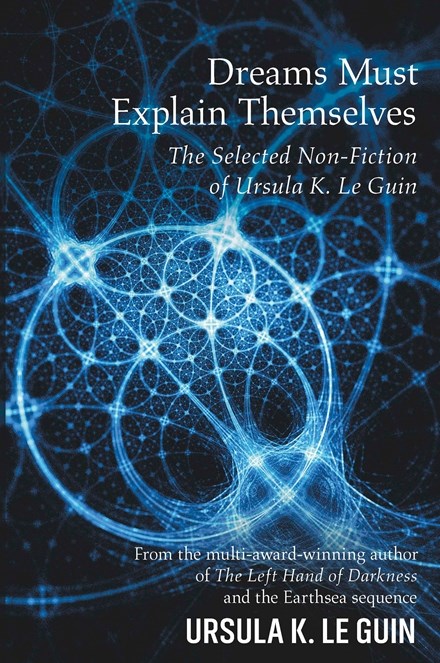
 You might have noticed that after a pretty quiet time, there’s been a resurgence in the availability of Ursula Krober LeGuin’s writing in the last couple of years or so. I reviewed The Word for World is Forest on its republication in the UK in 2015 (review HERE), but more importantly the publication of The Complete Orsinia and The Hainish Stories and Novels by The Library of America in 2017 is perhaps mostly to blame.
We’ve also had reissues as lovely hardbacks by Saga Press and here in the UK Gollancz have paved the way with re-releases such as Rocannon’s World, The Wind’s Twelve Quarters and The Left Hand of Darkness. For those of us who have been reading the stuff for a while, it is a useful reminder of how important Ursula has been in the past. For those who know less, if nothing else, this book is a timely introduction to relatively new readers, showing how important Ursula is to the genre.
With this in mind, Dreams Must Explain Themselves is a cause for celebration. For it is a grouping of fifty – yes, fifty – speeches, scripts and articles written since 1972. The first speech is an acceptance one given at the National Book Award in 1972. The fiftieth is another acceptance speech, but for the National Book Award Medal for Distinguished Contribution to American Letters in 2014.
There’s a lot of ground covered between the two. However, some themes are consistent. Ursula has always been recognised as one of the most influential advocates of science fiction and fantasy, and this is shown time and time again through these articles. For example:
“And I also rejoice in the privilege of sharing this honor, if I may, with my fellow writers, not only in the field of children’s books, but in that even less respectable field, science fiction. For I am not only a fantasist but a science fiction writer, and odd though it may seem, I am proud to be both. We who hobnob with hobbits and tell tall tales about little green men are quite used to being dismissed as mere entertainers, or sternly disapproved of as escapists. But I think that perhaps the categories are changing, like the times. Sophisticated readers are accepting the fact that an improbable and unmanageable world is going to produce an improbable and hypothetical art.”
As if her fiction was not enough to love her, through this book she regularly rails against the increasingly business-like nature of the art of writing, advocates the need for the genre to stretch and challenge and not be accepting of mediocrity, and, most of all, defends the genre against those who would decry its value.
This is a book of gems. I could have filled this review with quote after quote, but I think that part of the fun of reading this collection is discovering them yourself. Suffice it to say then that you will be pleased, intrigued and challenged by what you will read here. There are thoughts on writing, reviews of books and comments on the state of science fiction and the importance of books. Stories of her life and interests, of her environmental concerns, her fascination with social science and her feminist viewpoint are clear from the start. It is perhaps best treasured as a book to be dipped into, with a couple of articles at a time, in order to appreciate the precision of the language, the word-smithery and the sheer honesty of what is being said. You may not agree with everything (I didn’t!), but it is a book with a voice that you will want to listen to. It is, by turns, thoughtful, funny, considered, critical, argumentative and even grumpy, I suspect rather like its author – I would not want to be on the wrong side of Ms LeGuin in an argument!
Dreams Must Explain Themselves is a book that reflects the times that the articles were written in. They show us that there has been change in the genre, although some would argue that there is still a long way to go. As such, they are both a statement of intent as well as a rallying call to action, from a time when injustice was accepted more than today. The changes in the genre since then are in no small amount due to the high standard Ursula set and the inspiration she gave to others. For all those writers since who have acknowledged her influence on them – off the top of my head, Ada Palmer, Michael Chabon, N. K. Jemisin, David Mitchell, Nnedi Okorafor, Neil Gaiman, John Scalzi, Christopher Priest. There are many, many others.
I started reading this book before the sad news of Ms LeGuin’s death in January. (In fact, much of the above was written before her death.) I finished it after she had died, realising what a huge loss she is to the genre, and what a talent. Her written works of fiction stand the test of time, but this book shows the reader the intelligence and imagination behind those stories. Hers is a voice worth listening to, should you wish to hear it.
Dreams Must Explain Themselves by Ursula K. LeGuin
Published by Gollancz, February 2018
394 pages
ISBN: 978 1 473 205949
Review by Mark Yon



Excellent review, Mark.
Thank you Mark.
My esteem for Ms LeGuin is such that the reminder that she has a book of essays would probably occasion my going out to look for it. Your review goes beyond that sufficient to insure that I will do so.
Anecdote. My wife is a poet and author. She has never particularly liked Science Fiction . The Left Hand of Darkness is perhaps her favorite book (outside of Mark Twain)
Just browsing reviews to learn what is available of the SFF site.
And thank you, Gary. It’s a great book to dip in and out of. I always come away with some thought or idea. Hope you enjoy it too!