
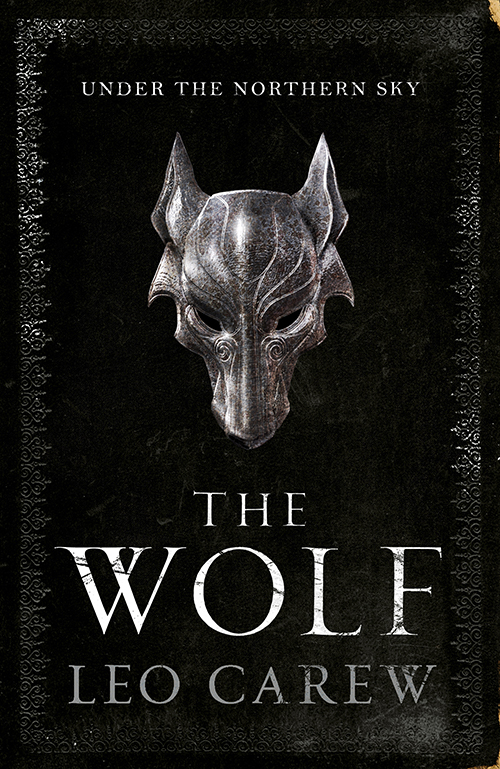
 Another month, another debut Fantasy novel. But once this one has built up steam it is a great read.
From the publisher:
“Leo Carew’s debut novel The Wolf, the first book in the Under the Northern Sky series, is a masterpiece in epic historical fantasy – a new voice to rival David Gemmell or George RR Martin.
A great war has come to the land under the Northern Sky.
“Beyond the Black River, among the forests and mountains of the north, lives an ancient race of people. Their lives are measured in centuries, not decades; they revel in wilderness and resilience, and they scorn wealth and comfort.
By contrast, those in the south live in the moment, their lives more fleeting. They crave wealth and power, their ambition is limitless, and their cunning unmatched.
When the armies of the south flood across the Black River, the fragile peace between the two races is shattered. On a lightning-struck battlefield, the two sides will fight – for their people, for their land, for their very survival.
Two sides. One victor.”
Getting beyond the publicity, The Wolf is a good book, but shows many of the usual issues with a debut novel. The beginning is a little wobbly, but once the book gets into its groove it works well. The characters, though starting as fairly nondescript traditional tropes, do develop into something more than the typical.
The story is a typical revenge tale, which at the basic level has Roper, a prince of the ancient Anakim, determined to avenge his father’s death, defend his Kingdom against the invading army from the South and seek recompense from those who treated him badly when he came to power.
From the wider viewpoint, The Wolf is not only a clash of characters, but a clash of cultures. The differences between the more human ‘Sutherners’ (ugh) and the towering Anakim is more than just appearance. The Anakim have a rigid social order of valour, based around fighting and conflict and a long lifespan. It made me think of the Spartans, which may be deliberate. By contrast, the humans, though seemingly less rigid, are the typical medieval-esque society most Fantasy novels relate to, with Kings, Queens and a court of dubious malcontents.
This all sounds wonderful, and I’m sure that many Fantasy fans will love it – so why am I not whole-heartedly recommending this novel? Well, it fell foul of some of my usual bugbears with many novels, especially debuts. Firstly, I had issues with some of the names, although admittedly not enough to kill the book for me. Some of the name usage is rather random – there are Nordic surnames, mixed up with place-names such as ‘Albion’. Whilst I concede that this may be an attempt by the author to mix things up, so to speak, and be different, it didn’t work for me.
In addition I found, for example, that the name ‘Roper’, instead of inspiring and engaging the reader, is a name that instead brings to my mind someone from a Northern kitchen-sink type drama, which may be appropriate but does not bode well. Worse, the invading force are ‘Sutherners’, a nomenclature which rather grated on me. In my opinion it would have made more sense, and would have been less disconcerting, for the author to make up his own nomenclature.
Secondly, the plot has a number of issues which read as untrue to me. I found the idea of Roper being placed into the middle of a major battle on his first outing, so to speak, an unrealistic situation. Surely the youngster, knowing of his potential future, would at least have been trained or seen battle from a safe distance beforehand? There’s also a concern that the book’s characters veer between extremes – from one minute being thoroughly charming to the polar opposite, which gives a rather schizophrenic feel to some of the characters. In the end I felt that there’s a lot of surface but little depth.
Of the plot there are times where things just seem to happen too easily and too conveniently. The ascendance of Roper, from a child watching his first battle to being the leader of thousands of men seems to be much faster, and with less effort, than I would expect.
Allowing for these issues, though, there’s a lot to like about this book generally. Some of the battle scenes, of which there are many, are written confidently and hold the reader’s attention admirably, even over forty pages at times. The relationships between the warriors and their wives is not as jarring as I thought it could have been, and adds a little more depth to what otherwise could be superficial.
To be frank, and despite what some comments would say, this is not an author who is the next GRRM, nor Terry Brooks, nor any other popular Fantasy writer you can think of. It is a good book from a debut author, who I think will develop with experience – he is only twenty-six years old, and should be applauded for his efforts, even if they are not entirely to my taste.
What is perhaps most important is that, on balance, The Wolf has more positive points than negative points, and those were not enough to derail my interest. Despite my issues and my quibbles, I did enjoy it and the pages kept turning after that wobbly start. There’s also a cliffhanger ending which means that we should expect a second book.
The Wolf by Leo Carew
Under the Northern Sky, Book 1
Published by Wildfire, April 2018
ISBN: 978-1472247001
Review by Mark Yon




The reviewer gets a lot of things wrong, making me question his reading comprehension and historical knowledge. First, Roper had trained all of his life leading up to his first major battle. The author often mentions the training academy he attended. As for the naming issues, which seem to be a huge focus of this review, all of the names are traced back historically but not often used today. Naming places Albion, Iberia, I think there was mention of some form of Bavaria, etc. creates a Europe which is not real Europe the same way many animes/mangas set in vaguely European places do the same thing. The Anakim (a biblical name for a race of giants) are essentially Norse Spartans. That’s why everything relating to the Anakim has a Norse name. They aren’t randomly mixed in. They are a completely separate culture living in Albion. It’s very clear in the book.
Hello Kreg. Thanks for your comment. I’ll try and take your points one at a time.
In terms of the training, if I remember right, Roper had been trained from the age of six, admittedly, though the author points out that the first battle in the novel is Roper’s first battle. To take on such a position as Roper does in your first battle seems unlikely – though possible, I grant you. I felt that to put both your leader and his heir in such a position in their first battle together was a plot point for dramatic effect rather than a strategic one – surely you work up to that point. Skirmishes, minor sorties, before a mass battle? As a story, it works for some, clearly, but not for me.
The issue with the names is explained in my review, I think. My point for mentioning it was that it can be an issue for some readers, as it was for me. Whilst some of the names may be based on historical precedents, to me it seems to be a mixture from different historical ages and styles, which, to me, didn’t work. In fact, it was perhaps that I recognised places and names from different points in history that actually took me out of the reading experience. For example,’Roper’ is more of an 17th century name to my view, though it tends to be in more common usage later, whilst there are Greek, Roman and, yes, Norse names in there as well. Whilst some may see that as a strength, I saw it as a weakness.
My point was that just because names from history have been used doesn’t mean to say that it works for the reader. For me it was a clash that detracted from the reading, which is never a good thing, in my opinion. My biggest issue was perhaps with names like ‘Sutherner’ which, I felt, was not a great choice of words -it may be accurate, but does it ‘feel’ right? It will work for some readers, but not others, like me. Similarly with the use of place-names. I feel that the author may have been better inventing his own names rather than use the historical ones, but tastes will vary.
The book is an attempt to merge elements of ‘real’ history with Fantasy. I appreciated the effort and felt that it was a good try, though there were other elements of the book in terms of say, pace and plotting, that made me think that this is the work of a debut author. All in all, the book, in my opinion, was good, but not perfect, and lacked the depth and skill of a more experienced writer. Others may disagree with my opinion, of course. Mine is based on reading SF & Fantasy (and, amongst other things, historical novels!) for over forty years. Obviously other views than my own are permissible!