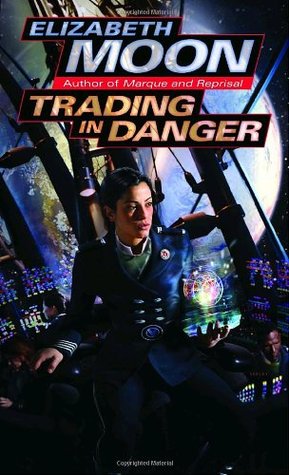
 When I want something entertaining to read, there are a number of authors I find I can usually rely on to provide what I want. For example, Robin Hobb, Lois McMaster Bujold, Anne McCaffrey – and Elizabeth Moon, who for over 30 years has produced solid, enjoyable, trustworthy entertainment. Her Paksennarrion series is one of the most enjoyable Fantasy series I have read.
However, Ms. Moon’s Vatta’s War series is one that I have tried before – more than once – and not finished. There’s a number of reasons for this, which I will explain further. But if you can get through this first novel, I’m told it gets better.
The plot: Ky Vatta is a highly promising military cadet with a great future ahead of her, until an apparently insignificant act of kindness makes her the focus of the Academy’s wrath. She is forced to resign, her dreams shattered.
For the child of a rich trading family, this should mean disgrace on a grand scale. And yet, to her surprise, Ky is offered the captaincy of a ship headed for scrap with its final cargo.
Her orders are absolutely clear, but Ky quickly sees potential profit in altering the parameters of the journey. Because, whatever the risks, it’s in her blood to trade – even if the currency is extreme danger.
I first tried reading this novel in about 2005, after finishing a run of reading Ms. McMaster Bujold’s Vorkosigan series (1986-present). This may be important, for the enjoyment of one may, in part, be the reason not for liking the other one. It is perhaps worth a comparison, as the two series have similar modus operandi.* Both deal with relatively young protagonists put into danger, with both lead characters being siblings in some sort of important family, each with challenges to overcome. Ky’s family is economic based – trade – whilst Miles’s is political.
On the positive side, both stories read well, in that the plot is communicated without strain. Both stories are engaging and kept me reading – this time around, anyway.
My issue is with the characters, and in particular the lead character of Ms. Moon’s novel. In Ms. Bujold’s novels, Miles always felt to me to be a case of “triumph over adversity”, that, instead of violence, the use of intelligence solves the issue. And that was refreshing. Ky, by comparison, is a young woman from a privileged background, not short of funds or influence. And whilst she clearly has to prove her worth, there are times when she seems to not realise how beneficial her background is. Though the author is at pains to show us how alone Ky is at times and how determined she is to stand on her own two feet and not use the family wealth and influence, unlike Miles, I felt less convinced of this in Ky’s case.
In short, the situation means that (to me) Ky is determined to have her cake and eat it (See what I did there? There’s a book reference that I won’t spoil.), using the family credit and influence when things get really tough. Ky always has the family to fall back on – even when they are incommunicado, she knows that they will always have her back eventually. Admittedly, that may also the be the case with Miles, but I didn’t feel it quite as obviously.
Ky is clearly very young, and it is to Ms. Moon’s credit that this is shown continuously through the novel. She makes mistakes and spends much of the book recovering from them. And yet we find her quickly winning people over and individuals willing to risk their lives for her, without too much effort on her part.
There are parts when, unlike Miles, who never seems to really complain and instead get on with making the best of a bad lot, Ky comes across as a little rich girl, crying over how bad things are for her. Her dismissal from the cadets is tempered by having the sympathy and support of important people still within the service, and she retreats to the family plantation to sit by the swimming pool, complain about horses not being available in the stables and wait for her family to organise giving her a job – which so happens to involve her being made Captain of a spaceship. She’s not working from the lowly jobs first, is she?
Now I know that the author is at pains to point out how much training Ky has to do to take command, how difficult her experience is and how inexperienced Ky feels in her new role, which does try to generate sympathy for her. Sympathy is also fostered by pointing out that she doesn’t seem to be a bad person, particularly spiteful or vindictive. Even her dismissal from the Cadets is not for a particularly bad reason, but due to a simple error of judgement (naivety) on her part. Ky is clearly a person who has much to learn at the beginning of the novel and it could be said that her determination to join the Cadets, against family wishes, was in part due to her resolve to break away from the family connections and life of privilege she could take up.
But the set-up still rails with me. Despite all the attempts on the part of the author, I still feel rather aggrieved with the character and the resolution. Would Ky have had these opportunities and be able to survive her challenges without the family leverage? I’m not sure, and, as a result, despite the best efforts of the author, I find it difficult initially to like Ky as a character. (Of course, I’m also aware that this may be the point of the story, that Ky is really some kind of future Scarlett O’Hara.)
Despite my misgivings, once Ky is away from the familial network and having to think on her own two feet, the story becomes more manageable/less strained. Yes, there are coincidences where things happen rather conveniently, and the whole situation seems to scream ‘set-up’, but by the conclusion Ky is a better character than she started as, using solutions that she has had to resolve. Which may be the point of the novel.
I must admit that I am pleased I finished the book. It’s not quite as predictable as I thought it was going to be, which is a good thing in my opinion. There are life-changing consequences as a result of Ky’s actions, which I am sure will reappear in later books, enough so that there were times when I felt sorry for her. By the end Ky is a less gullible, more wary person, determined to show her family and the universe that she can stand on her own two feet – able it with her very loyal crew.
Despite me still feeling that, had it not been for her privileged background bailing her out when she needs it, she would not be in a better place at the end, and despite all of her protests to the opposite, Ky is not as independent as she thinks.
I’m pleased that I have got past my previous issues to finish the novel. Despite my grumbles, the writing is good and there’s enough there at the end of the novel to make the reading worthwhile. Ms. Moon’s a good writer. I will continue reading the series, as I’m sure that they will get better. (Rob Bedford’s reviews suggest to me they do too.)
*I can also concede the point that a comparison between Ky and David Weber’s Honor Harrington may also be appropriate – but I haven’t read enough of that series myself to make what I consider to be a reasonable comparison.
Trading in Danger by Elizabeth Moon
Vatta’s War, Book One
Published by Orbit Books, October 2003
415 pages
ISBN: 0 345 44760 3
Review by Mark Yon