Human exploration, settling on a foreign planet and making contact with an alien species are staples of science fiction. In Semiosis, Sue Burke’s debut novel, a group of people have left an Earth in the near future (about 2060) that is deteriorating, hoping to cast off some of the social constructs that have pulled humanity down and start anew with a more harmonious mindset. After nearly 160 years, these people land on the planet they dub Pax, or peace. What they discover, unsurprisingly, is far from what they expected with peace as much a struggle in their new environment as it was back on Earth.
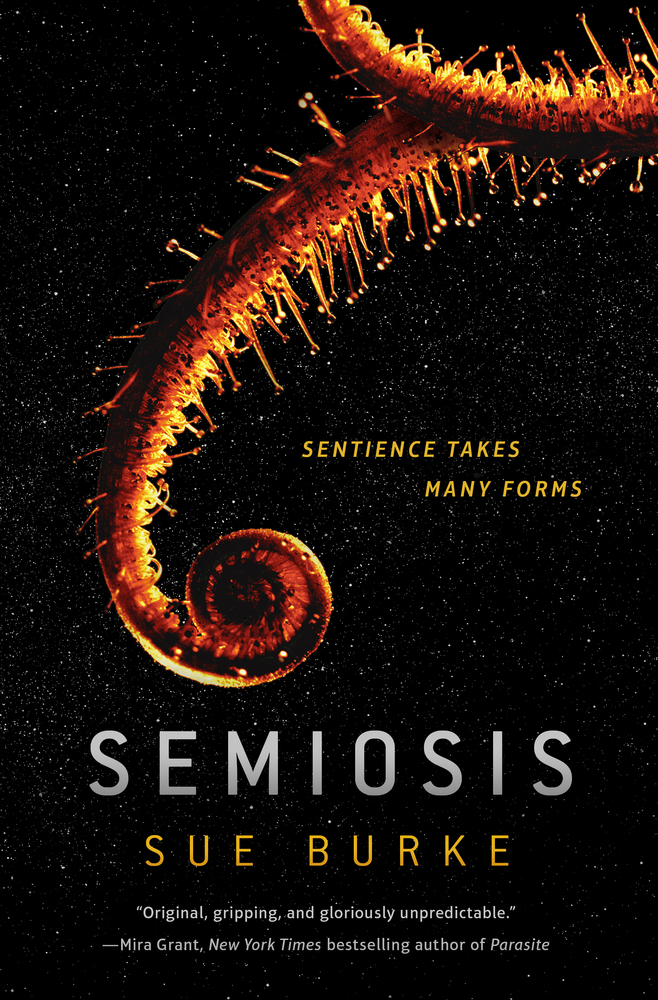
Colonists from Earth wanted the perfect home, but they’ll have to survive on the one they found. They don’t realize another life form watches…and waits…
Only mutual communication can forge an alliance with the planet’s sentient species and prove that humans are more than tools.
With only themselves upon which to rely, these settlers overcome initial strife and revolution to understand their new home-world. Rather than taming the land, they come to realize living as part of the world will lead to survival. Before they even land, problems arise; some of the colonists perish, equipment gets destroyed. Problems persist when they do land: the gravity turns out to be heavier than Earth, and oh yeah, there’s a little revolution when one group tries to enforce their will over the populace. There are many strange species on the world and at the apex of the intelligent species are plants, plants that are connected and themselves live in an almost hive-mind like state.
Many first contact stories, or stories that involve humans and an alien species clashing or cohabitating, involve aliens that are closer to animals or have some physical human traits. Burke’s aliens, or rather indigenous species, consist mainly of plant life. What further separates Burke’s compelling debut from other first contact stories is the structure of the story, told through different first person narrators, the novel chronicles several generations of humanity on Pax as they grow accustomed to the planet, its life (both current life forms and past civilization dubbed “Glassmakers”), and each other.
One thing I truly appreciated was how smartly Burke constructed the novel, and this is a multi-faceted complement. Events that transpire in the first chapter (or first generation and character point of view) could easily comprise a short novel. Those challenges leave an impression for the years to come in the novel, but Burke chooses to keep them to a minimum in order to get to the meat of the novel – survival and co-habitation. That first “revolution” not only is a precursor to how humanity chooses to live, not only with itself but how humanity comes to cohabitate a strange world with other intelligent species.
The other half of this complement is the multi-generational narrative, 7 chapter/narratives in total, with multiple characters who provide their point of view. Each character is truly their own, and where this comes even more to the forefront is when Burke’s narrative overlaps. That is, one character’s story closes while the next character is introduced from the same point in time only to go down that character’s specific path. The multiple narratives also allowed Burke to play with some genre tropes, even giving one of the chapters a gripping and enlightening murder-mystery.
One the other hand, this multi-narrative approach can lead to one of the narratives being not quite as strong as the others. For me, the third chapter/narrative didn’t come together quite as strongly. While some of what occurred held a great deal of weight, I felt more disconnected from the narrative in this chapter, especially compared to the murder-mystery chapter, the fourth chapter/narrative which was the strongest and most tightly wovenFortunately, the other narratives made for extremely compelling and fascinating snapshots of the evolution of a human colony and that colony’s intermingling with an alien species over a relatively short period of time.
As for other books Semiosis resonated with that I enjoyed? I felt the early stages of the novel had a similar feel to Scott Sigler’s Generations saga and the thematic elements Burke touches upon had some solid, pleasing resonances with Julie Czerneda’s Species Imperative trilogy. There’s a lot of interesting philosophical ponderings intermingled with biological examinations like in Czerneda’s trilogy that worked very well together.
Semiosis is a fascinating and impressive debut, worthy of deep consideration on how people live together and how they can (and should) learn from past mistakes. It is a novel that shows a hopeful new beginning for humanity and gives a glimpse of Sue Burke’s talent and intelligence as a writer that is hopefully a sign of more to come, whether in a new story/setting or in the fertile ground from which Semiosis was cultivated.
Highly recommended.
Hardcover | 333 pages | February 2018
Excerpt: https://www.tor.com/2018/01/08/excerpts-sue-burke-semiosis/
https://semiosispax.com/
Review copy courtesy of the publisher, Tor Books