 “JIM CROW MILE – A unit of measurement, peculiar to colored motorists, comprising both physical distance and random helpings of fear, paranoia, frustration, and outrage. Its amorphous nature makes exact travel times impossible to calculate, and its violence puts the traveler’s good health and sanity constantly at hazard. — The Safe Negro Travel Guide, Summer 1954 edition” — from Lovecraft Country
Within the first chapter of Lovecraft Country, we find that the Safe Negro Travel Guide helped direct Atticus Turner (perhaps Matt Ruff was thinking of Atticus Finch and Nat Turner) to dinners and places to stay on his trip south. When a flat tire delays his return home to Chicago, not just because of the flat but because a nearby white-owned garage refuses to sell him a tire, the Guide directs him to another garage fifty miles away, owned by a Black man. After a pay phone call and a long wait in a broiling car mitigated somewhat by reading The Martian Chronicles, Atticus meets Earl with his tow truck who spots the book and reveals he also reads Ray Bradbury, and Robert A. Heinlein and Isaac Asimov.
Thus Ruff quickly sketches his background to Lovecraft Country: Atticus is familiar with the genre of science fiction, much of it recovered from the pulps and published in paperback during and after WWII, so that on his trip he had in his trunk a box of tatty old paperbacks to choose from. And he’s familiar with the concepts behind Howard Phillips Lovecraft’s work, having read his stories of cosmic entities bent on re-entering our dimension and making it their own. And he’s all too intimately familiar with the racism of the South, the less ostentatious racism of the North, and the racism and xenophobia that informed Lovecraft’s character, which taints at least some of his fiction.
The novel is episodic and the first chapter, “Lovecraft Country,” establishes the intersection of magic and the occult with the lives of Atticus and his friends and family. A distant white cousin, Caleb Braithwaite, seeks Atticus out and persuades him to come to the home in New England of Caleb’s father, a warlock. There Atticus learns that a blood relative is needed to complete an ancient ritual that will grant the warlock enormous power to reshape the world. Atticus, of course, understands that shared blood means little and Negroes are expendable; he considers it unlikely any reshaping of the world will do him and his much good, and so some resistance ensues.
Other adventures include Atticus’ uncle and father retrieving the Book of Days, a ledger holding “a full accounting of their great-grandmother Adah’s servitude; the labors she’d performed, the indignities she’d suffered, and the wages and penalties she was owed”; Atticus’ friend Letitia buying an old mansion she hopes to turn into a boarding house only to find it haunted; the entry onto another world of Hippolyta, who had always wanted to be an astronomer but who was denied entry to a University; Letitia’s sister Ruby turning white; and more dealings with Caleb.
These episodes are all enjoyable – I especially like Letitia’s dealings with her new house – with a few dark moments and some humor, and their plots ingeniously deployed in service to Ruff’s characters and building to a final confrontation with the powers of darkness, only some of which are occult. But the real strength of this novel is its decisive, even-handed, implacable rendering of the intersection of racism with every facet of the lives of Atticus and those around him, the modes of thought and action that almost keep them safe, the strategies by which they skirt interference from white people and, in Ralph Ellison’s analogy, remain invisible, and how this constant refrain in their lives makes magic just another hurdle to negotiate and maybe even a tool to use.
Lovecraft Country is that best of reads, a serious novel that remains entertaining and often funny, populated with believable characters whose situation, both magic and non-magic, Ruff presents all too plausibly. Lovecraft Country has been optioned for filming by Jordan Peele and J.J. Abrams for HBO in the U.S.
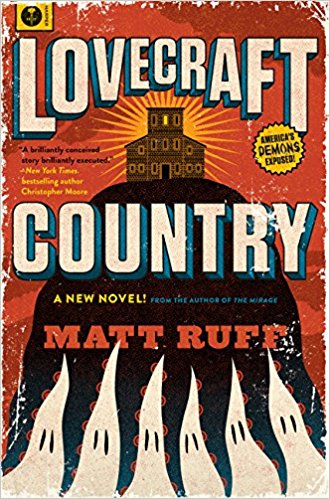
Lovecraft Country by Matt Ruff
(HarperCollins, 2016)
ISBN: 978-1509883349
386 pages
Review by Randy M.