 In our discussions here at SFFWorld I have mentioned before how important the TV series The Twilight Zone was and is to the genre. In short, from 1959 – 1964, over five seasons and 156 episodes, it was regarded, at its peak, as one of the most important television series out there. It dealt with human issues – life, love, racism, fascism and death, and also space exploration, aliens, the devil, time travel and the threat of nuclear apocalypse.
Much of this broad remit was down to the show’s creator and lead scriptwriter, Rod Serling. Rod wrote 92 of the 156 episodes, something unprecedented at the time, although Michael J. Straczynski managed something similar with the seven series of Babylon 5 (1993- 1998.) It also helped that with Rod there were other wordsmiths such as George Clayton Johnson, Charles Beaumont and Richard Matheson, who all created a quality that was often beyond the usual ‘monsters in space’ format.
When I was young in the 1970’s and ‘80’s I was very, very jealous of those of you who had seen the series. Reading an episode guide in Starlog #15 in August 1978, (available HERE) and knowing of the series’ reputation, I was desperate to see this series. In the UK I didn’t get chance to see any episodes until the BBC showed a limited selection late on a Saturday night in 1983. (I may have even seen the later Rod Serling series Night Gallery on late-night television before it.) As technology developed, to see more Twilight Zone I had to buy (at a ridiculously high price!) DVDs from the USA and run them on a multi-region DVD player (again, more expense!)
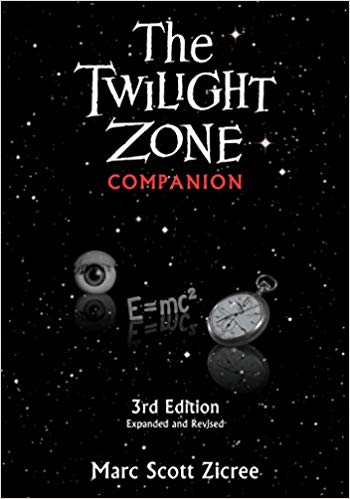
Today, I’m lucky enough to own the complete series on Blu-ray (for less than the price of one season on DVD!), with pristine images and superior audio. Presumably, now that this has just become available as a complete box set in the US and the UK, this has led to the republication of this book, now revised and updated in its third edition.
If you are someone watching the series for the first time, or watching again for the umpteenth time, you need this book to widen your experience.
The book’s layout is fairly traditional now. Each season is taken in turn, and each episode of the season, in production order, is given a synopsis. Each summary starts with Rod’s initial speech ‘into the Twilight Zone’, and usually ends with his outro.
For me the decision to present them in production order, though clearly explained by Zicree in the book, is a misstep. Whilst I accept that by showing the episodes in order of production it shows some of the difficulties and developments of the series, personally I would prefer to watch them in the order that they were shown on television. Each episode has the transmission date given and I guess that that’s what your DVD/Blu-ray selection button is for. But it is annoyingly fiddly!
It might have been an idea to cross-reference those in this third edition too, especially as Marc takes time to point out that there are fifty-two interviews that he collated for the Blu-rays online. There is an episode list at the front of the book for anyone who wants to look up a particular season/episode.
The summaries are generally thorough and not always as positive as you might expect. Each episode is also analysed and often given a context which is not always apparent from watching the episodes or reading the synopses. As well as the episode synopsis, there is a detailed overview of each season and an explanation of the trials and tribulations of making such a series.
What elevates this book above many that are similar is the wealth of additional detail given throughout. It is these extra details that elevate this book from a mere programme summary. There are minutiae included here, based on interviews with many of the still-surviving cast and crew (or at least those still with us in 1982), or their relatives that will be of interest those watching it a first time, or those, like me, who are watching the series more than once.
What amazes me now (but really shouldn’t!) are the stories about the battles between the production and the money-men, the television executives and the sponsorship which are well documented here – some things clearly don’t change! With all of this in mind, I am surprised at the quality of what came out, even the less-successful episodes, considering what was going on. Rod was clearly affected by it, and the ill-health that he endured in his later years may in no small part be due to the stress of having to continue to be successful, to helm a series that was, at first, a runaway success.
The book has been difficult (or very expensive!) to obtain for a while now (the second edition was first published in 1989), and so this new edition is much appreciated. Bringing the book up to date there are more interviews – now with added George Takei, interviewed in 2017, and Rod’s daughter Jodi, for example – and there’s been time for a critical summary and some analysis of the cumulative effect of the series by 2018. Marc doesn’t shy away from the 1980’s version, although he is more complimentary than I’d expected, and brings us slap-bang up to date with the news of a new version of TZ, overseen by Jordan Peele.
It is sobering to realise that the first and second editions were both written before the Internet was invented/widely used. At times the self-referencing (“Look at these pictures/scripts/interview transcripts online!) is a little annoying, but it can’t be denied that there’s a lot of work been done on collating this material (online – got it?)
In short, this book is a knowledgeable and enjoyable read. It should sit next to your Blu-rays or streaming device, to be read before or after each episode. (Be warned though – there are spoilers if you’re reading beforehand!) It is essential for anyone who wants to know more about the series, and now, with a wider audience than ever before, the highs and the lows of a seminal creation can be appreciated.
An essential reference work.
The Twilight Zone Companion (Third edition)
By Marc Scott Zicree
Published by Silman James Press, May 2018
508 pages
ISBN: 978-1935247173
Review by Mark Yon