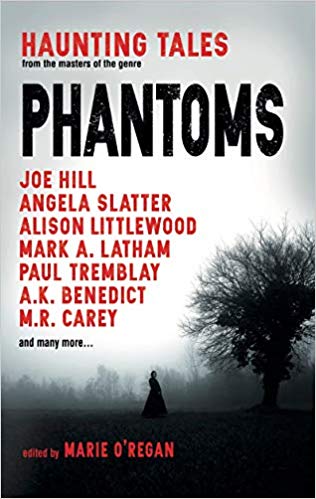
 As I type this it is October, and, as a result, the post-person to Hobbit Towers is usually kept busy with tomes pertaining to Hallowe’en. This collection is one that immediately caught my eye – eighteen tales that have the potential to chill the blood a little…
Editor Marie O’Regan (British Fantasy Award nominated writer and editor, co-chair of the UK chapter of the Horror Writer’s Association) has managed to select from some of the best contemporary stories to reflect the current state of Horror publishing. (And by the look of this, it’s looking great.)
Some names you may know, even if you’re not an up-to-date reader of the genre – Joe Hill, M. R. (Mike) Carey, Kelley Armstrong and Paul Tremblay have all been on the best-sellers lists recently. They are the attention-grabbers. Some are reprints, most are new here. Most noticeable is perhaps Joe’s story of a ghost in a cinema, 20th Century Ghosts, which is also the titular story of his debut collection I reviewed back HERE in 2006. It is still as good as it was then, but we have other stories to read before that one.
The first story sets the scene for much of the collection. Angela Slattery’s When We Fall, We Forget, is a creepy tale of revenge beyond the grave and a reminder that bad deeds rarely go unpunished. The idea of revenge and redemption from beyond the physical world appear often elsewhere in this collection too. Mike Carey’s politician in My Life in Politics is as unsavoury as a politician can be, whilst the mourner at a Scottish wake in Helen Grant’s The Chain Walk conforms to the stereotype of a miserly Scottish skinflint to a tee: both seem to get what they deserve.
There are some tales that are just odd, even dreamlike – Tom is in the Attic, by Doctor Who scriptwriter Rob Shearman, is a strange tale of ghosts and possession. John Connelly’s A Haunting is a real gem – a dreamy remembrance of the positive value of a shared life, by one half of a deceased couple, that will resonate with anyone with the luxury of a long marriage.
More down to earth, Tim Lebbon’s A Man Walking His Dog is about the discovery of a dead body and has a nice twist at the end. Josh Malerman’s Frank, Hide covers similar ground from a different perspective. Like Joe Hill’s story, Muriel Grey’s tale, The Front Row Rider, is a contemporary story that shows us that there can be much to fear in modern places. It may put you off amusement rides or the Underground for life.
Similarly, there are clearly ghosts out there who wish to tempt you to investigate further. A.K. Benedict’s tale of what lies in The Adjoining Room of a convention hotel will be familiar to anyone who has stayed in one, and might just make you check the lock on your door the next time you’re there. Kelley Armstrong’s The Ghost in the Glade seemingly just wants you to play, but has a sinister past.
Alternatively, for those who like their thrills in an ‘olde-worlde’ setting, there’s a glimpse of the Gothic in Laura Purcell’s Cameo which ramps up the traditional by being a baroque tale with a heirloom that may not be as treasured as it first appears to be. And whilst I’m mentioning objects with unusual properties, George Mann’s The Restoration deserves mention also, as a rather M. R. James-ian story of an old painting with a strange power. Alison Littlewood’s The Marvellous Talking Machine is a tale based on real events, that of a talking machine used as a circus-like exhibit in 1846. Her version has a touch of the Bradbury about it, managing to create something both creepy and sad.
As a slightly more recent nostalgia trip, Paul Tremblay’s A Haunted House is a Wheel Upon Which Some are Broken is the story of someone who returns to a house they lived in when younger where they find many ghosts there to meet them. It is told in the format of one of those adventure games of the 1980’s and ‘90’s where you turn to different pages to find out what to do next. Gemma Files’ story Halloo brings us up to date with a contemporary version of this, with the lead character return to a house from her past which has consequences for those involved.
Also bringing us up to modern day, Mark A. Latham’s One New Follower shows us the perils of social media in an alternate upgrading of the old idea of being followed by… something.
Of the new tales, the stories I liked best were Mike Carey’s story, and Alison Littlewood’s story, both already mentioned. The Adjoining Room by A. K. Benedict was also a creepy little gem George Mann’s was based on an un-original idea, but was told well. Catriona Ward’s Lula-Belle is an effective tale of sisterly love which did not quite end how I expected it.
There’s a fair range here, which I think readers will appreciate. Of the eighteen tales, I suspect that you are bound to know some of the authors, but there will be others you may not have. To study them further, Marie has given a handy About the Authors chapter at the end. This book may make you want to read more by some of them, and this should help.
In summary, Phantoms is an eclectic group of tales that will keep you entertained at Hallowe’en – or at any other time you want a slight thrill from your reading. Like all collections, not everything will work for everybody, but for me there’s more hits and misses, and there are even some that are worth buying the collection for, just on their own.
Phantoms: Haunting Tales from Masters of the Genre
Edited by Marie O’Regan
Published by Titan Books, October 2018
ISBN: 978 178 565 7948
400 pages
Review by Mark Yon