
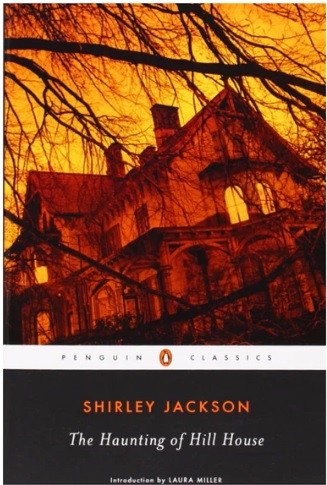
 With the arrival of a new Netflix series, I thought that it was time to return to this classic Horror novel.
Shirley Jackson (1916-65) is an author who should be better known by readers, whether of a Horror persuasion or not. There is a Shirley Jackson Award given annually since 2007 for ‘outstanding achievement in the literature of psychological suspense, horror and the dark fantastic’, but it is not as widely known as, say the Booker or the Whitbread, or even the Hugos. If you asked a general member of the public, I think you’d be hard-pressed to get any recognition other than through the films made of her best-known novel.
Shirley seemed to be a writer whose work sadly fitted between genre labels. It was too literary for readers brought up on the pulps such as Weird Tales and too Horror-related for those who considered themselves ‘well-read’. Her short story The Lottery (1949) and her novel We have Also Lived in the Castle (1962) are also worth looking at, though for me her short stories are usually the most satisfying reads.
And, of course, The Haunting of Hill House.
Hill House was Shirley’s fifth novel published. She only published six in her short lifetime. Stephen King has described Hill House as ‘one of the most important novels of the 20th century’ in his Danse Macabre (1981). As well as King, Jackson has been cited as an influence by, amongst others, Neil Gaiman, Paul Tremblay, Nigel Kneale and Richard Matheson (whose The Legend of Hell House is a much gaudier, sexier and relentless version of the haunted house story – worth reading for comparison.)
The story is fairly straightforward, made familiar by the passage of time. Dr. John Montague is a psychologist determined to investigate hauntings and make his name in academic circles. He hires a haunted house, Hill House, and invites a varied group of people to take part in the study.
The other characters are Eleanor Vance, a repressed, sensitive woman who was the victim of psychic phenomena in her childhood, Theodora (no surname), an ebullient artist who goes to Hill House to avoid her female friend, and Luke Sanderson, the cousin of the owners, who is ‘a thief and a liar’ put into the house by request of the family to keep an eye on things.
Later in the book (and not in the movie) the group dynamic is altered by the arrival of Montague’s wife and her headmaster ‘friend’ Arthur Parker. Her dabbling in spiritualism and her use of planchette, a device similar to the Ouija board that also allows writing, does little to calm the tense atmosphere within the house.
In a minor way, Mrs Dudley, the housekeeper, and her gatekeeper husband, are intermittent intrusions to the plot. Mrs Dudley’s determination to keep to her regular routine, with the repeated mantra “I set dinner on the dining-room sideboard at six sharp…“You can serve yourselves. I clear up in the morning. I have breakfast ready for you at nine. That’s the way I agreed to do.” is counterbalanced by her housekeeping and quality meals. Their presence is generally unpleasant and forbidding and adds to the feeling that something is not right at Hill House.
It is always dangerous to assume that a book’s characters reflect the author writing them, and yet it is tempting to see Eleanor as a literary extension of the normally reclusive Jackson. Like Shirley, Eleanor is a shy woman (though not by choice, admittedly), whose invitation is seen as a means of escape from her overbearing sister and brother-in-law. I must admit that some of her inner-voice comments are annoying to me, though they may be deliberately written as such. They clearly show a mind that may be experiencing some sort of imminent breakdown.
By turns, Theodora is perhaps the woman Shirley wants to be – confident, playful, even teasing. There are hints of a relationship developing with Eleanor that Theodora would like to be more. She is never short of a response and is the anti-authoritarian, even bohemian character full of energy – everything Eleanor would like to be. It is perhaps not a surprise that Eleanor is attracted to her.
Despite initial impressions given by others, Luke is a likeable character – mercenary, perhaps, but whose purpose here is generally a foil for the others. By the end, he seems to care less for the house (his future inheritance, remember) and more for the visitors. In the 1963 movie The Haunting he was portrayed by young heart-throb Russ Tamblyn, although in the novel he seems a little older – in his late twenties or early thirties, perhaps.
Dr. John Montague is that type of academic who likes the hunt, the research of a project, in the hope that his discovery will make the unknown clearer. He likes to hear the sound of his own voice, as evidenced by his lecture on the history of Hell House to the other visitors, but seems to be an amiable and supportive host, even when his overbearing wife arrives (a character not in the 1960’s movie.)
And then there’s the house itself – a place that is almost a character in itself, with a bad, sad history from the start. Hill House is a place deliberately designed to unsettle, that seems to exude evil from the start and with no room in the house created to be ‘normal’. Shirley does a great job of explaining this, with doors shutting of their own accord, creepy passages, draughts and unseen presences juxtaposed with rooms of baroque flamboyance and excess. This sense of unease and wrongness is the book’s strongest element in my opinion.
Many critics have commented on the book’s literary tone. Whilst I feel that the book is of a style beloved by English literature readers, with mannered sentences and elegant phrases, it is also true that the novel has dated, with some of its cultural references made obtuse with the passage of time – the book is nearly sixty years old, after all.
But it has a certain power and charm, still. And the ending is still powerful, for all of the other issues.
The Haunting of Hill House, despite some suggestions to the contrary, is not perfect. Personally, it will never be one of my own absolute favourites – I find Eleanor’s inner mind ramblings more annoying the more I reread them, though I accept that that may be the point – but the novel’s importance is reflected by its undoubted influence on others. It is fun seeing how its style and imagery has been repeated and influenced in more contemporary writers’ work.
In short, The Haunting of Hill House is a mature work written by an author whose writing belies her age. (Shirley was only 43 when the book was published.) It is not for everyone, but it still retains a certain power that makes it memorable, despite its dated style and antiquated cultural references, and benefits from rereading.
The Haunting of Hill House by Shirley Jackson
First published 1959 by Viking.
249 pages
ISBN: 978-0-14-192754-1
Review by Mark Yon


We somewhat disagree on this, Mark. I have yet to read any horror novel better than THE HAUNTING OF HILL HOUSE. There are some fine horror novels by writers who identify as horror novelists, and certainly Henry James’ TURN OF THE SCREW and Toni Morrison’s BELOVED are on par with Jackson’s, but better than THoHH I haven’t found.
A couple of notes: Part of the story revolves around Eleanor looking for someone to attach to. First there’s Theodora, then (as I recall) Luke, then Dr. Montague. When none of them quite suffice she’s bereft and unsure where to turn. (Tangentially, I wonder if there’s a more used name in horror fiction than Montague? M. R. James had an impact on all subsequent ghost stories.)
Oh, and as for Jackson’s fame, more than any of her novels she will be remembered, at least in the U.S., for “The Lottery” which I recall reading for multiple English classes in middle and high schools, and college.
Randy M.
Hi Randy: and yes, I know.. many people rate this as their best Horror ever (Stephen King!!) I can see that.. but I don’t feel it. There’s a lot I do like about it, and I’ve tried to say that in the review. I can see why Eleanor is having a breakdown and how that may be reflected in the book. But at the same time she’s whiny & self-obsessed (understandably so, perhaps) and the more times I read it, the more it rankles. I also totally get that she’s the epitome of an unreliable narrator. But I’ve tried to be honest, as ever. And I accept that my view may not be one of the majority…
The Lottery I know & I’ve read; but it is not well known here in the UK.
Mark, I hope that didn’t come across as you not expressing both your liking and your frustration with Jackson’s novel. You do, and it’s all fair comment. At one time I wondered if Eleanor wasn’t a character locked in a given time period: Late 1950s, early ’60s, women as caretaker, as spinster, with little outlet for creativity or pursuing a life of her own if locked into the former role. Then I started noticing the aging of the WWII generation and now the Baby Boomers, and I think Eleanor has taken on a new relevance. While women have a greater role in the workplace than when Jackson was writing, the progression hasn’t been from “rather than be caretaker” but more “heap that 9-to-5 on top of being caretaker” and so the feeling of entrapment and loss of self-determination may have come to the forefront again which might also help explain why Jackson has had a resurgence of popularity — Penguin has reissued all of her novels and several story collections over the last few years. Somehow I’m not surprised “The Lottery” isn’t as well-known in the U.K. It seems to me a quintessentially American short story and so maybe for that audience mainly if not solely.
Yes: think my copy is a Penguin copy. You make an interesting point I’d not considered. I’ve always thought of Eleanor as being a product of her time (late 1950’s-early 60’s), and for me that dates the book, but your point is perhaps valid when we look at today’s society, of those ‘entrapped’ to look after aging relatives, which appears to be on the rise. Good point: thank you!