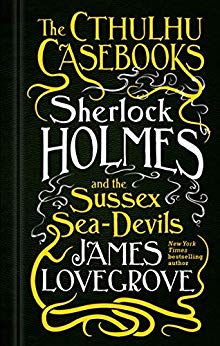
 Is it really three years since I started to read this series? With Sherlock Holmes and the Sussex Sea-Devils we get to the third, and I believe final, book in this mashup of HP Lovecraft’s imagination and Sir Arthur Conan Doyle’s most famous creation.
This third book is set in 1910, about seven years after the last novel (Sherlock Holmes and the Miskatonic Monstrocities, reviewed HERE.) As in the original Conan Doyle stories, Sherlock Holmes, to all intents and purposes, has retired from sleuthing and moved to Eastbourne, to take up beekeeping. Doctor Watson has stayed in London to carry on with his doctor’s practice and at the beginning of the novel it is clear that the two do not spend much time in each other’s company.
Unbeknown to the general public, Sherlock has actually continued to spend time fighting Cthulhu and in particular has had a number of ‘interactions’ with R’luhlloig, the god formally known as Professor James Moriarty. When members of the Diogenes Club all die in one night, including someone close to Holmes, it appears that another plan may be coming to fruition.
Following an attack on Holmes & Watson by the snake men (last seen in Sherlock Holmes and the Miskatonic Monstrocities), they retreat to Holmes’ cottage on the Sussex coast. A local businessman approaches Holmes there and asks for his help. Three young women, seemingly unconnected to each other, have disappeared from the nearby town of Newford. On further investigation Holmes and Watson are surprised to find that the locals are all too willing to accept the situation and blame the local legend of strange amphibian creatures, known as the Sussex Sea Devils, appearing from the sea to take women captive.
The world also seems to be heading to war, something which may or may not involve the unseen work of R’luhlloig.
Holmes and Watson are captured by R’luhlloig, who in the guise of German ambassador Baron von Herling, has designs on a more sinister purpose. The end of the novel deals with a clash between the Outer Gods and the Old Ones as R’luhlloig dares to take on the sleeping god Cthulhu.
As the third book in a trilogy, it is clear that we are nearing the end here. Sherlock is in his later years in both his fictional life (created by Watson) and his ‘real’ life, shown here. Holmes and Watson reflect this winding down into old age and are showing the aches and pains associated with old age. They are less physically mobile, though Holmes’ intellect remains intact.
If I had a minor quibble, I would suggest that Holmes has less sleuthing to do in this last volume than previous. I guess that this reflects the approach of physical old age, though there is no sign of senility here. He spends a lot of time being transported rather than taking action himself, though there are also times when he steps up to the mark.
The highlight of the book though is the battle at R’lyeh between R’luhlloig, representing the Outer Gods, and Old One Cthulhu, which doesn’t disappoint. James channels Lovecraft’s At the Mountains of Madness with ancient ruins, slimy frog-like henchmen and monstrous evil.
There’s an appropriate Postscript, which brings the story up to date and gives an acceptable ending.
So: it is an unlikely pairing, but the combination of Conan Doyle and Lovecraft is an endearing one and for me works surprisingly well with its combination of Edwardian gloom and ethereal malice. Sherlock Holmes and the Sussex Sea-Devils is the culmination of this series and if you’ve liked the previous two novels you’ll like this one.
Overall, the series has been a pleasant surprise, and is recommended.
Sherlock Holmes and the Sussex Sea-Devils
By James Lovegrove
Published by Titan Books, November 2018
464 pages
ISBN: 978-1783295975
Review by Mark Yon