These days, William Hope Hodgson (1877-1914) is perhaps best known for his The House on the Borderland (1908) novel. It is undoubtedly worth reading, an unsettling disjointed story that for many reminds them of the cosmic chaos often exhibited by other authors such as H. P. Lovecraft (although it is claimed that Lovecraft did not read Hodgson’s stories until 1934.)
However, it is a little unfair that Borderland is his most famous work, as he wrote other stories in his all-too-brief lifetime. (Hodgson was killed in battle in the First World War, aged only 40.) The Night Land is also worth a read, for example. Out of all of his work, however, I happen to prefer these stories, a version of the trope often referred to these days as ‘occult detective’, but when first written about here was a fairly new idea. Though the idea of such a character can be traced back to Edgar Allan Poe (The Murders in the Rue Morgue (1841), for example), Hodgson’s Carnacki is one of the first to blatantly tackle the supernatural. Many have trod similar paths since Hodgson wrote these stories – see also Seabury Quinn’s Jules de Jardin, Dennis Wheatley’s the Duc de Richleau or Manly Wade Wellman’s John Thurstone, for example – but these are, in my opinion, some of the best, and perhaps Hodgson’s finest work.*
The stories follow a similar pattern – the teller of the tale is Dodgson, a friend of Thomas Carnacki, a sort’ve Watson to Carnacki’s Holmes, if you like – who is usually begins each tale with being invited with other friends Jessop, Arkright and Taylor to a meal with our ghost-finder at his home address in Chelsea, London. Afterwards, often over brandy and cigars, they are told a story by Carnacki of his latest happenings. Once this is done, and sometimes after a few questions from the attentive audience, Carnacki sends them away with a cheery “Out you go!” until the next time he sends an invitation.
With such an appropriate framing mechanism in place, the meat of the tale is usually something (though not always!) of a strange or even supernatural nature. The story’s titles, perhaps fashioned after Sir Arthur Conan Doyle’s Sherlock stories, tend to let you know of some strange goings on. Let’s briefly go through the six tales here.
- The Gateway of the Monster (1910)
In the first story Carnacki is asked to investigate a room in an old mansion that people are afraid to stay in at night. The Grey Room was the site of a grisly murder years ago and now at night there is often heard screaming in the room and doors that were locked slamming open and shut.
- The House Amongst the Laurels (1910)
In which Carnacki is asked to investigate Gannington Manor, a big old house in Western Ireland where blood is reputed to drip from the ceiling. Carnacki spends the night there with a bunch of staunch policemen who struggle to cope with what they see. Warning: dogs are harmed in this one. Not one that ends how you expect.
- The Whistling Room (1910)
This time Carnacki travels to Ireland again to Iastrae Castle, near Galway, an old house with a room where exists a ghostly and unearthly whistle – one that has driven out many previous occupants. This one seems based on some sort of Irish myth or folk-tale, though the solution here is rather matter-of-fact. Interestingly, there are signs of a second, possibly higher power, that intervenes on Carnacki’s behalf, though this is never taken further in the stories I have read.
- The Horse of the Invisible (1910)
Perhaps the longest of the stories here. Interestingly, Carnacki here has been injured – his encounter with the unknown clearly having physical consequences. This time he has travelled up North, to Hisgins in West Lancashire, where a young woman, due to be married, is haunted by the ghost of a large white horse that is seen and heard stomping around the house and grounds. The appearances of the ghostly horse are quite impressively scary (although I did keep wondering how it got into the house!)
- The Searcher of the End House (1910)
A story that is more personal to Carnacki than those previous, as it involves his mother (at least to start with!) When he goes for a brief stay at her recently-acquired lodgings he finds that things tap doors open and there’s a rather unpleasant odour. The ending of this one is sadly much more down to earth that Carnacki at first suspects, though there is a supernatural element there as well. Perhaps my favourite of the stories here.
- The Thing Invisible (1912)
A story of an old church with a reputation and a dagger that seems to kill those that are a threat to the domain. Another story that doesn’t end how you expect. This one ends up being all about science in the end, and the solution seems a little too convenient if not over-elaborate, but it reads well.
Later stories were discovered and published posthumously, but are not in my edition of the book. These are The Haunted Jarvee (1929), The Find (1947) and The Hog (also 1947).
So: why do these stories work?
“… I am as big a skeptic concerning the truth of ghost tales as any man you are likely to meet; only I am what I might term an unprejudiced skeptic.” (page 87)
First of all, I feel that for all of the otherworldly trappings, Carnacki is a person who believes more in science than the supernatural, or at least in using science to determine ‘the truth’. Many of the stories show him going through events methodically, spending time making measurements and sealing rooms before a judgement.
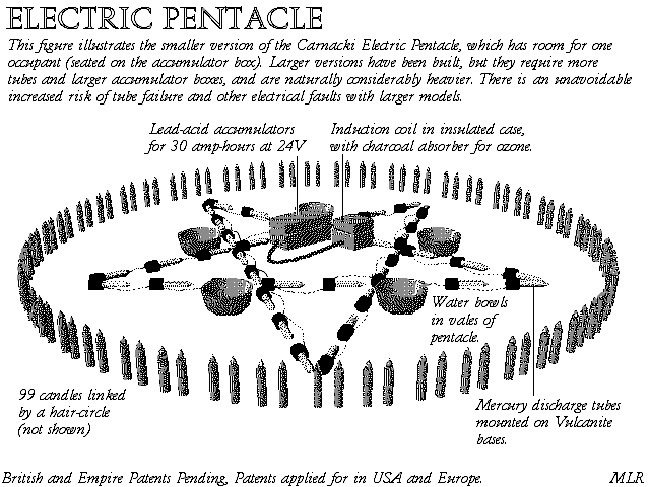
He also uses the latest technology “of the day”, such as an electric pentacle (see picture) and methods such as photography to help him make a judgement, rather than waste time and energy running around from place to place (although there is undeniably some of that as well.)
To this idea of rationalism and science Hodgson then adds a layer of academic knowledge. He refers to some of the practices Carnacki undergoes for protection, such as the Second Sign of the Saaamaaa Ritual, and quotes a number of documents (never truly existing) such as the 14th century “Sigsmund manuscript” to create the idea that Carnacki knows what he is talking about. Carnacki has a scholarly understanding of ancient texts, many of the titles of which are drip-fed through the stories. Think Lovecraft’s Necronomicon, but a decade before.
The consequences of this is that the reader feels that through Carnacki they are in the hands of a sceptical yet well-informed guide through things unknown and untenable, determined, like the best detectives, to discover and explain the unknown.
Knowing that we are hearing a story from a man with knowledge and experience also means that the reader is never quite sure whether what they are reading is a tale of how fakes are uncovered or a genuine tale of something that Carnacki does not understand. When he sees a ghost, he is often as mystified as the reader. He seems determined to use science to debunk as many spooky stories as he can – which also means that when he is scared, there might be reason to be so!
And there are parts that are quite scary. Some of the stories have the feel of those real ghost stories that you often hear about – perhaps Hodgson is partly to blame for all those ‘haunted’ TV programmes we see today!
To sum up then, Carnacki the Ghost Finder is a short but effective collection of stories that have clearly influenced others in the century since first being published. They are “of their time” (contemporary readers will struggle to find strong female roles here, for example) but have not dated as badly as some the other contemporary tales, and even in 2019 are quite readable. For anyone who likes to read ‘the old stuff’, perhaps with the lights dimmed and a good beverage by their side, these stories are recommended.
*Showing what little I know, H.P. Lovecraft thought these stories weaker than his earlier work. In 1934 Lovecraft wrote in a letter:
“Have also read 3 weird books by William Hope Hodgson — “The Boats Of the Glen Carrig”, “The House on the Borderland,”& “The Ghost Pirates” — Lent me by Koenig. Do you know these?. In some respects they have a peculiar & magnificent power — an ability to suggest realms & dimensions just out of reach & sieges by hellish legions the nameless from unsuspected, fathomless abysses of night. “The House On The Borderland” has a breath-taking cosmic reach. No comparison is possible between these fine works & Hodgson’s later feeble attempt — “Carnacki the Ghost Finder” — which I read in Florida.”
Who am I, a mere mortal, to argue with the Cthulhulian overlord?
Carnacki the Ghost Finder by William Hope Hodgson
Published as separate stories from 1910, but as a collection by Eveleigh Nash in 1913.
105 pages
Review by Mark Yon
They are in the public domain at Project Gutenberg (LINK)