

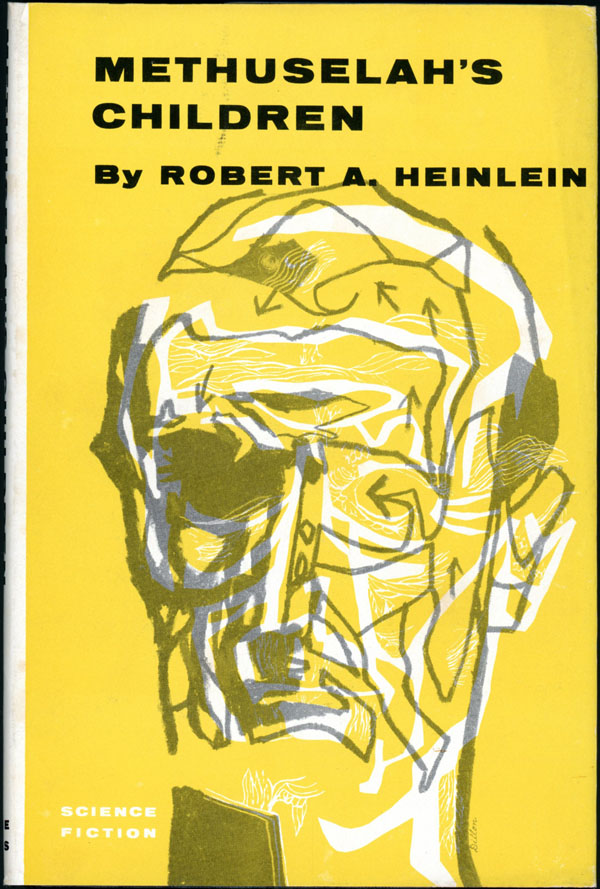
 Here’s the latest in my re-read of Heinlein’s Future History series.
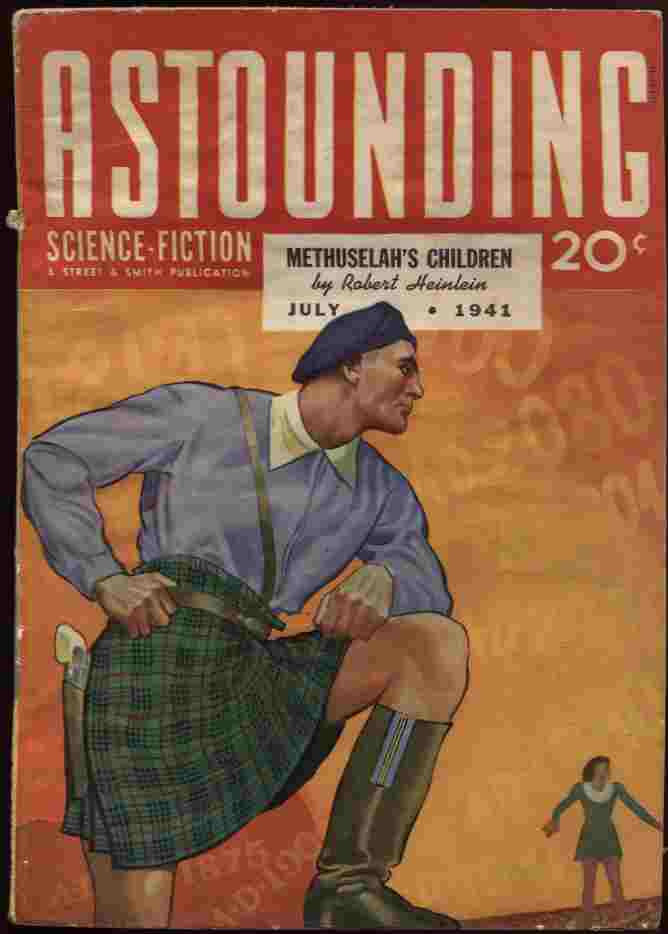
This one is slightly different, in that it is more of a novel than a short story, which is what the previous elements have mainly been. (Reviews HERE , HERE and HERE.) The background is that Methuselah’s Children was first a long story published in Astounding in 1941, but, like some of the other elements of the Future History, was revised and expanded into a novel in the late 1950’s.
However, this is, at least in its updated form, perhaps the most retrofitted into the timeline created by Heinlein. There are more connections here between Methuselah’s Children and the other stories than anything previous, even more than the other rewritten story in the series, The Man Who Sold the Moon.
The story is in two parts. The first begins at a rapid pace with Mary Sperling deciding not to marry Bork Vanning, despite him being “a prime catch”. (Once again Heinlein creates a positive female role model, with, I suspect, a little help from wife Leslyn in the 1940’s and/or Ginny in the 1950’s.) The reason for this soon becomes apparent as we discover that Mary is one of the Howard Family and is one-hundred and eighty-three years old.
The story broadens, so that we realise that the plot is really about the Howard Foundation, a group who through selective gene manipulation have extended their natural lifespans to live much longer than normal, more than 150 years. A programme known as ‘The Masquerade’ relocates family members to other places before their youthfulness becomes noticeable. Nevertheless, by 2136 and in the time after the ‘Crazy Years’, the group mainly live in secret, due to ‘normal’ humans feeling that the family are withholding the secret to longer life. They are instead hunted by proctors and the ruling body known as The Covenant of the Western Administration (see Revolt in 2100), determined to extract from the Family, by fair means or foul, the secret of the Fountain of Youth.
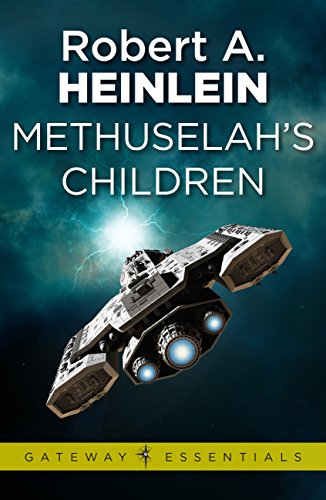
The second part is what happens to the Founders after they leave Earth. They travel to a planet with Earth-like characteristics to find that there is already intelligent alien life there. When the humans are encouraged to meet what appears to the natives is a god, but is probably a higher order of intelligence, the meeting does not go well. The humans are bundled up and transported to a new planet in a fraction of the time it normally would have taken.
On the second planet there are more aliens but ones who are more understandable than those on the first planet. The Family enjoy their lifestyle, but eventually become bored, feeling rather like lotus-eaters and whiling their time away doing nothing of importance. Led by Lazarus, the majority decide to return to Earth and, using further-developed technology, are able to return to Earth in three weeks. There the returning Family decide to resettle now that a genuine solution to longevity has been developed. Lazarus decides to buy a space-yacht and make his own way back into outer space.
From the book’s strong start, an action-romp fit for an adventure story, I was rather expecting to enjoy this one. However, by the end I was less enamoured, for a number of reasons. (This may also explain why it has never been high up on my most-remembered Heinlein tales, though I felt that it should.) Unlike some of the other material rewritten to fit the Future History, there were parts of this that clearly fitted 1940’s sensibilities and other elements that were more in line with where Heinlein was in the 1950’s. This can also be said for The Man Who Sold the Moon, but there the contrast is much more jarring.
It also doesn’t help that I had issues with the character who becomes the centre of this story, the eldest Family member of them all, Lazarus Long. (And yes, those issues even go with the annoyingly, smugly appropriate name.)
Lazarus is that Heinlein character that I eventually decided I disliked – loud, boorish and opinionated, who calls everyone “Bud” or “Sister”, speaks and acts like someone from the gangster movies of the 1930’s & 40’s and yet is still trusted to make big decisions by the majority. He steamrollers through decision-making and anything he objects to, convinced in that overbearing self-confidence of his that he is always right – the so-called “competent man” so beloved by Astounding editor John W. Campbell.
 In the bigger picture of Heinlein’s complete work, perhaps what annoys me most is that he is the prototype of other hectoring characters, not a million miles away from Delos D. Harriman, Jubal Halshaw or perhaps even Heinlein himself, exuding self-belief and spouting home-grown tautologies like a machine gun as if they are gospel. For example, (one of many) try “…. a committee is the only known form of life with a hundred bellies and no brain.” There are others – many, many others – which will take centre stage in Heinlein’s later writing, to its detriment, I feel.
Even Lazarus’s near-obsession with wearing a kilt (occasionally whilst others are naked) is a questionable throwback, something the author clearly feels is highly important. I’m sure that Heinlein would talk of the rebel heritage, and the fact that the kilt is a symbol of independence and tradition, but to me it’s as outdated as the cape, so freely worn in other science-fictional tales of the 1940’s and 50’s. For me, as the reader, it generated a big “so-what”?, a symbol as vacuous and meaningless as Lazarus’s endless pontifications.
And then there’s the plot itself. Boiled down to essentials, the ultimate point of Methuselah’s Children is “there’s no place like home,” that in the future Mankind manages to travel light-years from their point of origin to find that aliens are odd and scary and therefore want to go back to their home planet, not for the benefit of the human race but because they are homesick. Not exactly frontier-ownership!
 Let’s finish my criticism on a positive, though. Fans of Heinlein’s work, or at least regular readers, will appreciate the fact that this one is firmly connected together Heinlein stories in the tradition of a Future History. Where this one scored most for me was in its use of many elements mentioned in the previous stories. There are many, but most noticeable to me was that Lazarus is assisted in this novel by mathematical genius Andrew Libby, last seen in the short story Misfit (see review of Revolt in 2100) who invents an inertialess space-drive for the Foundation to use. Delos D. Harriman is mentioned, with Lazarus remembering his first Moon rocket. Coventry is also mentioned (see Coventry in Revolt in 2100) as is ‘the Crazy Years’ (see Revolt in 2100). There’s mention of telepathic ‘sensitives’, who have appeared in some of Heinlein’s other work (such as Stranger in a Strange Land or Time for the Stars.) There are others, but part of the fun of reading this is spotting them.
The next book in the Future History series was a fix-up novel named Orphans of the Sky, which combined two novellas, Universe and Common Sense. It was published as a novel in 1963, although the two stories are much older – Universe was first published in Astounding Magazine in May 1941, whilst Common Sense was published in October 1941. Set on a generational spaceship, the stories begin with a prologue summarising the story of the Howard Foundation.
There is one more distant connection between this and the Future History. In its rewritten form, Heinlein had, at the request of his publisher, intended to write more about the Howard family and Lazarus Long in particular, in a story/novel initially named ‘Da Capo’.
This did eventually end up being written, but in a very different form from that initially proposed, as part of Time Enough for Love (1973). Lazarus is clearly a character that Heinlein liked, for good or bad, and is a source of inspiration in many of the author’s later work – The Number of the Beast (1980), The Cat Who Walked Through Walls (1985) and his last novel, To Sail Beyond the Sunset (1987).
I have yet to decide whether to reread these novels – they are very different to what is here.
In summary, Methuselah’s Children is a book from a simpler, less indulgent time, and in my opinion is all the better for it. Let’s not get too carried away, though – as you may have gathered from my comments above, in my opinion the book is conflicted in its message, it has dated, and is definitely not without its issues. Despite all of this, there’s much to like here, especially at the beginning. I might even say that, for its age, it is unexpectedly good.
Most surprisingly, it is noticeable that, unlike the later tales of Lazarus Long, it is a short story filled with ideas rather than a few ideas padded out to a novel. I’m just surprised how much it encapsulates Heinlein’s strengths, and some of his later weaknesses, even in his early days of being published – from 1941, don’t forget! Even when I don’t entirely agree with what is portrayed as his views, there’s a lot to get from a writer who writes with a lot to say.
Methuselah’s Children was the winner of the Prometheus Hall of Fame Award for the Best Classic Libertarian Sci-Fi Novel in 1997.
Copies of the original magazine version are HERE, HERE and HERE.
Methuselah’s Children by Robert A. Heinlein
First published in magazine form in Astounding Magazine, July, August and September 1941.
Expanded into a novella; published 1958 by Gnome Press.
188 pages
ISBN: 0-451-09083-7
Review by Mark Yon





“…Lazarus Long. (And yes, that even goes with the name – how did his parents know that the name would be appropriate in the future?)”
His parents didn’t; they named him Woodrow Wilson Smith.
Quite right, KG: and I knew that from the later novels, too, from what I remember of them. Corrected, with thanks.
What you describe about the hyper-self-confident Heinlein protagonist is exactly why I’ve had such a hard time getting into his work. Every book of his I’ve picked up, the protagonist is just insufferably arrogant and judgemental.
It definitely depends which you read – I found the early stuff less so, until this. I was surprised at how strong this aspect was here, I don’t remember it being quite so… arrogant. Despite this, I think that Heinlein at his best can write, even if I disagree with what he’s saying. And he was miles better than most of his contemporaries.
From reading his authorized biography I gleaned that, indeed, he thought highly of himself and viewed himself as the prototype of the competent man, never wrong, never at fault.
Although I very much admired his juveniles when I myself were in my teens I’ve come to dislike his worldview. Still nostalgia can be very powerful sometimes… as long as I don’t reread his novels.
Thanks for the comment, Ricardo! It is an interesting point you make – my reading of the Patterson biographies and the recent Nevala-Lee one is that although RAH came across as how you suggest – lots of evidence in those books! – Robert may not have been quite as assured as his books may suggest, especially in those early years, though by the 1970’s & ’80’s he was clearly allowed to pretty much do what he liked.
Rereading has its perils – and for me this was one of them, perhaps the first I’ve really not been keen on, despite really wanting to like it. I was rather hoping that time and experience would make this one better, for me, but sadly not.