
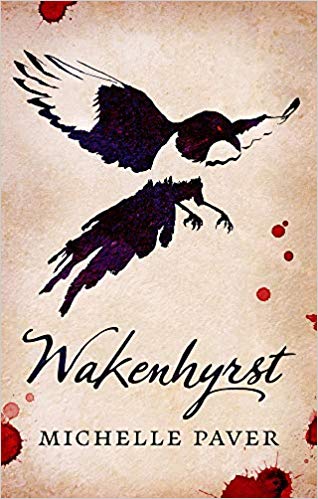
 The Gothic novel is one of the classic genre tropes of our genre – think Mary Shelley’s Frankenstein, Bram Stoker’s Dracula, or more recently Shirley Jackson’s The Haunting of Hill House or even Susan Hill’s The Woman in Black. Wakenhyrst is a novel that taps into this tradition, steeped in folklore, with strange things going on and odd characters.
Michelle Paver began her career writing young adult novels (Chronicles of Ancient Darkness series (2004 – 2009), beginning with Wolf Brother) but more recently her adult novels (Dark Matter, Thin Air) have blazed a trail on the adult creepy side. Wakenhyrst continues this pattern.
The framing story begins, not in Edwardian Britain in 1906, but instead in 1966. A newspaper article brings back to the public spotlight an infamous story and sets up what the main plot of the novel will tell us, that in the Suffolk hamlet of Wakenhyrst, Edmund Stearne, historian and academic, killed a worker at his manor house home of Wake’s End in 1913. Declared insane, he spent the rest of his life in an asylum, and, with a touch of M R James, became world famous for three Bosch-ian paintings made there. The reporter, Patrick Rippon, is granted a brief visit and meeting with the murder’s only witness, Edmund’s daughter Maud, now in her seventies. Meeting Maud at Wake’s End he is also allowed access to Edmund’s work in progress, a translation of The Book of Alice Pyatt (1451 – 1517), Mystic and Edmund’s private notebooks from 1906 to 1913.
The resulting publicity leads to communication between Maud and someone else mentioned in the newspaper article, researcher Dr. Robin Hunter, who is given access by Maud to ‘her story’ for publication. This deals with the events leading up to the murder from the perspective of Maud.
The resulting story unfolds – a story of witchcraft, repression, deception and madness.
What really works here is that the author does well to build the novel’s world skilfully. Michelle knows the genre of which she writes and the story is filled with knowing nods to many classics – there’s the creepy house isolated on the edge of the disturbingly wild and open Guthlaf’s Fen, a combination of creepy Gothic gloom and eerie nature rather like that imagined in Shirley Jackson’s The Haunting of Hill House and Susan Hill’s The Woman in Black. Added to this is the use of artifacts, academic research and things that should be left well alone, all keynote elements of many of M R James’ ghost stories. The book begins quietly and yet slowly adds all these elements to create a place that seems real and yet also creepy.
One of the most striking aspects of the novel is that this world is filled with memorably strange characters who are often not what they appear to be. Outwardly, Edmund Stearne is the model of Edwardian society but he has a darker, creepier side that is only seen at home. By contrast, his wife, Dorothy, is a woman whose main purpose is to be a conduit for Edmund’s lust and the bearer of his children. Repeated miscarriages have a cumulative effect on Dorothy and eventually lead to her death. This results in Maud and her younger brothers being brought up in the Stearne household by the servants. Edmund takes solace in the company of Eve, one of the servants.
Having established the background, the middle section of the novel steps the tension up when Maud, now 14, is given the responsibility of typing up her father’s notes on his current study. At the same time, she also manages to sneakily read her father’s private journals, which illustrate the real man behind the social façade.
As part of his research, Edmund uncovers an old painting in the local church connected to Alice Pyatt. Here the story raises the James-ian vibe by using this as an artefact that shows the horrors of Hell. The clear implication is that the fresco should not be made public. The painting, referred to by Maud as ‘the Doom’ is restored and put on display in the church, something which clearly has an impact in the village and on Edmund.
The last part of the story shows what Maud is reading in her father’s personal journal. We read of the physical and mental decline of Edmund, and Maud believes through reading the journal that her father sees her as a witch. This is partly due to a friendship that the lonely Maud strikes up with a magpie that she names ‘Chatterpie’, something which her father sees as akin to witchcraft.
Maud’s attempts to expose her father as ill is received with disbelief by other adults. When approached, the local vicar and her father’s physician feel that these actions are the imaginings of a young immature girl and are to be disbelieved.
Edmund’s actions become more erratic until eventually he kills a farmworker, believing him to be possessed and possibly under the influence of Maud, when in actuality he is a sweetheart of Maud’s. The story then returns to 1966 for its denouement.
Wakenhyrst is a slow burner of a novel that starts unhurriedly but relentlessly builds to a chillingly effective conclusion that is quietly unsettling. Not all of the characters are pleasant, but they are complex, logically developed and reflect the patriarchal society of Edwardian England depressingly well. Michelle manages to juggle classic elements of the Gothic theme with nature, folk horror, witchcraft and mental instability to create a modern Gothic novel that deserves to become a classic.
Wakenhyrst by Michelle Paver
Published by Head of Zeus, April 2019
ISBN: 978-1788549561
304 pages
Review by Mark Yon





Sounds exactly my cup of tea and I’ve loved her other novels. Can’t wait to read it!
Thanks for the comment, Suzie. I think if you’ve liked her more recent books, you’ll like this one. One of the best of its type I’ve read recently.
I’ve ordered it. Off to Iceland tomorrow to do some masterclasses with, among others, Sarah Moss. Cold Earth and Ghost Wall, whilst not Gothic, also have a brooding chill. Thanks for a good review without spoilers.
Thanks, Suzie: all the best on your trip. (And thank you for the kind comment on the review – I do try my best!).