
 With the nominations for the 2019 Hugo Awards being recently announced, I was also pleased that this year’s Worldcon in Dublin also nominated books for a Retro Hugo – for 1944 (which means books/stories published in 1943.)
Of the Retro Hugo nominations, I was most pleased with Fritz Leiber’s Conjure Wife being a nominee because it’s one I’ve been planning to reread for a while. I’m glad I did.
To put the novel into context, Fritz Leiber Jr. at the time of this story being published in 1943 was an author known for his lyrical sword-and-sorcery stories based around Fafhrd and the Gray Mouser, first published in 1939. He was also building a reputation for writing strange stories in magazines such as Weird Tales (appropriately enough!) and John W. Campbell’s Unknown Worlds. He was a regular correspondent to H P Lovecraft before Lovecraft’s death in 1937, and this seems to have inspired Leiber to write material of a similar nature. Perhaps unsurprisingly therefore, some of Leiber’s first sales outside of the magazines were eventually to Lovecraft’s old publishers, Arkham House.
Writing was not Fritz’s first occupation up to this point. Fritz was an author known for also being a poet, a scriptwriter and even holding down an occupation as a Shakespearian actor himself (being brought up in an acting family), it should not be a surprise that his stories were fond of wordplay and the use of language, imaginative and literate.
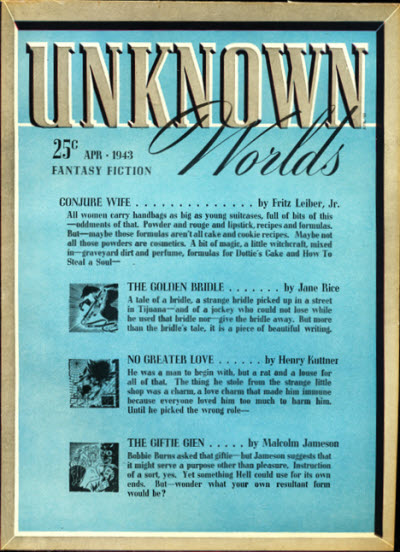
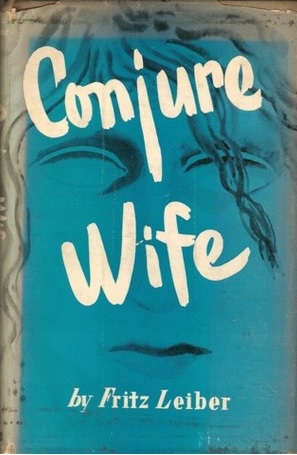 Conjure Wife was one of Fritz’s first novels, but like most genre novels of the time was first published in the pulps – in this case in John W. Campbell’s short-lived fantasy magazine, Unknown Worlds (1939 – 1943) in April 1943. (Link here.) It was not until the story was first expanded and revised for an anthology in 1952 and then ‘fixed-up’ into a separate novel in 1953 that it became more widely known.
Looking at the two together makes interesting comparison. The 1943 version is much shorter, less polished, rougher and yet more to the point. The 1952 version is more florid, with ideas expanded upon and the plot given room to spread out. There’s even a racier side to it, with more acute mention of sex (but let’s not get too carried away, this is still 1950’s USA.).
The plot? Norman Saylor is an academic in the field of ethnology who is on the rise in a small provincial university. Living in Hempnell with his wife Tansy, he has made his way up the academic ladder of Hempnell College with all of the political diplomacy and candour required, to the point where it looks like he is about to be offered the chairmanship of the Sociology Faculty, over the heads of his rivals. It is at this point that the novel begins when Norman discovers that his faithful wife has kept in secret a number of witches’ charms – to protect him from black magic and evil spirits. Norman scoffs at this – what would the Faculty say about a society wife of sociology who does such things? – and gets her to destroy them.
Of course, once this happens, things start to go wrong for Norman. There’s accusations of sexual harassment, angry phone calls from rejected students, and a feeling that many of those colleagues working with Saylor are actually determined to do him ill.
 At this point in the story, things turn much more sinister. There’s a twist in the story that may be a surprise to you about two-thirds of the way in, but it seems appropriate for Leiber’s dark sense of humour. The end of the story is a revenge tale, perhaps reminding us of the old adage that there is no wrath worse than a woman whose partner has been wronged, or vice versa.
On finishing this I was reminded of all of Fritz’s strengths and weaknesses as a writer. Conjure Wife is a story that seems to combine them all, even in the shorter version, which is surprising when you consider that this is an early work from the author. There are parts that are almost lyrical, with a tone that may seem a little too florid today, but has a certain charm. (The influence of Lovecraft is there, should you wish to look for it.)
Whereas the 1953 version tells the story focusing on Norman and Tansy in the third person, the 1943 version gives us a perspective from the other witches that has disappeared from the novel version. It’s all rather like Macbeth, and perhaps gives the game away too early for the novel version. There’s a lot of talk about maintaining ‘The Balance’, which seems less important in the novel version.
Both versions have deliciously spiteful about office politics and academia, with the drama of political and social shenanigans never far away, despite the impression that it is a cool and sedate environment to work in. Leiber seems to relish the point that every work cocktail party or card game is really a performance, a battleground for position and social standing.
 It goes without saying that the sexual politics are of their time, with the genders clearly relating to stereotypes, although Leiber does subvert them a little. There’s an interesting point made that all women have this secret power, whilst men are oblivious, which may not sit well with contemporary audiences.
What we really have here is a supernatural version of that old adage that ‘behind every good man stands a good woman’ and towards the end the opposite. Tansy is motivated by her love for Norman, and backs her man as he makes his way to the top of the academic pile. This allows Leiber to make various comments about how different men and women are and play upon the old maxim of how they don’t always understand each other. It also highlights the stereotypical roles each gender has to play in 1940’s & 50’s America – the man out earning a living, whilst the good wife stays at home supporting him. (There’s more than a touch of the 1960’s TV series Bewitched here.)
I’m pretty sure Fritz is parodying this a little, there’s more than a touch of humour throughout the whole proceedings, as if the author’s making comments with a knowing nudge and a theatrical wink. Rather surprisingly (for I had forgotten), in the novel version there is some talk, albeit covertly, about sex – for its time I suspect that it was rather daring.
So far, so Peyton Place.* The supernatural element is of course when we discover that black magic has a place in the socialite and academic world of the 1940’s and 50’s. It is a long way from the traditional setting of spooky castles and cauldrons, yet still quite surprisingly effective in places and throughout there’s Leiber’s dark, dark sense of humour that teeters over into things that are rather unpleasant.
Overall there is a sense created that this could be real and that this might be how things are (or at least could have been) in 1940’s and 50’s America. Obviously, it’s not, but for the time spent reading, it seems possible. And that is part of the skill of the writer.
In short, it is clear that Conjure Wife, particularly in the magazine version, is a product of its time, although there’s a lot of fun to be made with it if you can cope with the dated gender politics. It is good, particularly in the last part, even though the final twist is one it could have done without, perhaps. Despite this, for shock value alone, the 1943 version deserves its place in the Retro Hugo nominees. On balance (see what I did there?) Unusually for me, I think I actually prefer the magazine version to the novel version, which retains all of the shock without too much superfluous detail.
It’ll be interesting to see how it fares against its opposition in the 1944 Retro Hugos**, especially when one of the competitors is another work by Fritz! (Guess what I might need to read next.)
*Yes, I know: for the record, Peyton Place as a novel wasn’t published until 1956 – only 13 years after Conjure Wife!
**For the record, the other Retro Hugo nominees are:
Conjure Wife, by Fritz Leiber, Jr. (Unknown Worlds, April 1943)
Earth’s Last Citadel, by C.L. Moore and Henry Kuttner (Argosy, April 1943)
Gather, Darkness! by Fritz Leiber, Jr. (Astounding Science-Fiction, May-July 1943)
Das Glasperlenspiel [The Glass Bead Game], by Hermann Hesse (Fretz & Wasmuth)
Perelandra, by C.S. Lewis (John Lane, The Bodley Head)
The Weapon Makers, by A.E. van Vogt (Astounding Science-Fiction, February-April 1943)
Conjure Wife by Fritz Leiber
First published 1943 in Unknown Magazine. Later fixed into a novel, published 1953.
69 pages in magazine form; 190 as a novel. The original magazine version is HERE.
Review by Mark Yon





Nicely reviewed, Mark. You’re making me think I need to dig this out and reread it, too. Yes, and maybe GATHER DARKNESS as well.
Thanks, Randy. I found comparing the two versions quite interesting, and surprising. In particular, I was quite taken with the shorter version, as in Unknown Magazine. Might be worth a look, if that helps.