
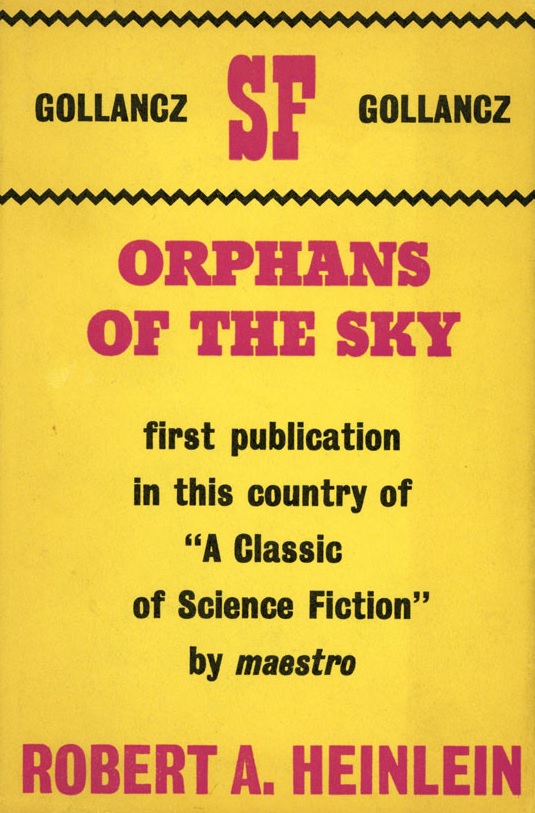
 In the latest of my Heinlein reviews we look at what is regarded as another addition to Heinlein’s Future History series, but one that was oddly delayed in its publication as a novel in the US, twenty-four years after its publication as two separate novellas in the pulp magazines.
Putting it into context, the two novellas were originally published as Heinlein was making a name for himself in the magazines. Universe was published after his short story Solution Unsatisfactory, published as by Anson MacDonald and later collected in The Worlds of Robert A Heinlein, but before We Also Walk Dogs (later published in The Green Hills of Earth, reviewed HERE); Common Sense was published after By His Bootstraps as by Anson MacDonald, but before Lost Legacy, published as by another pseudonym, Lyle Munroe. Taken in this context, they are clearly products of early Heinlein.
Universe tells us of Hugh Hoyland, a young man who becomes an apprentice scientist at the start of the story. As a trainee, Hugh is given access to details that the majority of his neighbours do not. We find out through Hugh, and the religious doctrine he experiences, that over hundreds, if not thousands of years, his society has regressed into a post-technology state. Following a rebellion which killed most of the Officers long ago, the successive generations are no longer even aware that they are on a spaceship, instead believing that ‘the Ship’ is the universe. Ship’s documents have been turned into holy relics and even the ship’s rules have been adapted into religious metaphors.
There are also ‘muties’, mutants and mutineers who roam the spaceship and often attack and eat Hugh’s fellow travellers. Hugh finds this out when he is captured in a fight.
His captor is Joe-Jim, an intelligent two-headed mutant with two personalities, who along with the encephalographic dwarf Bobo, form a mutie gang. They show Hugh the reality of the situation, by taking him to the ship’s Control Room, that they are but a small part of something moving in an infinitely bigger space.
Common Sense follows this by showing us what happens when Hugh goes back to the rest of his group to tell them what he has discovered about the muties and the world outside. He tries to contact the scientists, believing that they would understand or at least come see the evidence for themselves. Unsurprisingly, he is locked away and arrested for heresy until he is released by Joe-Jim, Bobo and others. The story ends with the rebels attempting to get others to realise and accept the truth, which has consequences for all concerned.
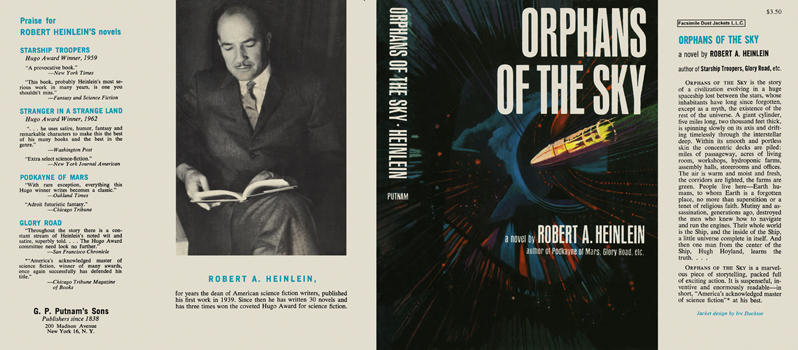
What these stories are famous for is that they popularised what will eventually be a trope – that of the generation starship, where the place the characters live is so big that they firmly believe that it is their universe, and they live without science, believing in myths and superstitions instead. Whilst the idea is not particularly new, even in 1941, it is done well.
So why wasn’t this one re-published in the 1950’s, along with the rest of the Future History stories? Even now, it is one of the harder-to-find stories of Heinlein’s work.
It is a Future History story – in the (admittedly later) edition I read, the first page links the spaceship to that of the first mission to Proxima Centauri, which was also the destination of the spaceship of the Howard Foundation in Methuselah’s Children (LINK). There’s also reference to some of Joe-Jim’s favourite reading as being the poetry of Rhysling, the blind singer in The Green Hills of Earth, which may be retrofitting for the edition I’ve read. It’s more of a subplot than a main story (I believe the link will be more explicit later in Time Enough for Love) but the connection is there.
Moreover, whilst I think the first part works better, the two novellas are clearly linked to each other and make sense as a novel rather than as two separate stories. The first part especially would easily fit into one of the other Future History collections such as The Man Who Sold the Moon or The Green Hills of Earth.
Perhaps it was the idea of mutants, though they were not uncommon in stories of their day? Is it that the muties are clearly cannibals, who eat their enemies with relish and who use the phrase “Good eating!” as a compliment? Could it even be the idea in the narrative that even with their limited social skills, the muties are more likeable than the humans, the real monsters of the story? Heinlein does well to make us care about the characters in such a relatively short space of time. I’m still not clear, though the idea of likeable creatures can be traced back to Mary Shelley. Admittedly, it is a tale painted with broad brushstrokes and yet has elements that belie its pulp origins. There are much worse out there that were published without censure.
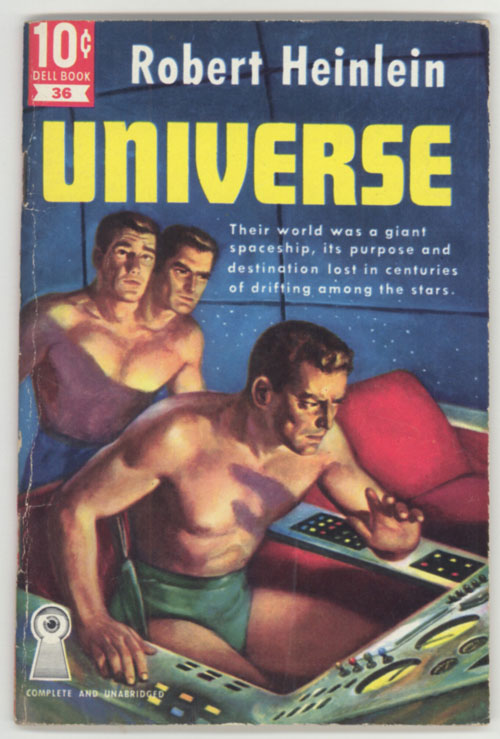 It is also true that some parts date less well than others, and are surprisingly crude considering Heinlein’s later work, which does much to address the issues here. There’s a strong misogynistic element that will sit uneasily with modern readers – the ‘damned women’ are kept in place with a thump and even at one point by being dragged around. In the typical traditions of pulp fiction, there’s also one female character having a mental breakdown at a key point in the plot whilst the men save the day.
In the same seemingly casual manner, many of Joe-Jim’s actions are reinforced with a threat of violence or an actual thump or a kick. Such were the attitudes of the 1940’s, I guess, but they are understandably less acceptable for modern tastes.
Despite this, Orphans of the Sky is not even my worst Heinlein story. For, despite the second part being less enjoyable than the first and, after the careful build-up, the ending seeming forced and unconvincing, I enjoyed it much more than my previous visit to the Future History, that of Methuselah’s Children (LINK.) This one is less hectoring and noticeably less annoying than Lazarus Long ever was. Perhaps that’s why I liked it more.
It’s also interesting to note that they were written and published about the same time but are different: Methusulah’s Children was published in Astounding as a serial in July – September 1941, whilst Universe was published in Astounding in May 1941 and Common Sense in October*. The author was clearly on a roll and increasingly popular, at a time when his name sold copies.
Perhaps unexpectedly then, Orphans of the Sky has dated a little, but in places it is surprisingly mature for its time of original publication. Once again, the writing, whilst not as polished and as complex as later work, shows Heinlein to be a rising star who would reach the potential for greater things later in his career.
*Universe in Astounding is HERE., Common Sense in Astounding is HERE .
Orphans of the Sky by Robert Heinlein
First published in two parts: Universe in Astounding, May 1941 and Common Sense in Astounding October 1941. Universe was published in an Ace novel in 1951.
First published as a complete novel in the UK by Gollancz, December 1963; also published as a novel in the US by Signet, April 1965
160 pages
Review by Mark Yon




RAH was the author who introduced me to SciFi, also got me to think of the world in other than a roman catholic perspective.
For both of those benefits, I am grateful. Several of his early works were rough, and L Long was obnoxious, but over all, I rank Heinlein as my favorite author of 50 yrs of prolific SciFi reading.
Hi Will.
Heinlein for me, like you it seems, was one of the entry points to science fiction when I was younger. These rereads have been interesting for me; I’ve found some have been worth it and others… erm, less so (Lazarus Long has been a low point for me as well –
https://www.sffworld.com/2019/02/methuselahs-children-by-robert-a-heinlein/
When Heinlein’s good, he’s very good, in my opinion. Especially when you compare him with the competition of the time they were written! Thanks for the comment.
Count me as another who found Heinlein as a young reader. I recently pulled out me copy of The Past Through Tomorrow, a massive collection of the Future History stories. There were a few stories in there that, despite their age, still carried the same emotional impact (“The Man Who Sold the Moon,” “The Long Watch,” “Requiem “). I read those to my wife – who had not read those – and she was in tears at the end.
Thanks for the comment, Tim.
I have a few copies of The Past Through Tomorrow myself, more than I should have! Erm… hardbacks (split into 2 here in the UK), paperbacks (my originals), ebook and Virginia Edition! They’re great to dip into and many of the stories hold up well. Here at SFFWorld I’ve reread them as if they’re the original book collections. And then added Methuselah’s Children at the end (which is included in some editions of Past Through Tomorrow), which I really didn’t like.
Now I’m actually tempted to reread Time Enough for Love and I Will Fear No Evil, just to see if they’re as disappointing as I remember them to be. After Methuselah’s reread, it surely won’t end well?
I too discovered RAH at an early age in my school library. Indeed, at the place and time I grew up, his “Red Planet” was pretty much the first novel I’d ever read with “Orphans of the Sky” not long after. I hadn’t even known there was such a thing as written science fiction other than bad comics until I found those books and I have been an unabashed fan of RAH ever since. And while I might argue the pros and cons of the story, the writing, the attitudes of the era expressed in the book now, I’d probably still be a little embarrassed to admit how much my 12-year old self wanted to be on that spaceship when I first read that book and disappointed to admit how infrequently that happens today.
Wasn’t even aware of these by Heinlein. Working my way sporadically through his works and will add these.
Mark, you make a mistake in this review that I find common in reviews. Each novel need not be a reflection of a utopian ideal. An author who depicts barbaric or misogynistic conditions isn’t necessarily oblivious to better circumstances. Heinlein has plenty of strong, intelligent female protagonists throughout his work. Their absence here or there doesn’t “date” a work. What it does is describe a society which challenges the reader to imagine how it might improve, and at the same time offers the reader a glimpse into worse conditions than those in which they dwell.
It’s similar to the misunderstanding I’ve found from time to time concerning “Farnham’s Freehold”. I’ve seen a few reviewers appalled by what they saw as racist content. “Did you read what Farnham’s son had to say about the black character!?! Terrible! Shocking!” I wish to emphasize that your slight does not rise to that level of utter misunderstanding.
“Farnham’s Freehold”, published at the height of the civil rights movement, is a masterful “negative example”. In it, Heinlein instructs by making the reader cringe at atrocious behavior. He’s not glorifying it. Nowhere in the book will you find a lecture on racism, yet “Farnham’s Freehold” undoubtedly helped to shape the attitudes of readers to evaluate an individual based on his character, and not his outward appearance.
In this book you review here, Heinlein is clearly making a case for the acceptance of those society once shunned — people who look different — people with different underlying cultures. And it also contains a common Heinlein trope — don’t blindly accept the word of self-appointed “experts”. That reminds me of a Heinlein quote, probably paraphrased – “When you get ready to do something, consult experts and let them tell you why it can’t be done, then go do it anyway.” I read that advice as a young adult, and it has served me well. I’ve spent a lifetime doing things people told me I couldn’t do. LOL
So what is my bottom line?
Don’t evaluate a book based on the attitudes of the character or its society. Find the obvious message, and stick to that. If every book described utopia, we’d all soon cease reading.
Thank you for your thoughtful and well considered comments, Jim. I think I’ve commented a few times in this series of rereads about how Heinlein introduced female characters at a time when they were less noticeable in science fiction. I’m never convinced of the utopian ideal from any author myself, but I’m interested to see how writers approach the topic – or how close they can get, if they wish to get there. Heinlein’s distrust of ‘experts’ is something noted elsewhere.
I see a book though as a presentation of ideas put out on show for readers to examine. I hope I don’t fall into the trap of believing that everything written in fiction reflects the author’s own ideas, although I do believe in this early work that Heinlein was often doing so. I know that Heinlein was very good at throwing ideas out there, and often just to get people to question things. In the case of his juveniles though I believe that it is well documented that part of RAH’s remit with his juveniles was to a) produce a book that sold, predominantly to teenagers; and b) to present ideas as entertainment that allied to the Scout’s ideals, which as an ex-military man RAH also agreed with.
Farnham’s Freehold is another on the reread pile, which I will get to eventually. I believe that certainly in his later, more adult work, Heinlein was determined to shock or at least get others to question ideals, as indeed he may have questioned his own.
Thanks again for your thoughts.