We’re very pleased to welcome Edward Cox to SFFWorld today. Ed has already had three acclaimed novels published to date, known as The Relic Guild trilogy. His new novel, The Song of the Sycamore, is a new venture.
We asked Ed the old cliche “Where did you get your ideas for the new novel from?” and despite it being a question few writers relish, this is what he wrote:
The source for my influences and inspirations is difficult to pin down. I’m often asked where my ideas came from or which authors inspired me, but the truth is I’m never influenced by any one thing; my novels are amalgamations of ideas accumulated over years and stored in my brain’s trundling processor. Inspirations for my new novel The Song of the Sycamore are varied: the story of Orpheus and the Egyptian myth of the sycamore, for example, along with legendary tales of science-fantasy and the Dying Earth. However, the story is also influenced by my memory of a very real event which occurred when I was a young man.
In 1986 I was fifteen years old and felt as though I was living beneath the constant threat of annihilation. It was the last years of the Cold War, the UK was hosting an untold number of the deadliest weapons on Earth, and nothing sold newspapers like scaremonger-headlines of the imminent nuclear war between America and Russia. I lived in Colchester, a military town since the days of the Roman Empire, and the newspapers told me that a Russian missile was pointed directly at my home, aimed at me. And then there was a newsflash. Something had happened in Russia, something bad, real, not invented by the press. A nuclear reactor had gone into meltdown.
For those who saw the recent Chernobyl series, you might have been reminded of what that time was like. Certainly, the series taught us all something new about the truths which had been buried for years. Nothing like the Chernobyl disaster had been seen before, and the media had a field day. Water would be undrinkable, air unbreathable, the entire planet poisoned for twenty thousand years. I remember feeling terrified for the Russians, expecting nuclear fallout to kill them all, to then spread to next country and the next until reaching Britain. And then we would all be forced to live below ground in lead-lined bunkers, surviving on canned food.
Of course, I had bought into the misinformation and sensationalism, selfishly believing the Russians’ tragedy was my tragedy because their disaster was bringing about the end of the world. However, when the headlines stopped and no apocalypse visited my hometown, I wised up. But I never forgot how fearful I let myself become, and it was only a matter of time before that fear influenced my stories.
Skip forward thirty three years . . .
In The Song of the Sycamore a citywide catastrophe which threatens an entire world is pivotal to the plot. Like Chernobyl, a catastrophe of this kind has never been seen before and there’s more speculation than solid fact about its cause and effects. Magic, monsters and weird technology play a heavy role – this is science-fantasy, after all – but they are representative of how little was known in 1986 about the aftereffects of nuclear disaster. My memory of Chernobyl, the fear and naivety of a young man who believed the world would crack open and all manner of mythological darkness would flood the land, is the foundation upon which this story is built.
I hadn’t long finished copy-edits when the Chernobyl TV show aired. I found it hard to watch at first. It reminded me of all the old feelings I thought I’d exorcised in the book. It also taught me how much I didn’t understand in 1986 and how much worse the disaster would have been if not for the heroism of some damn brave souls. The Song of the Sycamore has its own heroes, and they too are struggling under hierarchs who will utilise a monstrous power even when they can’t fully comprehend it.
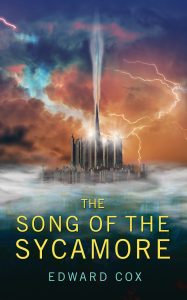
Edward’s latest novel, The Song of the Sycamore, is published by Gollancz and is out now in the UK. (SFFWorld‘s review will be up at the weekend.)
Thanks to Ed and Kate at Gollancz for sorting it out for us.