A young man fights through the ranks of his military to become the best fighter/swordsman so he can take revenge upon those who wronged him. Throw in some magic, mythology, and monsters, and you’ve got a popular and proven Epic Fantasy framework. Evan Winters takes that template and fills in the framework with refreshing details and great plotting in his debut novel, The Rage of Dragons, which launches The Burning saga.
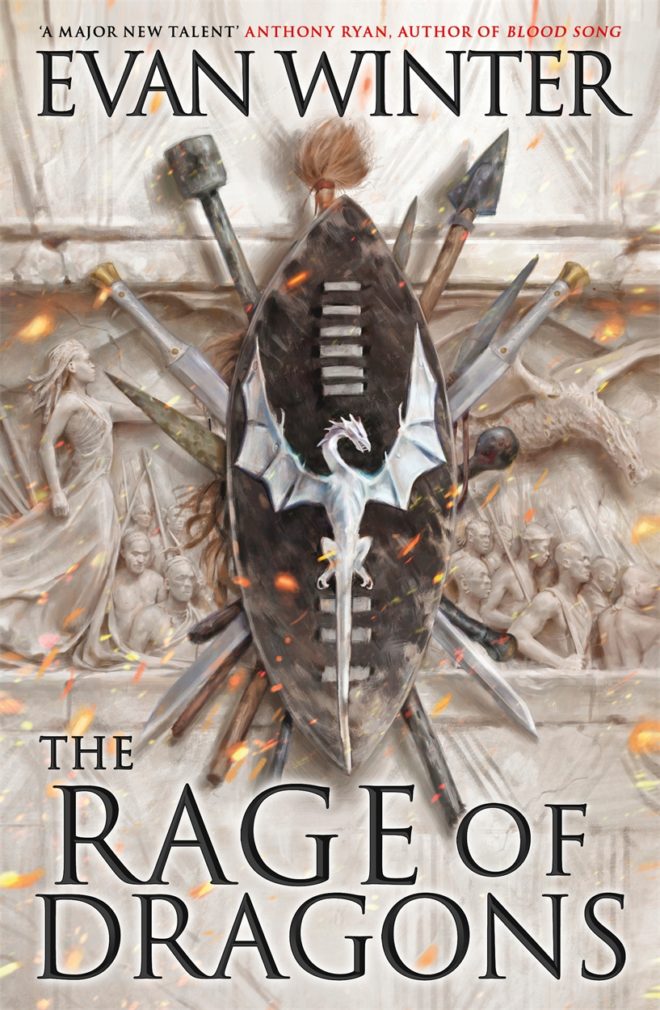
The Omehi people have been fighting an unwinnable war for almost two hundred years. The lucky ones are born gifted. One in every two thousand women has the power to call down dragons. One in every hundred men is able to magically transform himself into a bigger, stronger, faster killing machine.
Everyone else is fodder, destined to fight and die in the endless war.
Young, gift-less Tau knows all this, but he has a plan of escape. He’s going to get himself injured, get out early, and settle down to marriage, children, and land. Only, he doesn’t get the chance.
Those closest to him are brutally murdered, and his grief swiftly turns to anger. Fixated on revenge, Tau dedicates himself to an unthinkable path. He’ll become the greatest swordsman to ever live, a man willing to die a hundred thousand times for the chance to kill the three who betrayed him.
The Rage of Dragons launches a stunning and powerful debut epic fantasy series that readers are already calling “the best fantasy book in years.”
The Rage of Dragons begins typically enough for a big fat fantasy novel – a prologue set in the distant past establishes the fantastic powers at play in the foundation of the world, its mythology, if you will. The main timeline/narrative of the novel begins a couple of hundred years later and focuses on Tau, a lower-caste young man who is frustrated with his lot in life. He has aspirations for rising above his station to become an elite warrior known as the Ihashe – and having a life with Zuri, the young woman he loves, and who loves him. He is an Omehi, the nation of people introduced in the prologue who invaded the land. His people are still trying to maintain their foothold in the “new land” they invaded. Because he is of a lower caste, Tau’s interactions against the upper class can have grave consequences, despite his best intentions. Well, Tau wrongs the wrong people and he is wronged tenfold. He has even more of an obstacle to overcome in his goal of becoming an elite warrior, but no cost to himself is too high a price for revenge. Tau has his personal struggles to deal with all the while fighting a war that has been raging for as long as any living soul can remember
While much of the bones of the story are familiar, the meat of the novel/world/story are where Winters really provides the tasty elements of the story. Inspired by African mythology, the gods/goddesses are a refreshing change of pace from the Norse, Germanic, Greek, and Irish inspired mythologies. The book has been compared to the film Gladiator (a movie I absolutely love) by the publisher and others, the story arc of Tau does resonate with that of Maximus (Russell Crowe’s character). Revenge is a powerful story element and Winter infuses Tau’s story with such heart, such palpable anger, and such empathy that Tau’s plight and story transcend comparison to feel even more powerful. The “how” of Tau’s rise to power and revenge are magnetically compelling – the pages and the book didn’t stray too far from my hand.
Another element that sets The Rage of Dragons among the upper echelon of its peers is how detailed everything else, coupled with how well Winters weaves those militaristic and mythological details into the narrative. No real info dumps, no lengthy treatise on what a warrior should be. Rather, those elements are interwoven into the characters narrative, they feed each other for the greater whole of the novel. I also appreciated the fantastical creep of the novel. In the same way that best fantasy writers like Tad Williams, Robin Hobb, Elizabeth Moon, and George R.R. Martin lull the readers into a world with extremely realistic elements, Winters sprinkles in the fantastic early and the fantastic elements build to a larger component of the novel by the conclusion. Balanced is an overused term, I suppose, but Winters plays a great balancing act.
Something I’ve come to appreciate more and more lately is how a writer structures their novel, and I’ve probably commented on it, too. Make no mistake, The Rage of Dragons is a large book. Slightly over 500 pages in hardcover, while not the largest of Epic Fantasy novels, it is a tome. But, BUT! Winters is a very smart writer, from a structure perspective especially with regard to chapter lengths. As a reader, I suppose I could use the Goldilocks comparison – the chapter should be long enough to convey to the reader that you’ve accomplished and experienced a good chunk of the story. Conversely, it shouldn’t be too long where it is a slog to get to the end of the chapter, and that chapter ending should provide a balance of closure and encouragement to continue reading. Winters struck a *perfect* balance in this regard. A recent novel I had to set aside was the opposite – it was actually shorter, but the chapter length felt interminable so perhaps I appreciated what Winters did here even more.
Winters is among a wave of writers who self-publish then get a deal from a major publisher. The Rage of Dragons is supremely accomplished and well worth that added spotlight and attention.
Highly Recommended
© 2019 Rob H. Bedford
Hardcover | 529 Pages
July 2019 | Orbit Books
Excerpt: http://evanwinter.com/prologue-the-rage-of-dragons | http://evanwinter.com/
Review copy courtesy of the publisher Orbit Books