 So: what do you expect when a book appears from the scriptwriter of Jurassic Park, Spider-Man and Mission: Impossible?
Cold Storage is that kind of action-based, ‘world-in-peril’ book, or at least it is to start with. The action starts from the beginning, as in 1987 bioterrorist agents Trini Romano and Roberto Diaz are sent to Australia to investigate what seems to be a bioweapon attack.
However (surprise surprise!) it’s not. What they actually find is a Cordyseps* super-fungus that may have escaped from Skylab space wreckage. Having laid dormant in space for years, the Aussie climate and an unfortunate accident has accelerated its growth and mutated it into a new deadly form – it manages to kill pretty much everyone in a remote Australian town in days.
So – think Outbreak, think Michael Crichton’s Andromeda Strain, del Toro’s The Strain or even 1950’s ‘classic’ The Blob – the story’s going to be about how our inexperienced and inadequately resourced heroes in the middle of nowhere are going to save the day, right?
Well, yes. But what such a short summary doesn’t do is tell you how entertaining this is. David has a lot of fun with setting up situations that you think you know what’s going to happen, and much of the entertainment is about seeing how gory some of these things can be on a written page. (And just so you know, this thing infects people and makes their bodies explode.) There’s a surprising degree of humour here, though it’s not overplayed. (One character freaks out, for example, when an infected deer appears to operate an elevator – it doesn’t, by the way.)
To bring this story up to 2019 we then move to where a sample of the mutated Cordyseps novus found by Trini & Roberto has been kept in an underground mine by the Defense Department for further study. Over the last thirty or so years it has been kept there in the dark, mutating further, until it reaches the point where it then escapes…
Security guards ‘Teacake’ and Nicole are trapped in the building above the mine, now a storage rental depot, as the virus spreads. It is up to Trini and especially Roberto, now in their sixties, to contain the virus and hopefully save the non-infected.
Whilst the tropes are not particularly original – the beginning is straight out of The Andromeda Strain movie (1971) – the way this story is told is different enough and fast enough to keep you reading. You know the plot – but it’s dissimilar enough to keep you guessing along the way. What works here in particular is the relationships of our two officers and then our two hapless security guards, who watch each other’s back. The banter in the hands of a lesser writer could come across as forced but actually feels genuine, which is not easy to do.
At times it is clear where the Michael Crichton comparisons come in – like Crichton used to write, there’s some science-y jargon in places that is just enough to create that so-important believability, yet not too technical to alienate the general reader.
Whilst you could see it as a script-in-another-format, it generally doesn’t read like one, as there’s enough detail to make the plot more than that.
I’m sure it would make a good movie, though.
If you’re of a mind for a “nasty wildlife threatening the world” type of novel (it might just take your mind off what’s really happening, after all) then Cold Storage is a superior read that whilst it knows its trope-y origins keeps you page-turning (which is usually the point of a story, after all.)
Sometimes real life can be stranger than fiction. Cold Storage uses this to its advantage. This one is a set of fast-moving thrills that knowingly entertains from the start.
*If you haven’t seen David Attenborough’s Planet Earth video of what happens to bullet ants that catch the Cordyceps virus in the Amazon rainforest, it’s worth watching (LINK). But be warned, it’s not for the faint hearted…
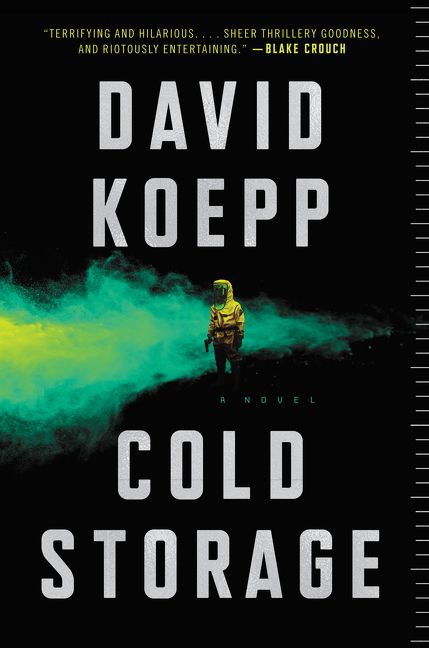
Cold Storage by David Koepp
Published by HQ/Harper Collins, September 2019
312 pages
ISBN: 978-0008334505
Review by Mark Yon