Fallen Dragon is a stand-alone novel from Peter F Hamilton, released in 2001 and shortlisted for the 2002 Arthur C Clarke Award. I’m a big Hamilton fan and have read this book multiple times, and often come back to it – prior to this read it had been a few years, and it’s surprising what sticks in my memory and what doesn’t. I also find that it’s a pretty good starting point if you’re new to Hamilton’s work and don’t fancy jumping into a multi-volume epic, and it does cover a lot of the themes present in most of his work. So what is it about? Read on…
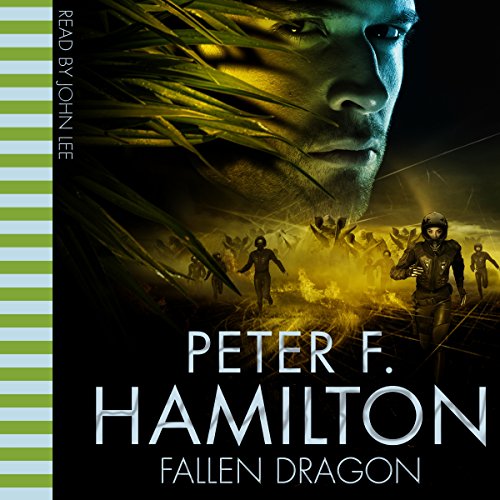
Fallen Dragon is a classic standalone novel by science fiction star, Peter F. Hamilton.
Lawrence Newton always dreamed of adventure amongst the stars. Now the ultimate prize is within his grasp, but what will he risk to get it?
Lawrence is the sergeant of a washed-out platoon, taking part in the bungled invasion of yet another human colony world. The giant corporations call such campaigns ‘asset realization’, but in practice it’s simple piracy.
When he’s on the ground, being shot at and firebombed by resistance forces, he recalls stories of the Temple of the Fallen Dragon. Its priests supposedly guard a treasure hoard large enough to buy lifelong happiness. So Lawrence decides to mount a dangerous private-enterprise operation of his own.
Lawrence Newton was born into a board family on the colony world of Amethi, a planet that required long-term investment and global warming in order to melt its ice and make it comfortably habitable for humans. He dreams of life among the stars, exploring and searching for new planets for the human race to colonise, but the reality of current starflight expeditions is bleak. When events in his life lead to a discovery that could allow him to fulfil his dream he heads to Earth in the hopes of realising it.
Fast forward to the present and Lawrence Newton is part of Zantiu-Braun’s strategic security division, travelling to planets to realise assets in order to bring profit back to the owning company. With starflight too expensive to justify trade between the planets that humanity inhabit this is the only way for owning companies (or rather the companies that have brought out the planetary debt) to gain any sort of income from these worlds. Arriving at Thallspring, Zanitu-Braun’s forces soon discover that there is an underground movement that is causing them many problems, but doing so without raising many questions and in such a way that Zantiu-Braun’s only action against such defiance, the collateral necklace, cannot by justifiably used.
But this is not the first time Lawrence Newton has been to Thallspring. On a previous mission he discovers that things are not quite as they seem in the hinterlands around Memu Bay, and with hindsight realises that there is unknown wealth in the region, a discovery that Zantiu-Braun is unaware of. As Lawrence and his platoon face the ever growing resentment that the locals have against Zantiu-Braun, struggle on the streets from day to day and have to live with decisions made from on high, the time is drawing close when he can make his move and finally realise his dreams.
Fallen Dragon is one of only a couple of stand-alone space opera’s that Peter F Hamilton has written. His series are huge multi-volume affairs that are as impressive as they are ambitious. Therefore, taking his skill and applying it to a stand-alone book was always going to have an interesting result. Not only does he manage to keep the sense of wonder that he has in his trilogies and series, but he does so with flair and style, bringing the military SF tropes of old up to speed in only the way he can. There are also many familiar ideas present here, some of which can be spotted in earlier books, but many have been fleshed out in different ways in the novels he’s written following Fallen Dragon.
The universe that Hamilton has created here is bleak and unforgiving. Interstellar travel is expensive and trade between planets is impracticable, never really justifying the cost. There is some travel between planets, though not very often and usually at great cost to those wishing to make the journey. The companies that started and funded colonies find themselves in massive debt because of this – there is no way for them to maintain them during the phases of development required until they are fully self-sustaining. Enter companies like Zantiu-Braun, they buy these colony worlds from the debt-ridden founding companies so they can ‘realise assets’ from the planets they take control of. Essentially, it’s piracy. Their security division supplies the brawn to enforce cooperation and they walk away with as much as they can in order to make the missions a worthwhile endeavour to their balance sheet.
Technology wise, Fallen Dragon is a true military sf novel. The skin suits (and their predecessors) are awesome and show just how unstoppable the technology can be, even if it has its weaknesses when put against superior technology. The faster-than-light of the starships, and that of the one-shot wormholes, fits well into a story that has humanity at the top of their technological level. There isn’t too much in here that is surprising, most of the tech that’s in Fallen Dragon is a believable extrapolation of the technology of today, and applied well throughout.

As for the story, it’s a very character focused affair with Lawrence Newton the main protagonist. The novel is split into three distinct sections – the here and now following Newton and the asset realisation of Thallspring; Newton’s past, his younger years on Amethi and his early days as a Zantiu-Braun squaddie that depict events leading up to the present; and a plot thread that follows Denise and the attempts of the Thallspring natives (or at least a select few) to disrupt the operations of Zantiu-Braun to their own ends. The present story focusing on Newton and Denise run side by side and are interspersed with Newton’s history and previous missions. It’s an interesting take that works well, with many mentions of events that we know we’ll get to read about – Santa Chico is perhaps the biggest example of this.
Hamilton is very capable at melding these stories to form a coherent whole and manages to stay focused on the plots at hand, never straying into needless side plots – a minor weakness in some of his larger series. There are times when his storytelling prowess is at its best – the sections where Denise tells a tale of the ancient Ring Empire springs instantly to mind – and I found Fallen Dragon to be a most enjoyable story. Lawrence Newton is a character with motivations that are relatable, although sometimes I questioned why he acted in the way he did during his formative years, but at the end of the day that’s why the story is successful – it manages to convey a real sense of character growth, and not just limited to Newton. Going into too much detail will take away from the enjoyment of the novel, and enjoyment is what this novel is about.
On this re-read I decided to go with the audiobook version from Audible, narrated by John Lee. Clocking in at 26 and a half hours, this is a long one, though worth the investment. John Lee has narrated many of Hamilton’s novels, from his Night’s Dawn Trilogy through to the Commonwealth Universe, and most recently the Salvation Sequence, and while enjoyable I find that he sometimes he doesn’t work as much as I’d hoped. His voice is clear, though sometimes with an over-pronunciation of words, and he manages to imbue each character with personality that distinguishes them well (though some character voices don’t quite work). He’s an easy narrator to listen to, and the vast majority of the time does an outstanding job at bringing the stories to life.
Personally I find Fallen Dragon to one of Peter’s strongest novels, and is certainly the starting point I would recommend to anyone new to his work. While it doesn’t have the scope of his previous Night’s Dawn Trilogy, nor the cast of characters I’ve come to expect from the Commonwealth Universe, it delivers a solid and thoroughly engrossing story. Well worth the effort and time, and very, very highly recommended.
Publisher: Pan Macmillan
Author: Peter F Hamilton
November 2016, 26 hours, 30 minutes
Audiobook, ISBN: 9781509832682
Review from purchased copy
© 2020 Mark Chitty | @chitman13