 Here’s a short story review from J.K.A. Short. Whilst the review is based on just one story, it has the depth that we at SFFWorld like.
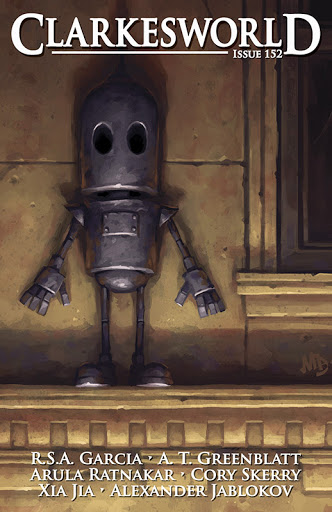
There is a wealth of science fiction writers out there who are really trying to experiment with different styles and entertain enlightening concepts. The short story ‘Tick Tock’, by Xia Jia, published in Issue #152 of Clarkesworld Magazine, first presents itself as a straight forward tale about an unnamed character who interacts and manipulates simulated ‘stories’ which he experiences through a quasi-dream state or digitized-projection of his real self. Yet the further you progress, it becomes more and more of a rabbit hole plunge that delves into the nature of virtual or ‘realised’ realities, deep-dive perceptions that ‘incept’ from dream state to deeper conscious states, and that highest form of creativity: imagination. Some of the best stories don’t just articulate living characters well or paint a vivid environment: they get you asking questions about the nature of our own reality and the structure of the universe.
The protagonist, if there is a such a thing here, is an ordinary man living a mundane life who slaves away as an ‘average worker bee’ in order to pay for the dreams he needs to escape his world: a place where “every alternate dream is a life that [he] longs for.” At one stage throughout his own isolated, active dream journeys, he awakens back to his original self and notices that his neighbour has perished: “I recognise the pod as my neighbouring pod. I don’t know the person who died, though, and I have never seen them around.” This honest and detached admittance, asserted so casually, invites deeper introspection, employing the reader to question the modern values of his world. As the character seems to explore: what value does he put on his ‘real’ life when the simulated one has overtaken it? After all in dreams he can do whatever he want.
‘Tick tock’ also explores an etheric, virtual ‘identity-palimpsest’ where one identity begets or is layered on (or within) another. At one point he wonders about creating the ‘ultimate role’ for his virtual self which will override all others. This can cause the reader to consider: who exactly is constructing his world view? Who is really orchestrating his life, inserting his dreams into his ready mind – at one level there almost seems to be an artificial echo from a voice that has programmed his worldview for him: “With dreams, who cares about life during the day, then? It doesn’t matter if your work is boring, if you’ve accomplished nothing, if you’re poor, lonely, inferior, or desperate. These troubles will soon pass.” Such a phrase could have been inspired by visualised (and fictionalised) despotic worlds such as audiences saw back in the 1920s via Fritz Lang’s expressionist drama, Metropolis, where legions of oppressed workers labour day and night just to keep the utopia of the culturati running. In this short story, we see a world where machines have long dreamed a world for humans, enslaving them in escapist desires, yet both are trapped within the constraints of what can be or is believed to have been imagined.
One of the most gripping aspects of the tale, without giving the plot away, is the idea that humans no longer dream. Artificial ‘dream creators’ construct custom realities within which their customers have full ‘sandbox’ freedom to do anything they desire. The writer, Xia Jia, is adept at twisting this into an eternal paradox: “as the creator of dreams, they never dream.” Further to this we even find the ‘average worker bee’ wondering about the avatar he created/modelled after himself and wonders if it too can dream. This introduces all kinds of exciting ideas such as ‘transhumanism’, where humans may become more like machines while the machines themselves mimic the intelligence of their inventors. Additionally, the curious introduction of a programmable and conscious AI, who is tasked with programming the ‘dream life’ of its identical, mirror self, makes you wonder: who is in control? Who watches the programmable programmers, for instance? It’s a subject often toyed around with by futurists: when we reach singularity, will AI be able to understand more about human nature than us and where will that lead global civilizations?
‘Tick Tock’ by Xia Jia
Published in issue #152 of Clarkesworld Magazine (May 2020)
Review by J.K.A. Short, July 2020