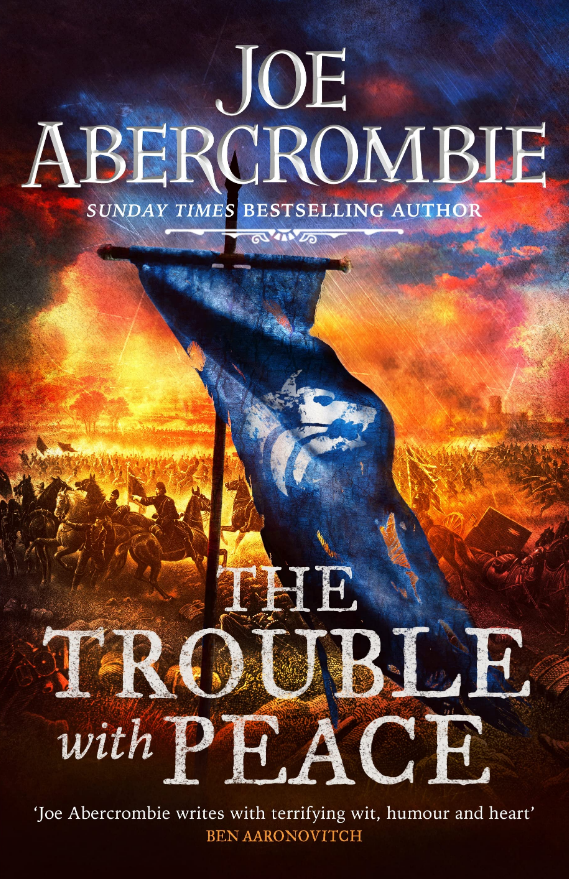
 The book begins with an ironic comment about the weight of a crown and a joke about old men’s bladders… and so we can tell that Joe’s back with his latest, the second in The Age of Madness trilogy, where many of the characters we first encountered in Joe’s original trilogy (The First Law) have given way to their descendants.
In A Little Hatred (reviewed by myself HERE and Rob Bedford HERE) we found that industrialisation had arrived in the Union. This has led to violence and revolution, as The Breakers and Burners attempt to gain control of the cities and the impoverished workforces therein. Their ex-Masters, the rich and over-privileged noblemen, struggle to deal with this sea-change, and much of the book reflects the tension between the revolutionaries and the factory owners. Recently crowned King Orso the First, now the High King of the Union, tries to negotiate a near-impossible path which satisfies both factions. … for the trouble with peace is keeping it, once you’ve got it.
“Your Majesty, we are not here to set right all the world’s wrongs…. (but) To ensure that we benefit from them.”
In addition, the disruption caused by the Burners and the Breakers allows those outside Adua, such as the Gurkish and those in Starikland, to look for weakness that they could exploit.
Savine dan Glokta, daughter of the infamous Arch Lector Sand dan Glokta, is centre stage once more. After the events of A Little Hatred, which led to a distinct fall from grace, Savine is now determined to build her reputation back up again, even if it involves her getting married to do so.
For Leo dan Brock, the Young Lion, is now Lord Governor of Angland and chafing under the responsibility of diplomacy when he’d rather be fighting. Disgruntled with the ineffectiveness of the Open Council, he would prefer to sort problems out on the battlefield, where he made his name.
In the North, Stour Nightfall, Leo’s once-rival, also begins to feel aggrieved that the many issues raised in A Little Hatred are being ignored by the monarchy and the political hierarchy now that peace is being restored.
The young girl Rikke still struggles to master the strange mystic power of the Long Eye. And over all, Bayaz, the First of the Magi and member of the Closed Council, watches from the shadows and continues his Machiavellian manipulation of events for his own interests.
Whilst this is clearly the middle book of a trilogy, Joe manages to maintain momentum throughout, and even manages to build towards the end. There is no preamble, we begin pretty much where A Little Hatred finished. From the start, there is talk of a “Great Change” coming, which is trumpeted throughout, and the last part of the book clearly has world-changing consequences for some of our characters. Whilst there are still major changes yet to happen in the next book, there’s enough going on and some wonderful revelations in this second book that keeps the pages turning.
It’s sometimes said in fiction that the best Fantasy and Science Fiction books echo reality, that their connection with basic fundamentals of life (life, death, loyalty, betrayal, for example) make them more memorable. And I found this so here.
Whilst this is not a mere retelling of the Industrial Revolution mixed in with some Les Miserables trappings – although in the hands of a lesser author it could have been – at times there’s almost a strange feeling of fiction imitating real life as the key players attempt to negotiate with each other, whilst simultaneously stabbing each other in the back. Some of the grand speeches given here reminded me very much of the rhetoric currently being expounded both here in British politics (dare I say Brexit?) and in other countries. For example:
“Just feels like there are too many brown faces around in Adua these days.”
“Too many for what? The people who come here are hard workers. They bring wealth and energy and new ideas. There are great thinkers amongst them. Great engineers. And how would you stop them, anyway? Make us less prosperous?”
In terms of the bigger picture, there are also key issues under examination. In Abercrombie’s world, how does the old sorcery cope with industrialisation, for example? Is there even a place for it in this ‘modern’ world? We begin to discover the answer here. The last third of the book gives us battle scenes as only Joe does, but this time combining many different perspectives – not just of the major characters but also from ones never heard of before – to show what’s happening amidst all the grue. This mosaic element – lots of small vignettes to create a bigger picture – worked very well for me.
What I was hoping for most – and got – was that typical Abercrombie character development, where the main characters show many facets of their nature – not all bad, but not all good either. Typically in an Abercrombie book, characters that may seem ineffective are often not and those who lead struggle behind the civic face seen by the public. As is usual, the joy of Joe’s books is that he shows people we would normally describe as heroes and villains with a much more complex nature than many writers would depict. Even the characters you want to survive and do well have their issues and problems, and vice versa. There is character evolution and plot resolution here – and not all is as expected as it might be. We say goodbye to some long-known characters here, but at the same time watch the ascendance of others – and not always in ways we like.
If you’ve read my previous reviews then it should be again obvious is that what impresses me most throughout the book are the glorious dialogue and one-liners thrown out throughout the book, not only in the epic battle scenes but also in the less bloody (but just as cutting) battles of diplomacy. To avoid civil war, our characters attempt, with varying degrees of success, to survive a subtler kind of war, and Joe does well to show that sometimes diplomacy can be just as brutal and perhaps even more ineffective than combatting it out on a battlefield.
To sum up, then. Is it gory? Yes, to the point where there were parts that made me wince. But, at the same time, that grim humour characteristic of an Abercrombie novel, that balances the gore and the unpleasantness, runs throughout in a way that seems to only really work for me in Joe’s books. Others have tried to emulate, but simply don’t match, for me at least. The first book in this new series was great. This is even better.
In short, fans will leap on this latest and I’m pleased to say in my opinion will not be disappointed. Other than having to wait for the final part, of course! Will definitely be one of my books of the year.
The Trouble With Peace by Joe Abercrombie
Published by Gollancz September 2020
ISBN: 978 0 857 82784 5
508 pages
Review by Mark Yon