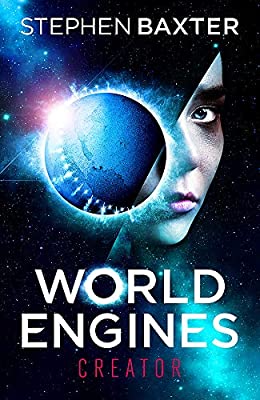
 Last year I reviewed the first book in this series, World Engines: Destroyer, with mixed results. It was interesting, unmistakably Baxter, but used Reid Malenfant, a character as its focus that I’d not really liked the first time around, in the Manifold trilogy.
The ending was a bit of a cliffhanger, too. (Warning: spoilers for the first book here, because this one doesn’t make sense unless you know what’s happened there!) In the 25th century Malenfant meets people from his past who are not from his actual past but alternative pasts.
The characters are from different times and alternative universes. From the 25th century Malenfant has brought with him Bartholomew, an AI doctor, and there’s Greggson Dierdra, the young girl who looked after Malenfant when he was revived in the 25th century. There’s also Emma Stoney, who on his Earth Malenfant was married to, although the Emma Malenfant encounters in 2469 is not ‘his’ Emma. Also from a different timeline is Nicola Mott, an alternate version of Malenfant’s co-pilot from the 1990’s.
Although much of the first book at the end is about watching how all these different people interact, an expedition to Phobos to find Emma leads to a greater discovery, that these worlds in alternate universes are, for reasons as yet unknown, being manipulated by beings that they call ‘World Engineers’. In Malenfant’s 25th century Earth is about to be destroyed by a collision with a planet they call Shiva, an event possibly engineered by the World Engineers. Malenfant and his fellow travellers move the moon Persephone into the path of Shiva to divert it and so save Earth.
Whilst in the process of doing this, Malenfant meets others at Phobos as Phobos seems to be a focal point that connects to a manifold of different worlds times and universes. Malenfant finds there a military group from the RASF (Royal Air and Space Force) from a British Empire dominated timeline, led by Wing Commander Geoff Lighthill. The British team have discovered what they call ‘chimneys’, which allow them to travel between the multitude of different universes.
(Spoilers done!)
With all of this set-up in the first book, the second book then is set the task of answering big questions – who are the World Engineers, and what is their purpose? Where have they come from and why have they set this challenge, or ones like it in the different universes?
The second book drops the reader straight into a situation. In a rather cyclical pattern, World Engines: Creator begins much as World Engines: Destroyer did – Malenfant wakes up, trying to remember what has happened.
This is a plot device to explain the events of the first book and introduce new characters. The survivors of the first book have, in an attempt to travel to the deep past and the origin point of the World Engineers, travelled to a universe where Persephone has become an Earth-like planet. When attempting to land on this Persephone II, there is an accident and some of the crew are killed. The survivors become stranded because of a heavier gravity on the planet and a badly damaged spaceship mean that a return to space seems unlikely. However, they meet Russian Irina Viktorenkova, who, in another one of those strange multiverse coincidences, seems to be the mother of a character that was in the first book, and Ham, a Neanderthal-like human who seems well adapted to the planet’s one-third heavier gravity. Working with the rest of Irina’s Russian cosmonauts from another Earth, they journey to a place where some of them are able to return to Commander Lighthill in his spaceship Harmonia, circling above the planet.
The explorers then find themselves in another similar, yet different, Solar System. Here they encounter an Earth which has expanded into their Solar System in a burst of international cooperation following an almost-nuclear war (‘The Nearly War’) in 1985. They explore Zeus, (a moon of a Saturn without rings) which seems to have all the building blocks required for aerobic and anaerobic life. Dierdra and Bartholomew travel down to the moon’s surface, where things become rather more cosmic and big revelations are revealed.
Baxter again has a lot of fun in telling of the different versions of history that the explorers have experienced. The crew of the RASF seem to have their stiff-upper-lips firmly in place exploring for the greater glory of the colonial British Empire, whilst the Russians got into space using nuclear rockets and following the beliefs of rocket scientist Konstantin Tsiolkovsky known as Cosmism. Anyone who remembers the best-selling counterfactual The Third World War by Sir John Hackett from the 1980s will recognise one of the universes (and Baxter does reference this in the Acknowledgements.) There’s also lots of little nods to science-fiction throughout as well.
But really, this is all about the big ideas. It’s in the nature of such books that the big ideas are talked through and explained by the characters as we go along. At one point on Persephone II Malenfant even manages the equivalent of a Powerpoint presentation. This didacticism is not for everyone, but such an approach means that Stephen can tackle some really big concepts – Deep Time and space, Cosmism, the nature of life itself – and make them understandable to the non-scientist, such as myself. It’s necessary, but not everyone’s cup of tea.
The flip-coin result of this though is that there’s a lot of talk in the novel, to the point where along the way there are longueurs that are too long. Whilst there’s some nice observations about different human-like species as well as some salutary lessons about interspecies communication, the time on Persephone II, which covers about two-thirds of the 500+ page book, is just too much. There were times then the trekking to a lift-off point seemed… well, endless. (Whilst I can see that that may be the point, I was reminded of the point in the movie Scott of the Antarctic (1950), where the ongoing diary reports repeat the never-ceasing trekking by the explorers.) The key point of tension that exists here to keep the pages turning, and is left dangling over our heads as a major mystery, in the end seems to be a bigger deal to some of the characters than me as a reader. (It also made me wonder why this particular issue hadn’t happened in other places in their travels.) The overall impression is that, like the first book, the pace of the plot is uneven.
The last part of the book speeds things up. Disconcertingly, after such a big build-up, the last few (short) chapters throw out big reveals in a few pages, and lead to an event that becomes almost 2001-like, which is, I’m sure the impression Stephen is trying to create. Whilst some of the decisions made at the end seem a little abrupt, the author does manage to provide some answers that will satisfy those who have managed the journey to this point, although there is clearly more to happen in the next book.
Summing up, I enjoyed this second book more than the first, but I’m not sure that the unbalanced pace set will be appreciated by every reader. In my opinion, it’s a good read, and I welcomed the way that Baxter has managed to incorporate elements from some of his other books, but you are going to need to realise that there’s a long haul here before there’s any kind of payoff if you’re going to like this one.
Recommended for Baxter fans, and those who liked the first book, but I can see that some are going to be scratching their heads at the end of this one, and wondering what the fuss is about – again.
World Engines: Creator by Stephen Baxter
Published by Gollancz, August 2020
550 pages
ISBN: 978 1 473 223226
Review by Mark Yon