I recently reviewed an (admittedly vintage) science fiction novel where we had the main characters covertly steering Mankind through history “for the greater good”, something I questioned the arrogance of. Nevertheless, after that I found that in my next read, by accident, I had a more contemporary version of that idea, that there were secret societies and god-like beings doing the same for the human race.
I had thought that I had had enough of such stories, at least for now. And yet, to my surprise, what arrived to review next was, by coincidence, another version of this idea. This time though, it is women who are doing the steering.
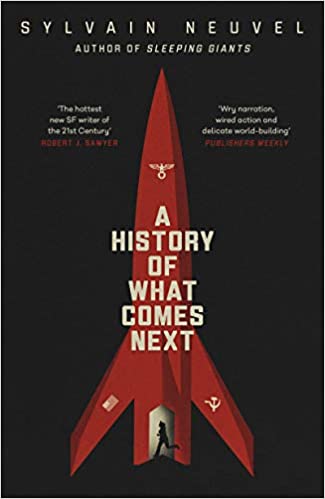
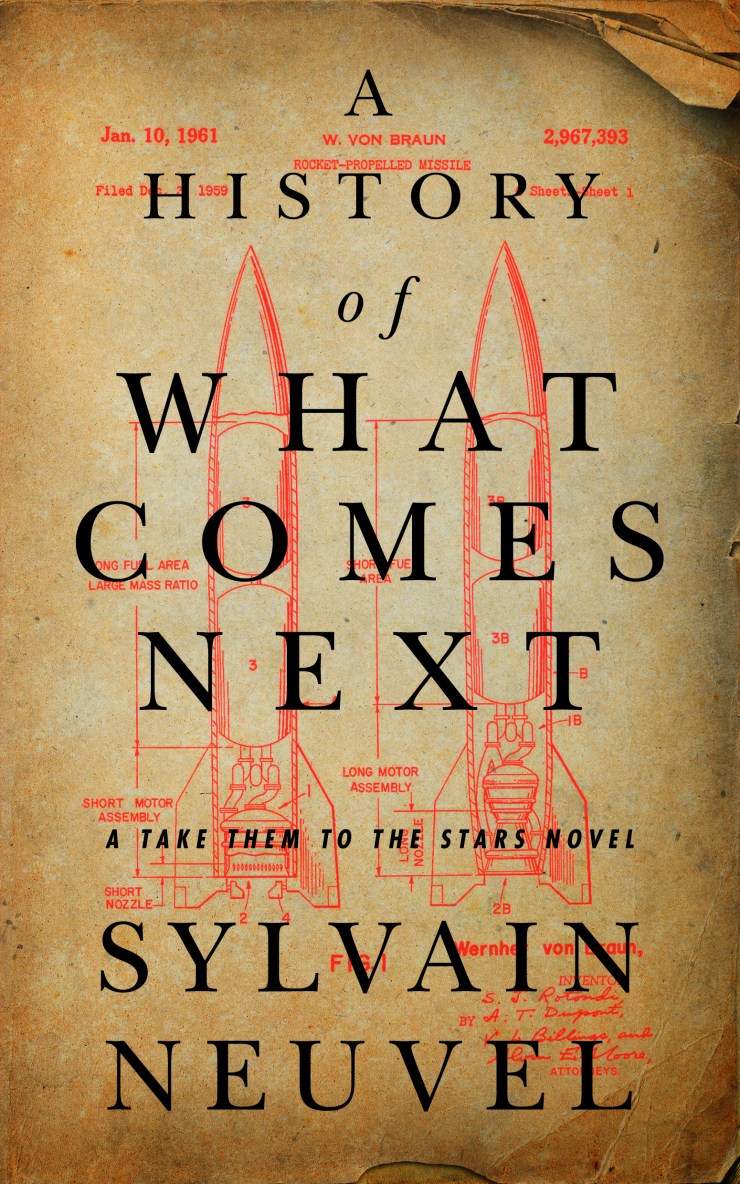
From the publisher: “Over 99 identical generations, Mia’s family has shaped human history to push them to the stars, making brutal, wrenching choices and sacrificing countless lives. Her turn comes at the dawn of the age of rocketry. Her mission: to lure Wernher Von Braun away from the Nazi party and into the American rocket program, and secure the future of the space race.
But Mia’s family is not the only group pushing the levers of history: an even more ruthless enemy lurks behind the scenes.”
OK: so ticking the “Why should I read this?” boxes in my head, this is about the 1940’s to 60’s Space Race, in an alternate history and using lesser-known aspects of the actual story to tell an entertaining story. I could suggest that A History of What Comes Next taps into the same vein of ideas as Mary Robinette Kowal’s Lady Astronaut series – an alternate Space Race story from a female perspective – although to me this is perhaps better written.
If I was to conform to the cliches then it would be easy to think that this is going to be a cute generational history story. However, it’s actually sweary and surprisingly violent and may not be for those of a sensitive disposition. I enjoyed it.
The plot is basically that there is a group of women who call themselves the Kibsu, who for reasons that will become apparent in the novel, have ensured that a blood line has been maintained for generations through the women. The book is focused on Mia and her mother Sarah, who are the 98th and 99th of this lineage, although the story begins in 1910, with the 97th, Mia’s grandmother. Each of the sixty short chapters are written from the perspective of the key characters, meaning that there’s a running internal dialogue that carries the story.
As we read, we find that what the women are doing is keeping this line going at all costs, summarised in a mantra that is passed down through the ages:
Preserve the knowledge.
Survive at all costs.
Don’t draw attention to yourself.
Don’t leave a trace.
Fear the Tracker.
Always run, never fight.
There can never be three for too long.
There are also interludes throughout the book that show how those rules have come about, ranging from 825 BC to 1945 AD. They tell of the women’s resolve to survive, often having to resort to desperate and gruesome means of ensuring their survival.
This determination to stick to the rules (and also what happens when they don’t!) means that relationships are created purely to maintain the bloodline. Husbands and male lovers are often disposed of once daughters have been born. Because only two of the bloodline appear to be viable at the same time (one as mentor, the other as trainee), grandmothers commit suicide in order to allow their daughters and granddaughters to continue the Kibsu’s work and ensuring that humans will eventually get into space.
 To complicate things, whilst all of this is happening, the women spend much of their time also running and hiding from the Tracker, who are actually a group of men (possibly clones) determined to hunt the Kibsu down, for reasons that will be revealed through the story. So far, the women have avoided being killed, although there are times when things get awfully close.
This is a great storyline. It also helps that I liked the characters, and in particular Mia. She’s bright, lively, fiercely intelligent and yet she’s not invulnerable and she makes mistakes. She reminded me of a more contemporary version of Heinlein’s Friday Jones (from Friday) whose superior skills made her a useful asset but at the same time such actions clearly cause the character emotional and mental damage. Thinking back to that vintage writer, Mia is probably the epitome of what Heinlein would see as the person to carry the plot.
Whilst the role of women and minorities are essential to this story, the point is made without it being made obvious. It is important, and ensures engagement with the novel, but it does not feel like it is the entire point of the novel. Unlike some recent books, I found A History of What Comes Next gets the point of the importance of often secret activities of women without hammering the point home, repeatedly. It is deliberately “A History” rather than “The History”, but one that is worth your time, nevertheless. It was interesting to read how the American, Russian and even Chinese governments are persuaded to compete as a result of these women’s work.
To me, the main point seems to be that regardless of sex the characters act to ensure that Mankind expands into the Solar System, rather than have the Space Race flounder in the 1970’s as it did. The reasons for this are hinted at in the plot, but I think that the pioneers from the Golden and Silver Ages of Science Fiction would be pleased with that.
This story goes up to the point just before the Mercury, Gemini and Apollo space programmes begin – I’d love to read what happens next, so the fact that the book is subtitled “Take Them to the Stars, Book One” is a great sign. I would be very happy to read more in this setting.
There’s also some interesting little touches that make this a blast. There’s a 60 track playlist available, each track being the title of one of the 60 chapters in the book dating from 1937 – 1961, and there’s a great Further Reading list at the back of the book that points out that many of the people and events in the story are based on real people and events – even the seemingly far-fetched ones! It is a lot more entertaining than you might think.
A History of What Comes Next is a novel with a brilliant premise that’s a lot of fun and was clearly a joy to write as well as read. It takes the tropes of the past and reuses them in an engagingly contemporary style story, and also shows an author with burgeoning talent. I look forward to the next book in this series.
A History of What Comes Next by Sylvain Neuvel
Published by Michael Joseph/Penguin (UK), March 2021
304 pages
ISBN: 978 0 241 44512 9
Review by Mark Yon