 I recently reviewed the first volume of this collection, admittedly a remarkably slim novel of 128 pages and a mere two stories (Gulf & Elsewhen), one of which is a novella.
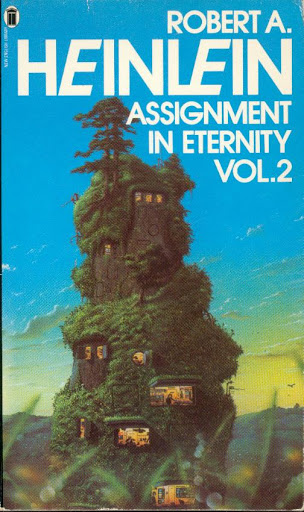
Whilst I don’t love this Tim White cover on my NEL paperback (see right) quite as much as the one on Volume 1, I enjoyed the stories in the first, so it makes sense to continue with this volume.
Like Volume 1 there are two stories here, both continuing this idea of secret societies and potential superhumans. The first story is Lost Legacy, 104 pages in length. Like Elsewhen in Volume 1, it was published in 1941, but this time under the pen-name of Lyle Munroe. It was not published by John W Campbell, Heinlein’s editor-friend and mentor, which suggests that it was a minor work Heinlein may have had trouble selling. However, as a book written in 13 chapters it is a lengthier story, written Heinlein has been quoted as saying that it was “his pet”, one of his favourite stories ever written and one of the ones that have received most fan-mail, especially from other writers.
Ben Coburn and Phil Huxley are both working at Western University. Ben is a brain surgeon. When one of Phil’s promising Psychology students who is researching ESP is in an accident, Ben has to remove part of the student’s brain cortex. Suddenly the student who could ‘see’ without using his traditional senses can no longer do so.
With Joan Freeman, they discover that they have hidden talents. Using the power of mind they seem to be able to achieve seemingly-impossible things – the ability to see without using their eyes, for example. When caught in a winter storm on Mount Shasta, they are met by Ambrose Bierce, a writer who mysteriously disappeared in 1914, who takes them to a secret lodge on the mountain*. There they are given further training which allows them to tap into a hidden power and do things like levitate.
We are also shown psychic records of a long history that involves a fight between good and evil, which they discover through dreams have led to the rise and fall of human civilisations in the past. The trio dream of the Twilight of the Gods where gods such as Odin, Mercury, Jove, Loki and Vulcan disagree over their customs. Some form a breakaway group, known as the Young Men, and decide that they want their roles to be different. Using their powers, this covert group ultimately lead to the destruction of the ancient civilisations of Mu and Atlantis, and today are ensconced into big business, witchcraft and the social and political establishment. They are determined to destroy the work of those in the Shasta lodge.
Ben, Phil and Joan, despite not completing their studies feel that they should return to real life and begin to train others in their new skills, especially Boy Scouts. (The use of Boy Scouts is interesting as they are about to have Heinlein’s so-called ‘juvenile novels’ written mainly for them.) Unsurprisingly, the Young Men and their associates try to stop them, there is a battle, but the good adepts eventually win the fight for now.
The ending is particularly imaginative. In an idea worthy of Arthur C Clarke in about thirty years time, the story ends with a near-deserted Earth as the people there have ascended to another plane of existence.
When first reading this years ago, I hadn’t realised how different this story was. This is miles away from the man of science fiction, the engineer who plotted the Space Race in his Future History. For that reason to me this one is a surprise – Heinlein at his most mystic. Whilst leavened with that scientific attitude, he still postulates that just because it can’t be explained, doesn’t make it less real whilst including all the Heinlein-esque trappings of snappy dialogue and lengthy dialogue.
Like in Gulf, in this story Heinlein gives us his ruminations on a topic popular in the 1940’s, that of hidden powers accessed by ‘supermen’ (and women!) who work for the common good. As I mentioned in the Volume 1 review, there were many others at the time covering similar ideas – A E van Vogt’s Slan for example, first serialised in 1940, took the idea of ESP and put it in a Space Opera setting – and a myriad of short stories. Many of those stories saw these psychic powers such as telekinesis and ESP as something real as well as something as a curse by those with it and a threat by those without.
Heinlein’s take is more measured, the voice of a healthy cynic exploring the concept without entirely buying into the idea. He mixes real people – Bierce, Abraham Lincoln, Julius Caesar, Mark Twain – with myth, putting them into a conspiracy theory setting that today would be snapped up by the credulous. It is the “Shaver Mystery” four years before Ray Palmer took the idea further in Amazing Magazine.
I’s also an idea that Heinlein thought was important. In his Expanded Universe (1980) story collection, Heinlein, even in the 1980’s, thought that there was something to this idea of mental powers. It is also an idea that he would use again in his Young Adult novel Time for the Stars (1956) with the twins of the novel being able to communicate through faster-than-light distances via telepathy, and even in Stranger in a Strange Land (1961), where Mike ‘groks’ and I Will Fear No Evil (1970) where two personalities inhabit the same brain and talk to each other.
For Heinlein, the idea is a boon, not a curse, and something that is for the future benefit of Mankind should humans wish to take the opportunity. By removing the restrictions on Mankind’s innate abilities, the future is full of possibilities, a very Heinlein-like thought.
The second story in the book is Jerry Was A Man. First published in 1947 as Jerry Is A Man in Thrilling Wonder Stories, it is a story that was sold under Heinlein’s name, but not in the usual places, this shorter story tells us of a future where animals can be bioengineered, thus following the theme that living creatures can become something else. Want a miniature elephant as a pet? No problem! How about a Pegasus? Well actually, no, not that one, for reasons that Heinlein explains in the story.
Most of the story is about gaining legal recognition for Jerry, a bioengineered chimpanzee who in many ways is human-like but is about to be euthanised as his eyesight has deteriorated to the point where he is no longer valuable for work.
Taken on by wealthy socialite, Mrs van Vogel, she is determined to get the courts to determine that Jerry is for all intents and purposes a man and therefore subject to the rights of humans. She succeeds.
This is odd. Interestingly, we have the appearance of Martians, perhaps like those Elders of Red Planet and Stranger in a Strange Land, who have the skills to bioengineer the animals.
The main weakness, though, is that Heinlein doesn’t seem to know what angle to take with the wealthy van Vogels. The wife seems to have more money than sense until the court verdict is announced. Mr van Vogel is happy to throw money at anything his wife wishes. Heinlein initially seems to mock the couple’s egregious spending, yet in the end uses their wealth to be able to take the Breeding Ranches to court. Indeed, it seems unlikely that without the couple’s vast resource of wealth the case would not have got to court at all. This seems a bit of a mixed message, though the story reads well enough overall.
Like Volume 1, this second volume of Assignment in Eternity was a book worth finishing. They give a different side to Heinlein’s writing and show that his skills were as apparent in Fantasy as much as they were in SF. It is as good as Volume 1 and would be a nice collection if the two volumes were combined – which later editions were, of course. As examples of early Heinlein, the two here, as indeed the four stories in the whole collection, are pretty good and even now they show many of the touches of a writer who was streets ahead of most of his competition.
*On publication, editor Frederik Pohl titled the story “Lost Legion”, the reason for which seemed unusual to biographer William H Patterson Jr. To me the title is reminiscent of James Hilton’s popular book and consequent film Lost Horizon (book 1933, film 1937), which involves a party who find themselves lost in the Himalayas and are taken to the city of Shangri-La where they discover the residents have special powers. Coincidental?
Assignment in Eternity Volume 2 by Robert A Heinlein
This edition published by New English Library 1978
Originally published as a collection in 1953 by Fantasy Press
Stories originally published 1949 and 1947.
142 pages
ISBN: 0 450 03759 2
Review by Mark Yon