 It’s a bit of a paradox in itself, but to me time travel stories seem to be timeless.
There’s something about them that seems to continuously appeal: perhaps it is the chance to relive events already taken place, to repeat things that were mistakes and try again, or to see how further on in time we can extrapolate into the future. It’s easy to blame HG Wells ‘The Time Machine’ (1895) of course, but stories of time travel exist before Herbert George’s arrived. I’ve even had Dickens’ A Christmas Carol (1843) described as one!
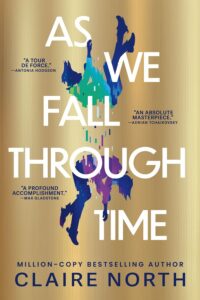
With all of this in mind, I have noticed recently a proliferation of new time travel stories at the moment. For example, I’ve already reviewed “Time to Burn” by Ellery Lloyd this year. Their debut uses the idea of time travel in a murder mystery story more related to crime readers than science fiction readers. Time travel, once just the province of science fiction, now seems to have crossed into mainstream fiction. The idea is now so commonplace in general fiction, so natural, that authors and readers seem to be able to use the trappings of science fiction without it causing too much of a stir. Claire North, of course, has covered similar ideas, in The First Fifteen Lives of Harry August (2014), with its multiple-reincarnated titular character, to great success. In her latest, As We Fall Through Time, she goes all-out science-fictional.
As We Fall Through Time is a story that takes on the idea of what it could be like for a person to be able to time travel, shows us the potential consequences of time travelling, and then combines it with a murder mystery. It reaches into the past as well as into the future, where the actions of the present have determined our troublesome lifestyle.
The book centres on Cal, a man who, as we later discover through his backstory, begins to time-travel from 1607. The reason for Cal’s ability is unclear – it just happens when Cal enters adulthood – although it may be hereditary. This timey-wimey element also shows us that Cal can change sex, from male to female and vice versa, which I felt was a little convenient, although it allows Cal to show societal changes through time. Such convenience may be a step too far for some readers.
Nevertheless, the main plot begins in the 19th century, when Cal meets Olivier, a soldier from the French Revolution. Falling in love with him, Cal changes events so that Olivier does not die in Napoleon’s Battle of Borodino in 1812, but lives to continue a relationship with Cal instead.
This creates a minor time paradox, not a new idea, but used well here. Cal, and others like him, can generally reduce or stop the paradox by using amarantines, objects that close the rift and return things to stability. However, this only really works for small paradoxes.
Generally major events, such as assassinating Hitler or changing world events, are near impossible to change by one time-traveller alone, and can cause the destruction of events in the past, as well as possibly in the future. Similarly, meeting yourself in the past, present or future is a major no-no, as doing so ultimately causes rifts in space-time so big that it would destroy what has been or will be.
With practice, time travel becomes easy for people like Cal. There are no limits in terms of how often or how far you can go, although the traveller needs to touch something that exists ‘now’ as well as ‘then’ – a wall, a floor, a temple – to travel. Some travel into the future is also potentially possible, although it is much harder to do so. This is a novel where you could begin the morning in 18th century France, be in 20th century Paris for lunch and spend the evening meeting friends in the 22nd century, for example, and North shows us how much fun this can be.
Much of this is cleverly anchored by adding brief mentions of recognisable objects and events to the science-fiction-y stuff to make it seem real – having a Coke in a city restaurant, a hot dog in the US, and so on – in other words, it felt as if a time-travelling person was travelling through time.
The book is firmly focused (in the main) on its characters, and particularly Cal. Anyone looking for detailed explanations of what happens and why may be disappointed – this is not that sort of book – the focus is on Cal and those who are part of his life.
With this in mind, it should not surprise you then that most of the first part of the book is about the relationship between Cal & Olivier, However, having ushered in the main characters to the story, the plot then becomes a murder mystery when Cal is asked by Fadimatu, another time-traveller friend, to discover the reason why a body – her body – is in a museum in 2018. Fadimatu does not know how she died, who killed her or even where (the body has been moved to the museum), but would like to find out, even though she cannot find out herself.
To complicate matters further, when a huge paradox occurs in 2207, one of the effects is that the timeline where Oliver lives disappears. Understandably with what has gone before this point, Cal also then spends much of his time searching for a way to bring back his lover, even though he has now never existed.
The solution may be to close the 2207 rift, so to do so Cal needs to find out when it happened and why. The task is made more difficult by the appearance of what they call ‘ghosts’ – lost souls who drift in time, hungry to attach and feed, vampire-like, on people such as Cal.
As you can see, Claire’s ambitious plot has lots of plates spinning at the same time. Time is spent on developing the characters, which pays off at the end. As a result of this, Cal’s obsession with finding Olivier seems less extreme and more rational that it might have done.
The time travel element is very well done, although it does become quite complex towards the end, when you try to follow multiple versions of the same characters all trying to avoid themselves elsewhere in time. There were moments when I found it quite difficult to follow exactly who, where, and when I was reading about, and what has happened to them previously.
Summing up, As We Fall Through Time is a story that uses science fictional tropes to tell a character-centred adventure story with a romantic theme. It is one of the better time-travel stories I’ve read of late, and I was pleased that the time travel aspect of the story was an integral part of the plot and in its conclusion, even when it didn’t always work for me.
© 2026 Mark Yon
Hardback | Orbit
AS WE FALL THROUGH TIME by Claire North
October 2026 | 416 pages
ISBN: 978 035 6526 249