 “I have always been drawn to the weird, the strange and the supernatural in fiction. That is certainly my natural territory.”
– Lisa Tuttle, in an interview with Angela Slatter as quoted in Monster, She Wrote by Lisa Kroger and Melanie Anderson
Lisa Tuttle first appeared on the s.f. scene in the early 1970s, winning the John W. Campbell Jr. Award for Best New Writer in 1974 (the award shared with Spider Robinson). This makes her the contemporary of George Alec Effinger, Alan Brennert, Suzy McKee Charnas and the relatively unknown, George R. R. Martin, with whom she co-wrote the novel, Windhaven. It also makes her contemporary with Stephen King, Ramsey Campbell, and Anne Rice. Of those three, Tuttle probably comes closest to writing like Campbell as time after time she produces clearly written depictions of event after inexorable event leading her character to the brink, and sometimes over it.
Date of publication for the stories mostly range from 1990 to 2017, except for “Where the Stones Grow” from 1980, an original story for the landmark anthology, Dark Forces, edited by Kirby McCauley and heralding the arrival of a new generation of horror writers (including the first publication of Stephen King’s “The Mist”) while also honoring earlier generations. Tuttle was only one of two women represented in the anthology, the other being Joyce Carol Oates. The story itself, as Tuttle says in her introduction to it, is curiously old fashioned, and would not be out of place in a collection of ghost stories. It is also very effective as such.
Besides “Where the Stones Grow,” not surprisingly this collection has the feel of a more mature writer than the earlier A Nest of Nightmares. Here Tuttle shows she has grasped her subject matter and is now twisting it this way and that, viewing it from different perspectives. She examines a variety of plights of women: abduction (“Closet Dreams”), miscarriage (“Born Dead”), stalking (“The Book that Finds You,” an excellent homage to Robert Aickman’s strange stories) and menstruation (“A Birthday”). That latter is also an example of Tuttle’s exploration of body horror; “Food Man,” “Vegetable Love” and “My Pathology,” all revolve around the potential or the limitations of a woman’s body, and “My Pathology” is arguably the collection’s most potent story, through the trope of the mad scientist and his assistant exploring obsessive love.
There is not a bad story in this collection and along with A Nest of Nightmares (reviewed HERE) offered some of the best reading I’ve enjoyed in the last year. All in all, Tuttle has had a long but comparatively low-key career to date. The appearance of these collections argues for a re-evaluation of her work and a re-assessment of her place among her contemporaries.
Interested readers may want to note that Tuttle produced three novels that sit within the horror genre: Familiar Spirit (also available from Valancourt), Gabriel and The Pillow Friend (reissued by Bantam Spectra in 2006).
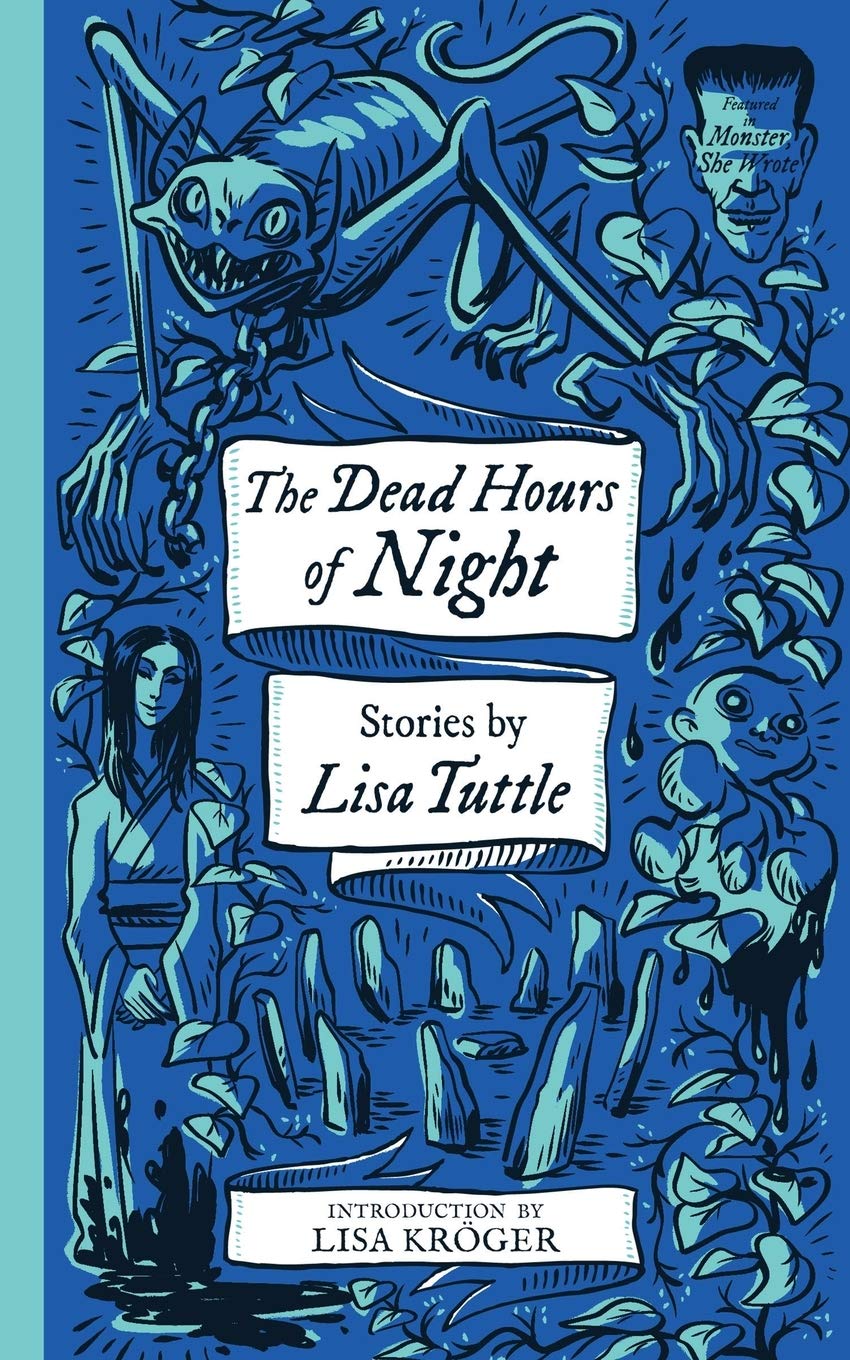
THE DEAD HOURS OF NIGHT by Lisa Tuttle (2021; Valancourt Books)
236 pages
ISBN: 978-1948405829
Review by Randy Money