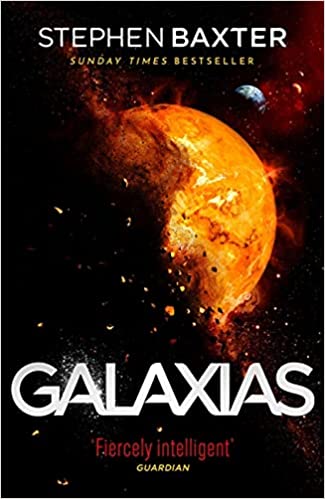
 I’m a big fan of Stephen Baxter’s stories. They do come in different types, though.
It’s difficult to pin down exactly what I like. Is it that sometimes they’re far future epics covering thousands of years (see the Xeelee series). Or is it that he brings epic disasters down to the human scale – Flood/Ark, Moonseed (reviewed here.) Is it his take on alternative history – Voyage, Anti-Ice, the Weaver series, for example? Or is it that he takes on the big science ideas – exoplanets (Proxima/Ultima), evolution (Evolution, Mammoth), and quantum universes (the Manifold series) and adapts them to tell tales?
As I read more and more I am beginning to think that it is perhaps his style – that British sensibility, that idea of playing things down, diffused with a British sense of deprecating humour. Like Arthur C Clarke before him, he often sees things with an observer’s eye, describing world changing events through individuals, and makes wry commentary upon it, whilst at the same time believing that in the end good will out.
After his last books dealt with moving planets (see the World Engines series) this time around we’re on similar epic ground. And we start with a great idea to grab your attention – what would happen in the near future if not planets, but the Sun disappeared?
The first part of this book shows us this through three friends who are in very different occupations. Tash Brand is a British Government advisor, working for Minister for Science Fred Bowles. Mel Kapur is an astronomer floating around the globe on the airship Skythrust Two (fans of the 1960’s television series Thunderbirds may recognise this!), working for the Astronomer Royal, Charlie Marlowe. Whu Zhi is a gifted scientist onboard the Lodestone space station, whose husband Jim Boyd is an astronaut returning back from a manned mission to Mars. Much of the book therefore is about watching these social, economic and global changes through our lead characters.
The book begins in 2057 when the Sun suddenly disappears, with no warning or preamble. As you might expect, there is chaos and confusion as a result. Luckily, things return to something-like-normal after a day, but the whole world and even the Solar system are physically affected. The Moon shifts, satellites and spaceships lose their way and planets alter their orbits with no effect from the Sun on them.
There are social and economic consequences too in a world that has already changed from what we know. It is quite chilling to see current themes as a backdrop to this event and how they might reappear in the future – COVID outbreaks, mass migration and climate change, for example. In Britain, as with much of the world, flooding is common – the British government is located to Newcastle from an engulfed London, for example. Much of the book is focussed on Tash, but this also brings in the impact of the unprecedented event on her friends as they all struggle to make sense of what has happened.
The event becomes known as “The Blink” and because the Sun has returned does not seem to have been a natural occurrence. The source of the Blink is named Galaxias, to which a message seems to have been sent from the Moon as the Blink happened, something which raises the bigger questions – who/what was it that caused this to happen? Who/what was the message sent to? Will the Blink happen again?
I’ve said before that Stephen writes like Arthur C Clarke, something I hope he sees as a compliment. You know – lots of big ideas, a rather down-played British sensibility, and even wry humour. Whilst the characters are often identifiable, they are usually at the mercy of the cool concepts and brilliant ideas. Much of that is true and holds up here too. However, the big difference here is that I think that where Clarke would see alien contact as an opportunity, a chance for uplift, here Stephen looks at a slightly different view – what if Earth has just been noticed by something out there? And what if it is not friendly?
In the middle of the novel the book’s solution to this first meeting of alien intelligence is more proactive – space entrepreneur Serena Jones sets up a mission to go and see what’s out there. Some think that this might be just drawing further attention to the planet, others that we have been set a challenge that aliens are expecting us to rise to, and international conflict occurs as a result, again something which Tash and her friends are witness to.
The world begins a new Space Race, with the Western World developing the Pioneer 4 to go out and possibly meet the alien and the Chinese doing their own thing. The situation is complicated by the fact that Whu Zhi’s mother is working for the Chinese government whilst Whu Zhi himself is part of Serena Jones’s team. The impact of this on these friends is noticeable. Their relationships change as a result of these interplanetary events and throughout there is an uncertainty that we do not know which is the best approach.
But what is most important is that the books posits a belief in Science to work out solutions and answers. It is Science that helps us develop solutions to cope with a new reality. Even the politicians seem to be trying to do their best for their people rather than just themselves, and their ability to listen and take on board the scientist’s advice is pleasantly refreshing, throwing into sharp contrast the events of recent years.
As we get to the end of the story, the science shows us solutions to the origin, source and purpose of Galaxia are revealed. It is here that Baxter shows us the grandiose nature of his tale by suggesting BIG ideas set over millions of years. I must admit that at this point they sounded a little bit out-there to me, but as ever the Afterword shows that they are based on solid research and scientific proposals. I must say though that Stephen cannot be accused of thinking small here.
And that is for me the attraction of such a story. Stephen juxtaposes these big interplanetary events with the concerns of a relatively small group of people. Such a dramatic range shows us as readers the extrapolation of these ideas that might otherwise be too big to contemplate and how they can affect people like you or me. It also works by showing us the future consequences of human actions, whether it be climate change, population growth or space travel.
In summary then, this combination of big ideas and small-scale effects in a possible future landscape is a winning one. Combining the world-disaster elements of books like Moonseed with the cosmic ideas of the Xeelee series, Galaxias shows us that epic Science Fiction still casts a dramatic spell over us and that Stephen can tell an exciting tale on an ambitious scale through the eyes of individuals. I enjoyed it enormously and feel that this is one of Stephen’s better novels of late.
Galaxias by Stephen Baxter
Published October 2021 by Gollancz
544 pages
ISBN: 978-1473228856
Review by Mark Yon