 Stamford led me to the chemistry laboratories. It was deserted except for a man hunched over a lab bench in the back of the room. As we came in, he straightened up, and my first, puzzled thought was, Why is he wearing an overcoat in here? But then, as he turned toward us, the overcoat flexed around him, spreading slightly before pulling back in, and I realized that it wasn’t an overcoat at all, but a pair of coal -black wings, crow’s wings, and the man wasn’t a man, but an angel.
— Dr. J. H. Doyle’s first meeting with the angel known as Crow
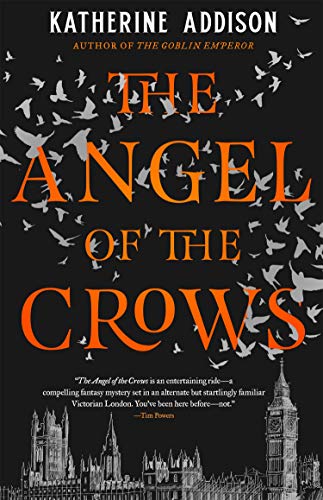
In The Angel of the Crows Katherine Addison reshuffles several of Sir Arthur Conan Doyle’s stories of Sherlock Holmes and Dr. Watson and deals them into a Victorian England, specifically London, rife with angels, vampires, werewolves, hell hounds, and other less savory characters, some of them human.
In an author’s note, Addison (a.k.a. Sarah Monette) states that the novel started as “wingfic,” fan fiction in which popular characters are re-imagined with wings, for the TV series Sherlock which starred Benedict Cumberbatch and Martin Freeman. Her Holmes is an angel named Crow, who shares at least one quality with Cumberbatch’s Holmes, a lack of understanding – or a disregard – of the niceties of human interactions (Crow, at least, shows some perplexity and seems interested in understanding); he is, though, rather mellower than the Cumberbatch Holmes. Addison’s Watson is Dr. J. H. Doyle, whose personality feels much closer to Freeman’s prickly Watson than to that of, say, Nigel Bruce.
Crow makes a rather likable version of Holmes, and in some ways an ideal version, affable but not entirely at home in the human world, puzzled by some emotional reactions, concerned for ethical reactions. Espousing rational thought and the gathering of evidence, yet he is seen by peer angels as dangerous if not Fallen, because he is not tied to one particular location but has found a way to remain mobile and pursue the passion for solving crime that grounds him in the human world. Doyle is a solitary figure, who holds two secrets close, shutting out all others until meeting Crow. And the advent of Dr. Doyle into Crow’s life gives the latter a sounding board, someone who doesn’t mind his eccentricities and who is almost painfully aware of the conventions, filling in those areas of human experience Crow isn’t familiar with and which color the motivations behind crime, understanding that ties Doyle to the solving of Crow’s cases.
Among the stories retold are “Silver Blaze,” A Study in Scarlet (see the quote above) and The Hound of the Baskervilles, their results not necessarily changed, but the path to resolution reworked. This makes the novel episodic, each story expanding the reader’s view of Addison’s supernatural England, so that by the end of the book a sense of the hierarchy of angels, the precariousness of their existence and the place of other supernatural beings is well-established, while also leading to Crow and Dr. Doyle investigating two of the most notorious real-life serial killers in London’s history.
I am impressed with how Addison disassembles the familiar tales then reassembles them, merging hansom cabs and gas lighting with telling details of hellhounds and angels and so building another nineteenth century London. There is a risk of tedium for the reader in reworking such well-known and well-loved stories quite so close to their originals, and if she is not entirely successful in avoiding that according to some on-line reviews, I still found this an engaging and entertaining book, slyer in its approach to world-building than some commenters seem to appreciate, and more complex because it also examines both the gender conventions of the Victorians and the possible limitations of the deductive reasoning prized by Sherlock Holmes.
THE ANGEL OF THE CROWS by Katherine Addison
Published by TOR, June 2020
ISBN: 978-0765387394
440 pages
Review by Randy Money