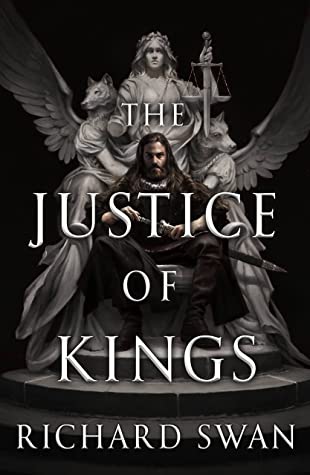
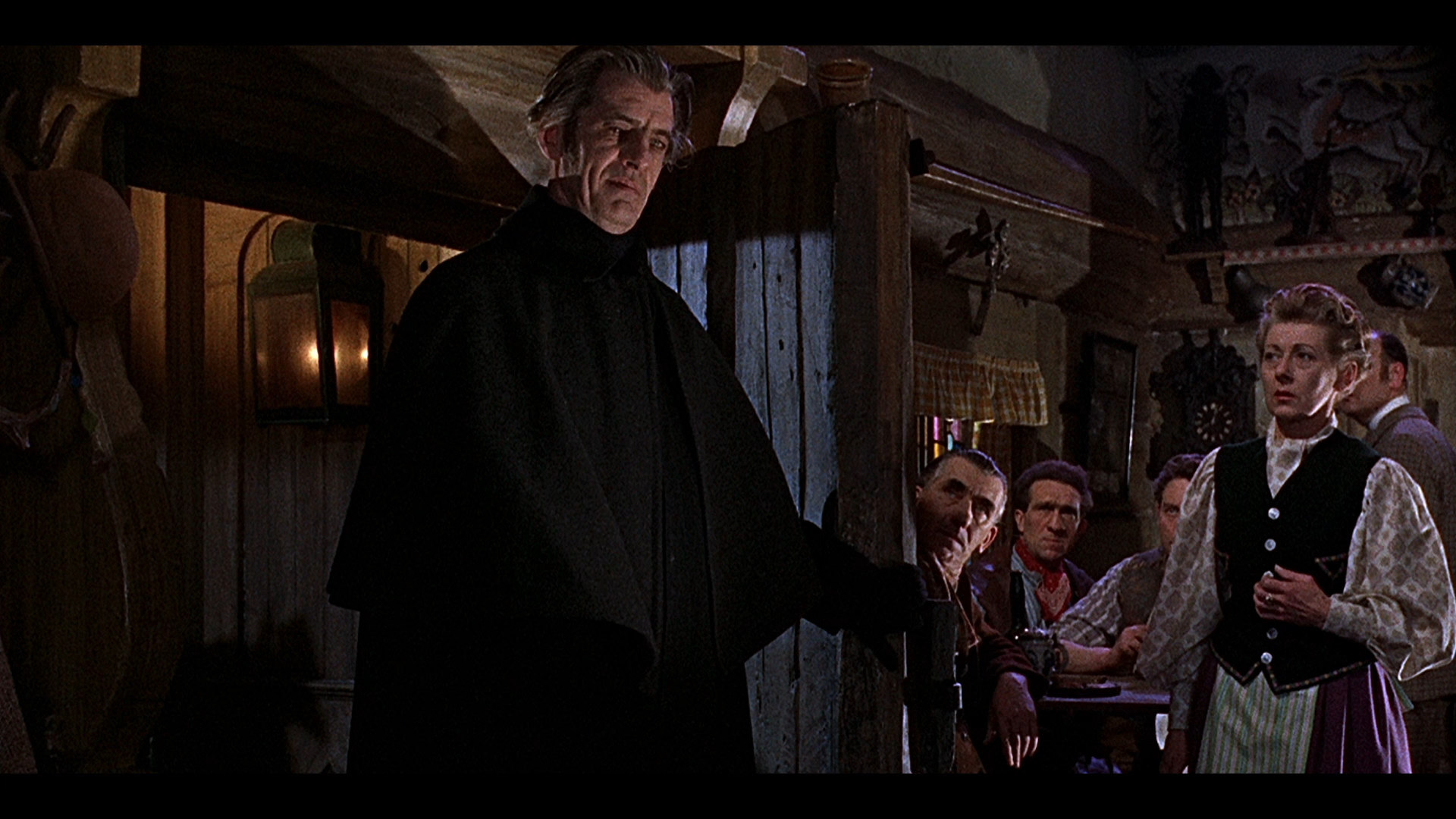
 I am of a certain age to remember the old 1960’s and 70s Hammer Horror movies with some fondness. For some people reading that sentence, just reading that will bring back memories of Peter Cushing and Christopher Lee, duelling it out as Van Helsing and Dracula, amongst other roles.
The reason I’m mentioning it here is because this book partly reminds me of those films.
You see, quite often in the early part of the film there would be a scene in a bar or tavern, in a small German/Austrian/Transylvanian village in Renaissance times, well away from the bustle of the urban metropolises.
The reason for mentioning this is that at times The Justice of Kings feels like it is in a similar setting.
“No Man is Above the Law”
You see, there’s a Justice, named Sir Konrad Vonvalt, whose job is like a Witchfinder General, travelling the country and administering justice in the name of the Emperor and the Sovan Empire. As with any Justice, Vonvalt’s word in the past has been law, with few who question his judgement.
No trusty wielder of justice works on his/her own, of course, and so alongside Sir Konrad we have Dubine Bressinger, Vonvalt’s taskman and a stalwart soldier, the iron arm of the law, if you like, there to ensure the word of Vonvalt is followed. Although Vonvalt is an expert swordsman himself, we quickly discover that there are times when two swords are better than one.
However the story is told from the perspective of Helena Sedanka, a young teenager that Vonvolt has picked up and who acts as his clerk, scribe and accountant (for in these times Vonvalt has to make sure that his expenses are covered) as well as his moral compass.
Their travels lead them to the village of Rill, where Lady Natalija Bauer has been killed, in what may have been murder. Sir Konrad and his group, as arbiters of justice, are brought in to resolve the matter.
One thing that Vonvalt has that Cushing and Lee did not have are some arcane magickal skills – namely The Emperor’s Voice, which compels the user to do as the user commands and, rather more creepier, the ability to resurrect and speak to the dead for a limited time. The magic in this book is used sparingly, but when it appears it is wonderfully disturbing.
This investigation leads to the middle part of the book, which is a trial, for times are changing and the word of a Justice has to be presented in court rather than metered out with a sword.* The narrative becomes a tense situation as Vonvalt has to cross-examine three men that we know from the beginning of the book are guilty in front of a jury. , Luckily, Vonvalt shows himself not only to be a dab hand with a sword but someone with linguistic skills as well, and his opening speech is a tour de force of engaging story.
“The Magistratum is very clear: the law is to be applied equally to all persons within the borders of the Empire – and any person who, outside the Empire, nevertheless submits, voluntarily to its jurisdiction.”
It is at this point that we get to the overarching theme of the novel, which is that things are changing in the Empire of the Wolf. We are experiencing a changing of the old order, now over fifty years old, into something new, and the transition, from small beginnings, is not simple nor easy. Vonvalt is one of the old-guard, who struggles to realise and then cope with the fact that things are changing.
The group also discover that there are plans to usurp the Emperor, and that their murder may only be a small part of a bigger puzzle.
This may be enough to engage your interest. However, what is key to this novel is that whilst all of this Sherlock Holmes-style intrigue is occurring, The Justice of Kings is most of all about character. Much of the book is about how these events alter our band of heroes and their associates. Most memorably and perhaps expectedly much of this falls upon Vonvalt. Whilst he is a complex character, determined to uphold the law and generally regarded as fair and honourable, the events in the book clearly affect him.
Helena herself is in many ways a teenager trying to be an adult, as the narrative, written when Helena is older, wryly observes. She is restless in her assistant role, aware of the privileges being with Vonvalt brings her but clearly chafing at being a clerk. She wants to spread her wings whilst simultaneously is plagued by self-doubt about her abilities.
The relationship between Vonvalt and Helena is an interesting one, in that she sees him as a hero, a father-figure who has taken her in, looked after her, educated her and who clearly loves her, although not in a physical way. She is good at what she does, and Vonvalt clearly sees her becoming a Justice one day and does his best to supplement her clerical skills with other abilities towards that end. Helena’s elevated position, whilst not luxurious, also shows us that the prominence of women in this world is limited, although Vonvalt’s colleague, Justice August, shows us that it is not entirely a man’s world.
Bressinger is also complex. An able swordsman who has fought with Vonvalt in the past, he is by turns garrulous and taciturn. It is clear that he is loyal to Vonvalt and protective of Helena but has a complicated past.
Although the focus of the novel is on these characters, the setting they travel through is appropriately grim and dirty. The world is quite decrepit and dilapidated.
The peoples there generally eke a poor and simple existence on the whole and Richard does well to show this. Decapitations, hangings, amputations and immolation are all part of the grim world of the Soran Empire.
It is also a world where the Justice’s powers are sorely stretched. This results in some messy fight scenes, and moments of violence that would not be out of place in the grand guignol horror setting of a Joe Abercrombie novel, or even a Hammer Horror film.
To sum up, The Justice of Kings is an impressive debut novel. Part detective novel, part action-narrative, it is a tale of loyalty and changing circumstances combined with a degree of intrigue. With some memorable personalities and events, the narrative slowly envelops the reader, leading to a dynamic ending with some intriguing elements to pursue in later books.
* Something which may be based on Richard’s other occupation before becoming a writer.
The Justice of Kings by Richard Swan
Published by Orbit, February 2022
ISBN: 978 035 651 6424
414 pages
Review by Mark Yon