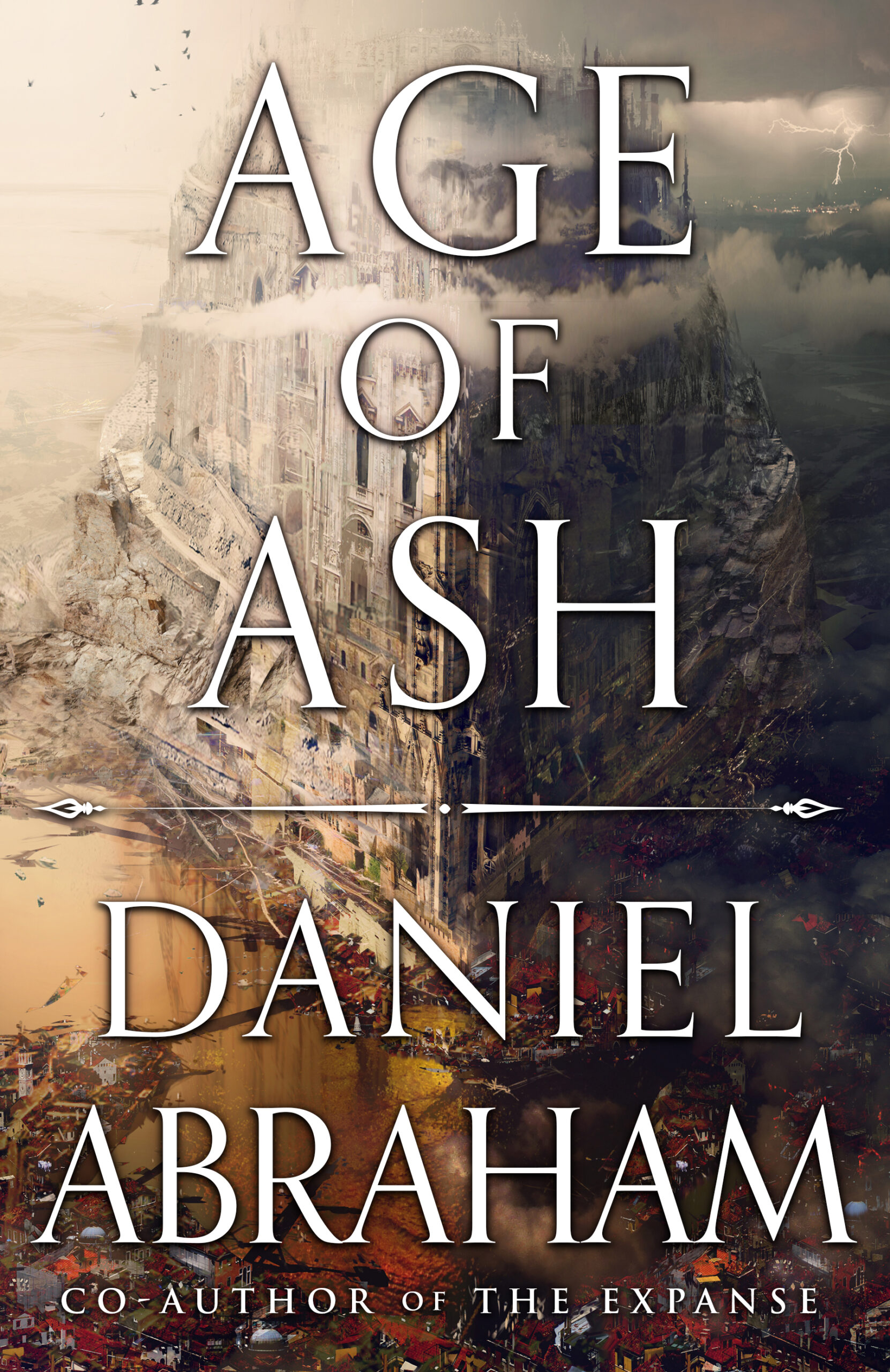
 It seems a long time ago now that both Rob Bedford and I were first singing the praises of Daniel Abraham*. Although he has more recently been known as James S. A. Corey, one of the co-writers of the Expanse novels, turned into a very successful television series, we first noticed him with his fantasy novels – The Long Price Quartet and the Dagger and the Coin series.
It is therefore with pleasure that I turned to the first in a new Fantasy series, Age of Ash.
From the Publisher: “Kithamar is a centre of trade and wealth, an ancient city with a long, bloody history where countless thousands live and their stories unfold. This is Alys’s.
When her brother is murdered, a petty thief from the slums of Longhill sets out to discover who killed him and why. But the more she discovers about him, the more she learns about herself, and the truths she finds are more dangerous than knives.
Swept up in an intrigue as deep as the roots of Kithamar, where the secrets of the lowest born can sometimes topple thrones, the story Alys chooses will have the power to change everything.”
Whilst it can be said that we’re travelling along well-trodden paths here, there’s a lot to like. This is a low-grade fantasy novel on the whole. What I mean by that is that it is a story of petty theft and poverty in the main, rather than a story that deals more uplifting qualities such as honour and valour. Although the book begins with a royal funeral, the book goes back to an earlier time to show how we get to that point and focuses more on life on the streets.
Throughout we get the idea that Kithamar is a big city (and the maps at the front suggest this too, admittedly.) Clearly there is much to describe and much going on in this sprawling urban area, but Daniel keeps the focus tight by mainly concentrating on Alys. When Alys’s older brother Darro is killed, which may have been Alys’s fault, she goes on a hunt determined to find the cause and the killer. This leads to her becoming a gangster-like adversary on the streets of Kithamar. With her friend Sammish, Alys searches the streets looking for answers.
However, Darro’s death may be only one death amongst others in a power struggle, involving the cousin of the recently-enthroned Byrn a Sal. Arcane practices mean that this struggle seems to involve a silver knife which Darro had.
In terms of the bigger picture, what Alys has got herself involved in by accident is a clandestine war between opposing political factions that in turn are associating with certain gods and goddesses. An attempt to usurp the prince and create a change in power may be being covertly nurtured.
Where does this one score?
The setting is impressively vivid and the descriptions of the city, when they are given, provide an impressive image of life in Kithamar. Daniel is quite unremitting in his descriptions of the city of Kithamar as it changes through the year, so much so that the setting is almost a character in itself as we see things change from Autumn to Winter and then Spring. Admittedly, for all of the beauty created by the change in the seasons (and the weather!) much of the book shows us that Kithamar is not usually very pleasant – most of the colourful descriptions of the city concentrate most on the depravation and squalor than the baroque lifestyle of the rich and famous.
Where Daniel scores as per usual is his characterisation, and this is perhaps the book’s strength. The characterisation can be nuanced and pretty complex. In particular, Alys and her friend Sammish show clearly what it is like to struggle, and what the harsh lifestyle of living in poverty has done to many of Kithamar’s people. Alys finds that in order to discover what happened to Darro she has to become like he was, with a brutal gangster-like presence. This, of course, contrasts with the opulence of the wealthier groups, although brutal yet covert assassination is still part of the political game.
On the downside, I felt that less strongly written was the role of those involved in the political side of the novel. Whilst such imperial shenanigans are clearly an important part of the plot, and I suspect something that will become more important in later novels, it is not until the last part of the book that those elements are explained, and even then they feel less strong than those scenes in the grubby end of the city.
I also felt that the pace of the story was variable. Whilst there is undeniably progression through the story to the quite exciting (yet a cliff-hanger) conclusion, I must say that there were points in the middle where not a lot seemed to be happening and the pace became slower, to the point where I began to lose interest a little. There are points where we get exposition dumped into the plot, in that James-Bond-villain kind of way. This lower key progression of plot is pretty much through the whole book. If you come looking for big epic battles, you will be disappointed. This is not that sort of Fantasy novel.
But I quibble. There’s a lot to like here, for all my issues, and it must be said that Age of Ash is different to Abraham’s other Fantasy series. Age of Ash is a very good example of those fantasies focused on the unpleasantness behind the gleaming facades of a sprawling city. Whilst it may not be quite as violent or as unpleasant as, say, Joe Abercrombie’s books, the overriding impression at the end is that Kithamar, and the people within it, is a complex tapestry of life – even if it is not a place you want to hang around too long in. I suspect that we may have much more to discover in future books.
*It’s actually about 15 years!
Age of Ash by Daniel Abraham
Published by Orbit, March 2022
ISBN: 978-035 6515 427
448 pages