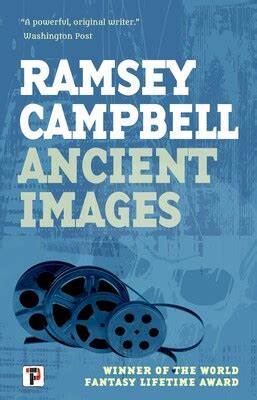
 I think that Ramsey Campbell is one of our genre authors who should be better known. Although you might not recognise the name, he’s a World Fantasy Award winner, an editor, anthologist, reviewer and critic. Quietly constructing his own Horror stories for over 40 years, Ramsey has honed his craft to become a master of producing stories that create unease – as well as the odd Grand Guignol tale as well! There’s M. R. James-ian ghost stories, Lovecraft homages, Clive Barker-like bloodbaths and pretty much everything in-between.
With well over 50 books published, rather like Stephen King, it can be difficult to know where to start. However, this one’s not a bad one in my opinion.
Sandy Allen is a film editor, whose friend Graham Nolan has, at last, unearthed a copy of the long-lost black and white movie named Tower of Fear starring Bela Lugosi and Boris Karloff. Accepting an offer for a personal viewing, Sandy finds Graham apparently committing suicide and the film missing.
Sandy, with her friend and co-colleague Toby, are determined to find the film and the reason for Graham’s death, which they believe was not suicide.
As they follow a trail attempted to meet people involved in the production of the film for clues, mysterious events suggest that there is more to the film than they realised. There’s the suicide, of course, but also the odd circumstances and death of one of the film’s comedic double-acts, not to mention the people who suddenly refuse to answer their phones or respond to enquiries. Many believe that the film is cursed and refuse to even talk about it.
The search is not easy. Nevertheless, the rest of the book deals with Sandy’s findings which lead to an idyllic Lincolnshire village named Redfield whose landowner family is connected to the film and its suppression.
Following my brief description of Ramsey’s work above, anyone expecting a slash-horror story here will be sadly mistaken. Instead, I found Ancient Images to be a slow burner, one that began with a hook and then built up the tension until the end. There are icky moments, admittedly, but they are far outweighed by the descriptions of the seemingly ordinary British way of life, whilst in the shadows things lurk. As good as Ramsey is at describing bucolic ‘Britishness’, it is always an undertone where someone’s watching you, that something is not quite right. This is emphasised in the village of Redfield where Archers type rurality turns into Wicker-Man-like events.
This is further emphasised by experiences happening that at times seem dreamlike and unreal, experienced by Sandy in particular. Are they nightmares created by tension and stress, or are these something else, even something real? Ramsey’s prose often creates this sense of vagueness and ambiguity, but then adds some contrasting, even startling, descriptions along the way to jolt you back to what is the everyday.
It’s not entirely perfect, although I enjoyed it a great deal. Most of the characters are fairly simple and relatively undeveloped. I must admit that talk of using typewriters, having change to use in a phone box and the need to go out and do physical research did throw me a little at first. (The book’s a reissue, first published 1989 – no Google, internet or mobile phones here!**)
The chapter where Sandy meets a group of film buffs who write a fanzine named Gorehound and spend their time with degraded bootleg VHS tape copies for their entertainment also aged this, but could equally apply today – I’m reminded of the ongoing search for Dr. Who episodes, for example. Despite the feeling that today Social Media and Google would make much of this book redundant, much of the book feels quaintly historical and yet still relevant over 30 years on.
Occasionally there’s a feeling that there’s an odd coincidence too many, or that things all interconnect too conveniently, but generally the flow of the plot and the tension created by the need to solve the mystery keep things moving along nicely.
Lastly, I must admit that a welcome addition to this edition is the afterword written by Ramsey in 2011, in which he gives us some context. Ramsey tells us that the book is partly inspired by classic cinema and reminds us that the book was written at a time when “video nasties” were reviled by the British media. It is (rather like Ramsey himself!) thoughtful, self-depreciating and gently critical.
In short then, Ancient Images is a novel that is ‘of a time’, an impressively quick and deceptively effortless read, that draws you in and kept me reading. It’s not a bad place to start the Campbell experience.
Ancient Images by Ramsey Campbell
Published by Flame Tree Press, February 2023. Reissue. First published 1989.
304 pages
ISBN: 9781787587649
Review by Mark Yon
* Ring by Koji Suzuki was actually published two years after Ancient Images.
**And just to put that in perspective – also published in 1989: Midnight by Dean Koontz, The Dark Half by Stephen King, Guards! Guards! by Terry Pratchett and Hyperion by Dan Simmons.