If you have been reading genre fiction for a while, you may notice certain patterns and trends appear and reappear. There was the phase, for example, where it seemed like every Fantasy book cover had a hooded figure on its cover, or every SF novel had a Hugo Awards style spaceship or a Chris Foss book cover. The latest I’ve noticed is for the trend of turning well-known characters around, so that figures once seen as villains are now heroes and vice versa. The other is a blending and a multiplication of sexes, either with gender-swapping or by them just being multisexual. It is not unusual for main characters once seen as strongly heterosexual to be gay, lesbian, bisexual and so on.
All well and good, some cry. Fiction should rearrange things and test ideas as well as reflect the wide variety of diverse sexes, cultures and races out there. It is perhaps a sign of the times that such broad varieties are accepted and seen as less unusual, or less shocking, than they used to.
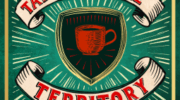
Which brings me to Perilous Times, a contemporary take on the Arthurian legend. At first, I thought that this book was going to be a humorous story of characters out of time and out of their depth. The cover made me think that it was going to be rather Monty Python-like. I was mistaken. (How often do we say to not judge a book by its cover?)
From the publisher: “Sir Kay and his fellow knights awake from their mythical slumber whenever Britain has need of them; they fought at Agincourt and at the Somme. But in these perilous modern times, the realm is more divided than ever, a dragon has been seen for the first time in centuries, and Kay is not the only ancient and terrible thing to come crawling up out of the ground . . .”
Here the old legend of King Arthur has been brought up to date with a near-future setting, where Britain is in decline and wracked by social upheaval, political unrest and environmental destruction combined with climate change. Beer costs twenty-four pounds and ninety a pint. There are refugee camps, flooded landscapes, cities run by gangs and under mercenary rule, religious cults roaming the land, an abdicated King and a government nowhere to be seen, hidden away in secret committee meetings. Things are indeed perilous.
This modern version also shows the relationships of the characters as more contemporary. Interestingly, it is Kay, the brother of Arthur, that we are most meant to feel for in this version of the story. By comparison Arthur is portrayed as a megalomaniac who has let power go to his head and allowed atrocities to happen in his name. This is exacerbated by him struggling to come to terms which some elements of a changed Albion. Lancelot is bisexual and returns, pining not for the loss of Gwenhwyfar, Arthur’s wife, but Galehaut, who he still thinks of dearly. Merlin is a deranged academic who can see across multiple universes and who spends his time experimenting and trying to guide the knights along the best possible future, whatever that is.
The book also poses some interesting contextual problems. What if our heroes are not who we expect them to be? What would knights from the realm of King Arthur make of missiles, for example? Machine guns? Climate change? Lee cleverly deals with this by pointing out that some of the knights have appeared in more recent times, fighting in World War I and II, as well as in Malaya and other places. If the knights are killed, they go back to start again, in a sort of reset that reminded me of Tom Cruise in Edge of Tomorrow. As a result, their knowledge of weaponry, flying machines and improvements in communications are not that far from the present.
There are times where this can feel a little unreal. Having ancient icons talking of social media and using words like shagging can feel a little odd, and will not be to everyone’s tastes, but it worked for me within the setting Lee has created for his characters.
Much of the main plot deals with the relationship between the knights and the changing landscape, made worse by climate change. On his rebirth, Kay manages to connect with Mariam and a group of women who are environmental terrorists, determined to destroy the corporate businesses destroying our planet for the sake of profit. He agrees with them that the planet – or Britain, at least – needs to be restored to the state of its previous health if it is to survive.
There is some humour, it must be said – Kay killing a deer for food in the mistaken belief that it will feed his group, only to find that they are vegetarian is just one example – but when the lighter elements do happen, they are more Pratchett than Python.
Overall though, Perilous Times feels surprisingly dark, more than I thought it would. Like in Pratchett’s novels there are times when the main feeling in the novel is anger at the injustice that rages across the pages. There is a constant questioning of how things have got to this state, socially, economically and environmentally.
In the end, though, the themes of love and friendship remain, and the value of service, duty and loyalty still hold firm. I liked the fact that despite the dark nature of the plot at times, Perilous Times in the end still has an element of hope – not to mention dragons (with an interesting origin story as to their nature.) Goodness can prevail, people can and do care.
I was surprised at how much Lee manages to combine elements of the old legend into his version. There are a lot of links to the original Arthurian tale should you wish to look for them. They are not essential, but I enjoyed connecting the dots when they appeared.
Summing up then, Perilous Times is a queerly reimagined version of the Arthurian legend updated to today that warns us about future times, raises a mirror to life in our near-future and questions what makes us important. It is a book that takes something that might know of and does something different with it, and for that reason it may be worth your time.
PERILOUS TIMES by Thomas D. Lee
Published by Orbit, May 2023
544 pages
ISBN: 978 035 6518 527
Review by Mark Yon