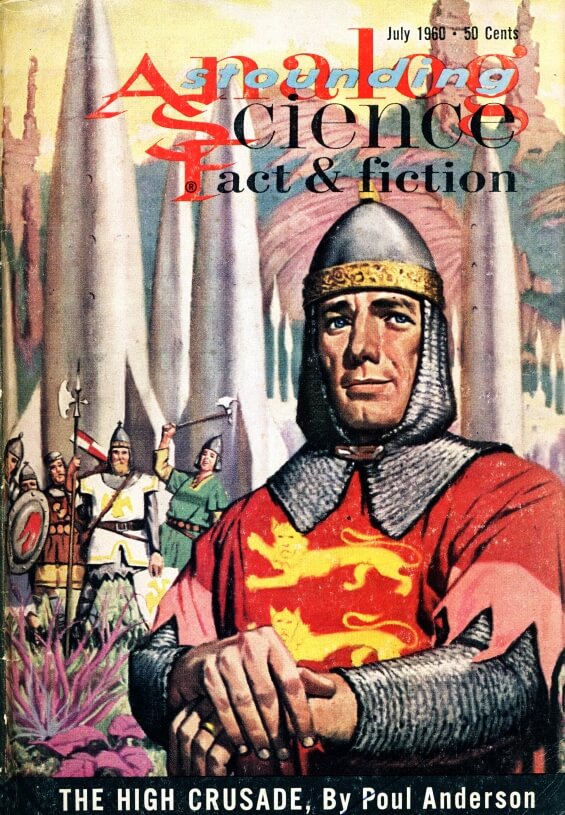
Welcome, my friends, and read about a classic, a tale that deals with those ancient tropes where ‘old’ meets ‘new’. The High Crusade is a story that combines science fiction with history, something that the author Poul Anderson (1926 – 2001) was known to be an enormous fan of. This fairly short novel, first published in 1960, tells of Anglo Saxons in the 14th century meeting an alien race in Lincolnshire and the consequences of this event.
The story is centred upon Roger de Tournville, but is told by Brother Parvis, his religious adviser.
In 1345 Roger was gathering an army to help King Edward III in France and while assembling his army in Lincolnshire an alien spaceship from the Wersgor arrives. Initially this causes a degree of panic amongst the English, except for Sir Roger, who gets his soldiers to attack the spaceship. He rushes through the spaceship, killing all of the participants, except for one, named Branithar.
Roger and his army take their captured spaceship and using Branithar as pilot, travel into space. We discover that the ship was merely a expeditionary scout ship for the Wersgorix Empire. Their captive alien flies the spaceship to the planet of Tharixan, the home base of the expedition. Despite the ship crashing there (the new occupants are not that used to the technology at this point), Roger manages to persuade the group leaders on Tharixian that his army on the scout ship is merely part of a much mightier army from Earth, and with skilful negotiation and a certain degree of bravado Roger manages to take over the three bases on the planet. The aliens generally do not know what to make of Sir Roger, nor of the tactics and weapons he uses, and so despite their superior weaponry they are fairly quickly subdued.
The last part of the book has Sir Roger managing to travel to the Wersgorixan home planet, creating alien allies along the way and then negotiating with the Empire. Some of his troop, including Roger’s wife, Lady Catherine, become unhappy with this as they feel that Sir Roger has lost his way and instead of trying to find their way back to Earth he’s now more content with being part of a galactic group. The story does end though with the army returning back to the Earth, although many of them, including Sir Roger, stay in space to continue their galactic responsibilities.
So – what makes this story successful? Well, The High Crusade is a bit of a romp. Things are never examined in too much detail or with too much seriousness, and certainly never at the expense of a good story or fast pacing. The death of some of Roger’s men and a good few aliens are not really considered to be an important part of the story, and yes, the Anglo Saxons manage to learn how to use alien weapons and learn the alien language rather quickly, but this allows Poul to get on with the story. To be fair, these plot issues are partly explained in the story – the weapons, for example, are designed simply enough for children to use, so the Anglo Saxons work them out pretty fast – but even then the explanations feel a little too hurried or perhaps convenient. Generally, though, the charm of the story seems to cover over the implausibilities.
Having said that, this is a book that is fairly short, although admittedly longer than its original serial coverage. As most books of its time, this is a novel in less than 200 pages. Given more space, I am sure the author would make this less of an issue.
Much of the enjoyment comes from the telling of the tale by Brother Parvis as a single person narrative. Although there are parts that are serious, The High Crusade generally has the feeling of wry humour about it, even though the single perspective limits the plot at times. (How can Parvis be everywhere and see everything?) Anderson gets around this by having Parvis freely admit that parts of the story that have had to be improvised by Brother Parvis for the sake of story-telling narrative. It’s a point not worth dwelling on too much, although it helps that Brother Parvis is an affable storyteller with a certain degree of charm, intelligence and wit.
Whether it is Parvis’s possibly-biased perspective or a genuine trait (I tend to think the latter, personally) Roger is a likeable leader with intelligence and an ability to charm not to mention that essential trait of being able to make decisions and think on his feet, sometimes with amusing results.
As the story develops, the tone is such that the reader wants the army to do well. Although it’s not perfect, I can see why this tale of humans overcoming aliens would have been popular with John W. Campbell, editor of Astounding Magazine at the time. At its core it is a tale of human adaptability and ingenuity overcoming technological superiority, a very common Astounding/Analog theme.
To add to this, there’s a nice smattering of mediaeval-esque language and terminology throughout, which gives it an Anglo-Saxon feel and a realistic texture. This is where Poul clearly shows his own knowledge, as a major member of the Society for Creative Anachronism in his lifetime, where clearly such details from the past are well known and understood.
Less successful for me in the story is the Arthurian love triangle between Lady Catherine, Roger’s wife, and Sir Owain Montbelle, a young pretender clearly after ‘moral support’ from Catherine. Lady Catherine is easily swayed by this charming young man, whilst Roger is otherwise engaged with other things. Whilst its nod to the story of Guinevere, Arthur and Lancelot is noticeable, that part of the plot did feel a little unnecessary.
Generally, though, The High Crusade is a “What-if?” story told with a fair degree of knowledge of Anglo-Saxon terms, given an entertaining but not too deep and meaningful spin and having a generally feel-good tone. Even now, it makes a quick but entertaining read, with enough charm to cover over the inconsistences. The High Crusade was nominated for a Hugo Award in 1960.
THE HIGH CRUSADE by Poul Anderson
First published July – September 1960 in Astounding Magazine
Hardback published by Doubleday, November 1960
192 pages
Review by Mark Yon