 Randy’s latest review is of a relatively unknown classic author, recently reprinted and appropriate for Halloween!
The shadows crawled like crippled rats around us.
From “The Silver Coffin”
In the essay “The Outsider – And No Others” (included in this volume) Robert Barbour Johnson states that on first reading the first Weird Tales magazine, he was hooked; and when H. P. Lovecraft’s work appeared, he had met his guiding light, at least for the weird tale. Once smitten, he was determined to be published in its pages and succeeded: Six of the nine stories in this book originally appeared in that magazine.
Probably the obvious should be stated: These stories are of their time. Some attitudes displayed are often less than admirable, but nothing here is quite as rancid as Lovecraft’s racism in his worst stories. Taken in their context, I enjoyed all of these stories, but as with most story collections, some were better than others:
“The Cancer Devil” – from the pages of Dime Detective, Robert Remington investigates the mysterious deaths of two recovering cancer patients, and a nurse in Hoff’s Cancer Clinic. Readers familiar with pulp detective stories or fans of 1930’s horror movies like Dr. X or The Mystery of the Wax Museum would find this good fun.
“Lead Soldiers” – overtly political in a way the other stories aren’t, imagine Providence dealing with Mussolini.
“They” – short, concise story in which an old man warns a hiker about the danger in the canyon after dark.
“Mice” – a man is invited to a former classmate’s mansion for a night, with dire consequences. A reworking of H. P. Lovecraft’s “The Rats in the Walls”; though not as effective, still an interesting effort somewhat marred by Johnson’s attempt at heightened language. He was wise enough, though, not to directly imitate Lovecraft.
“The Silver Coffin” – effective little story told by a family retainer to an unnamed narrator concerning a curse on his employer’s family, and the outré job his father and he himself have performed for them. Atmospheric.
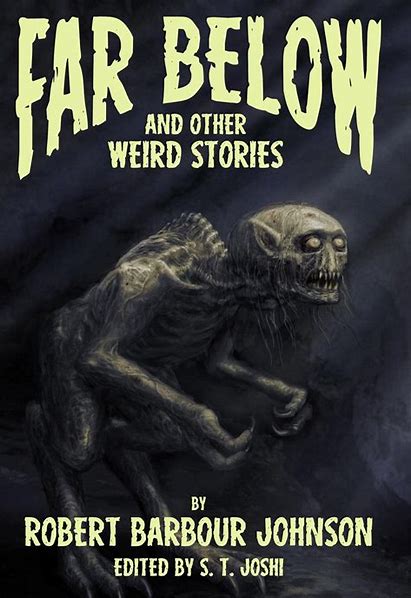
“Far Below” – a far more successful Lovecraftian tale, at one time voted by the Weird Tales readers as the best short story to appear in the magazine. Johnson takes an allusion in “Pickman’s Model” about the Boston subway and gives it a transfer to New York City as the head of a special unit guarding a stretch of subway tunnels tells the unnamed narrator why there’s a special unit. Johnson was stronger at dialog than Lovecraft, and the conversational nature of this heightens the suspense. This remains an effective tale.
“Lupa” – a detective explains to a doctor the train of reasoning he uses to identify a misshapen body in a boarding house room, and his conjectures about the vanished young woman who had lived there.
“The Strange Case of Monica Lilith” – for three years Mrs. Lilith has visited the posh, lake-side resort with her pet. No one has ever seen the pet, but they saw her carry its case in. When Mrs. Lilith unexpectedly dies, her pet gets loose and creates havoc. Originally published in 1954 in Mystic Magazine. The underlying humor makes this reads a little like a Robert Bloch story.
“The Life-After-Death of Thaddeus Warde” – Thaddeus, mild and non-descript, is still annoyed enough when he dies that he comes back for revenge. As with “… Monica Lilith,” there’s a tall-tale facetiousness to this unlike the WT stories.
The difference between “The Cancer Devil,” “…Monica Lilith,” “… Thaddeus Wade” and the Weird Tales stories shows that from early on Johnson tailored his writing to the publication, adopting a more sober tone for his Weird Tales efforts. It’s also notable that his WT stories often use one character telling the story to another. While that might make the stories sound static or uninvolving, Johnson has the knack of giving each teller enough character and drawing out the reveal of details in a manner to keep the reader reading.
Besides the stories, the collection includes an introduction by S. T. Joshi offering a concise summary of Johnson’s career, discussing the stories briefly, stating his pleasure that the stories are finally under one cover, and then he gets out of the way. There are also three of Johnson’s essays, the one mentioned earlier, “Can We Live Without ‘Fantasy’ Ficton?” and “Charles Fort and a Man Named Thayer.” Besides a few interesting things to say about fantasy fiction of the time, my main take away is that Johnson rather liked the sound of his own voice. But his fiction is disciplined, which makes this interesting, enjoyable reading for pulp horror fans.
FAR BELOW AND OTHER WEIRD TALES by Robert Barbour Johnson
(2021; Weird House)