 … [He watched] where the water spilled into the cement curb that formed a pool under the spout. He washed his hands, bits of earth breaking apart and filtering to the bottom. Gradually a mosaic of glassy fragments formed his own image in the shallow depth. He watched it shimmer, draw together like the pieces of a puzzle, yet not quite, never quite, forming an undistorted reflection.
From The Other
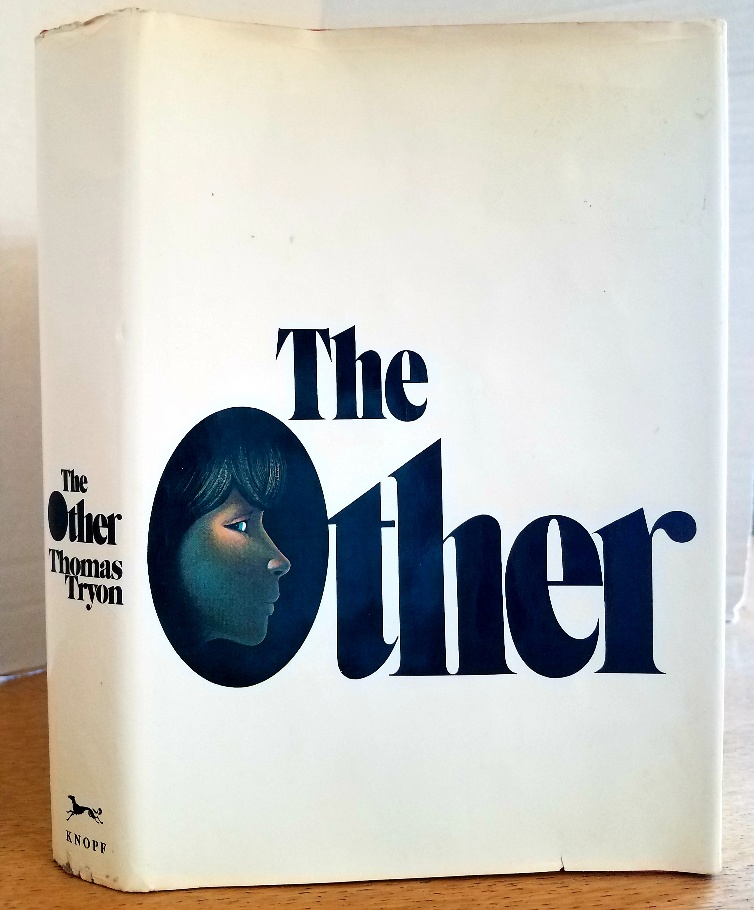
The emergence of horror as a viable commercial genre in the 1970s and 1980s is usually attributed to the success of three novels: Rosemary’s Baby by Ira Levin (1967), The Exorcist by William Peter Blatty (1971), and The Other by Thomas Tryon (released the same month as The Exorcist). The first two, besides having memorable titles, were greatly enhanced by their film adaptations, both movies considered exemplars of the type, and classics in their own right. The Other, in spite of six months on the best-seller lists and critical acclaim, didn’t fare as well when adapted for film, and maybe that’s why it has been out of print more often. And that’s a shame. This isn’t just a good horror novel, it’s a good novel.
The Other opens with an unnamed narrator reminiscing about a long past summer, the summer the Perry’s faced several sorrows as one disaster after another whittles away at them. From there, Tryon shifts to that summer, focusing much of his story through the perspective of Niles Perry and his grandmother, Ada. Besides Ada and Niles, the Perry farm is home to Niles’ twin brother, Holland, their mother, Alexandria, adopted sister Torrie and her husband Rider, and Uncle George and Aunt Vee and their son Russell.
Niles and Holland’s father has died recently from injuries sustained while working on the Perry farm. As a consequence, Alexandra has retreated into her room and into bottles of rye, while Ada is left to run the household. Ada has a special attachment to Niles. She taught both boys the “Game,” an exercise in focusing on something – an object, another person – and describing what that sees and feels and how it acts, essentially becoming one with the object. Niles is especially adept at this, at one point becoming so enmeshed in being one of the family chickens it takes awhile to bring him out of it.
Niles is outgoing and friendly, kindly disposed toward his family, and helpful around the house. Holland is the moon to Niles’ sun, a darker mood, more of a loner; Holland and Niles seem almost able to read each other’s mind, but Holland is the dominant twin, prone to pranks, and not concerned if they inconvenience or even hurt someone – he was behind the death of Ada’s beloved cat. Niles meanwhile either covers for him or argues in his defense. But when true harm comes to family members, there appears a battle between darkness and light and as the family suffers one loss after another, who is responsible?
To say much more about the plot would dilute the effect of The Other. Tryon wrote with a firm, flexible style, at times almost like Ray Bradbury, with the ability to conjure the time period (1930s) and the sense of place; even in retrospect his writing seems more assured than you would expect from a first-time novelist. He was one of the few former actors I’m aware of able to transition to full-time writer and, rare among bestsellers, this novel is as engrossing now as when I first read it in the 1970s.
THE OTHER by Thomas Tryon (1971; Alfred A. Knopf)
ISBN: 978 039 4467 443
272 pages
Review by Randy Money