 Although author John Connolly is perhaps best known for his Charlie Parker detective novels (currently 21 books and counting), but over the past twenty years or so he has also been quietly producing creepy short stories as a sideline. His collections Nocturnes (2004) and Night Music (2015) have highlighted this element of his work. His latest collection continues this tradition, although it is a book of two halves.
Unlike the previous collections, Night and Day is not completely fiction. The first half of the book is made up of nine short stories, very much in the style of those previous collections, six of which are new to this collection. The latter half of the book is a non-fiction piece about the 1972 horror movie Horror Express, starring the legendary Peter Cushing and (Sir) Christopher Lee, extended from the first edition by small press publisher PS Publishing in 2018. So: fiction and non-fiction, opposites – like night and day!
From the publisher: “Night & Day takes us from the dusty shelves of an uncanny library filled with fictional characters to a bunker deep beneath the earth where scientists seek revenge on old Nazis, from an English marsh haunted by a mother and her son to a country house where a grieving widower finds comfort in a most unlikely source.
Concluding with the author’s account of how an obscure horror film brought him closer to his lost father, and how nostalgia can help through our hardest times, this is a collection that will move, entertain, and keep you reading late into the night.”
The first story encountered is The Caxton Private Lending Library and Book Depository, a quirky fantasy tale imaging what could happen if characters of Chaucer’s the Canterbury Tale were brought to life. The lending library is a great literary idea, as a place that where the living breathing characters of literary invention are under the guardianship of a curious caretaker. Another story later in the book extends this premise further.
The second, And All the Graves of all the Ghosts is a ghost story that gives us ‘a Presence’ in a house, with chilling results. Next, The Evenings With Evans is an unusual story of grief and loss told in the first-person, a story that chills in its matter-of-factness. Taking an abrupt left-turn into something completely different, Abelman’s Line is a story about time travellers who hunt Nazi war criminals, which combines real events with horrific results. A surprisingly good sf adventure story.
With The Mire at Fox Tor, we’re back into more expected material, straight out of the classic ghost story oeuvre, which made me think a little of M R. James or perhaps more E. F. Benson, as does The Flaw, which feels like a variant of M R James’ The Mezzotint. The Bear is an allegorical tale depicting divorce and a loss of innocence. Lastly, in this part of the book, Our Friend Carlton is a blackly humorous Hitchcock-ian story about a corpse that keeps returning to his killers. A good way to finish this part of the book.
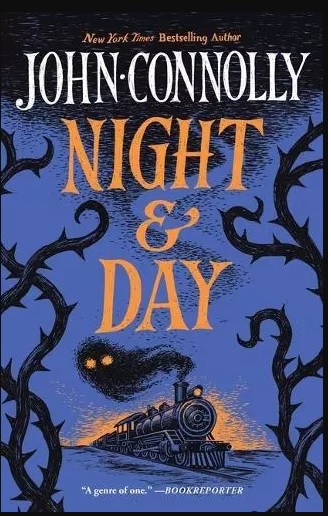
As already mentioned, the remainder of Night and Day is a monograph originally written for PS Publishing, although revised and updated. (The brilliantly vivid cover of a train also evokes the movie.)
Horror Express may be a fairly unknown movie these days, although those interested can find it available as a Bluray disc and on Youtube. You might wonder why such a relatively obscure movie has been chosen by Connolly to write about, and you may perhaps wonder whether this is worth reading without knowledge of the film. But fear not, readers! Connolly points out with some emphasis that you do not need to know the movie to follow his meandering commentary. He also points out that he thinks it is a good but not great film.
Really, the essay is more than just a film review. His analysis uses a deceptively engaging style to create a conversation about the movie. There are details that you might expect, Connelly giving an effective synopsis of the film’s plot, biographical details of its lead actors (Peter Cushing, Christopher Lee and Telly Savalas), the film’s director and producer, and the complexities of the film’s production. As well as this, Connolly uses the movie to examine topics as diverse as Russian gulags, train travel in Australia, European film directors, the Hollywood purge of Communists in the 1950’s, and the growth of Hammer films in Britain and abroad.
From a wider viewpoint, the article is also about the importance and relevance of nostalgia. There is much thought given to the idea and influence of nostalgia – for as Connolly is at pains to point out, it is not just the movie Horror Express that is under scrutiny here, but more to do with the warm memories of it and the circumstances in which it is seen.
Ultimately Connolly discusses the influence a film – really, any film – can have upon its viewer, as well as giving an insight into the significance of this particular film to Connolly, as it allowed him to engage with his rather distant and difficult father.
In summary, Night and Day can be seen as a miscellany of ‘odds and sods’, as we used to say, in terms of its variety and content. This means that it runs the risk of also becoming a bit of a curate’s egg for some readers, but personally I found this eclecticism both impressive and engaging, as a book you can dip into as you wish. Beyond the variety of the content, the quality of the material remains strong. I think that the book is worth reading just for the fiction alone, but it may be the non-fiction article, with its biographical details and personal asides, that is more lastingly memorable.
NIGHT AND DAY by John Connolly
Published by Hodder and Stoughton, October 2024
ISBN: 978 139 9739 269
368 pages
Review by Mark Yon