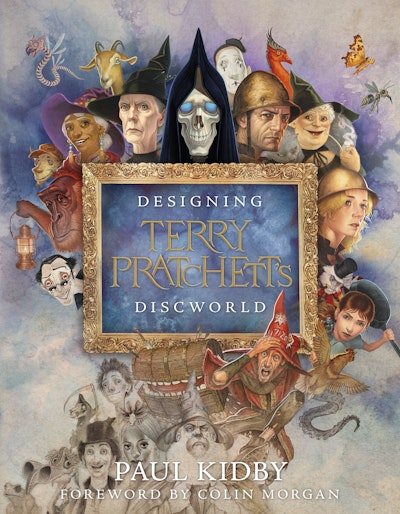
 It used to be a regular thing – as the end of the year came around, there would be in the shops another Terry Pratchett novel, just in time to be bought for Christmas by and for devoted fans.
Since the author’s passing in 2015 (nearly 10 years ago now!), obviously the supply of new material to buy has dwindled, although the Pratchett estate have managed to come up with something each year – last year we got a collection of Terry’s published short fiction (A Stroke of the Pen) and in 2022 Rob Wilkins’s official biography (the award winning A Life With Footnotes) kept the interest in Discworld going and the fans happy. This year the offering is an account by the artist chosen by Terry to work in his books, calendars, diaries and other ephemera since 1993, Paul Kidby.
Although this is a little smaller in height than many art books (including The Art of Discworld and Imaginarium) this is an impressive, glossily produced book printed in colour throughout on heavy stock.
In the book’s introduction, Paul explains how he managed to go from being an enthusiastic boy to a professional artist. There was a career before Discworld, and the book briefly shows us some of Paul’s work for Future Publishing (I liked his pictures ofJudge Dredd and from the DC World!) as well as the cartoon design for UK fruit juice drink Um Bongo, which many will remember.
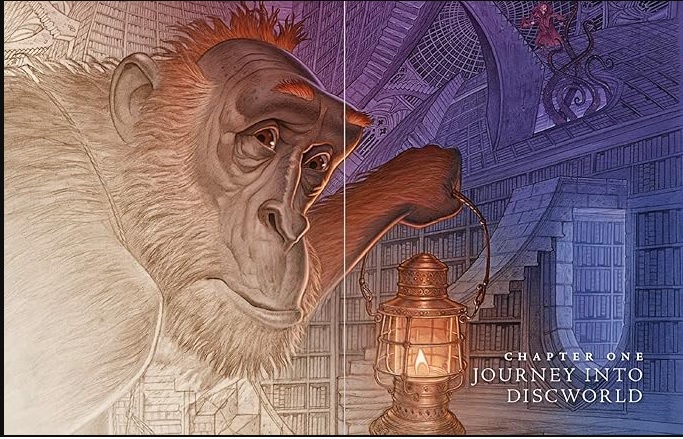
But it is his work for Terry that we are here for. Unlike The Art of Discworld and Imaginarium, which really focus on presenting the art, here we have a narrative written by Paul on how Terry & Paul worked together. The general tone is light and positive, and there are some lovely handwritten asides along the way. In his introduction Paul writes that (Pratchett) “…was an encouraging and enthusiastic collaborator.” with a handwritten comment underneath, “…as long as I got things ‘right’!”
As the book progresses, it becomes clear that the production of the artwork was a result of a partnership – whilst Terry was the undisputed creator, Paul was the artistic force, taking the people, places and man-eating luggage from Terry’s ever-fertile imagination right into our world.
The artwork was important to Terry as well as Paul, and clearly the result of lengthy discussions and notes made, draft sketches and many rejected versions before settling on the final version. this also gives the artwork a uniformity that many fans appreciate and endorsed by the author himself.
Most of the book is divided into chapters that depict many of Terry’s favourite characters: wizards such as Rincewind, witches, Sam Vimes and the City Watch, Death (and Binky!), Tiffany Aching and Moist von Lipwig, amongst others.We have draft sketches, mock-ups and drafts of images of people, creatures and places that fans will appreciate. It’s the equivalent of being shown around an artist’s workshop at the work in progress.
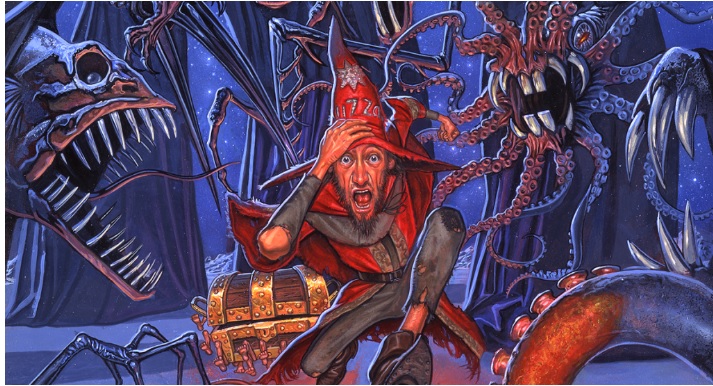
Rincewind the wizard
More than that, the book shows us how involved the process of producing artwork for books is. In these days of ‘quicky-art’, where covers often appear to be made up in Photoshop in about 10 minutes, I was impressed at how often things had to be drawn and redrawn with minor changes. The book also reflects the wider changes in book cover art – from physical to digital, from pencil to colour.
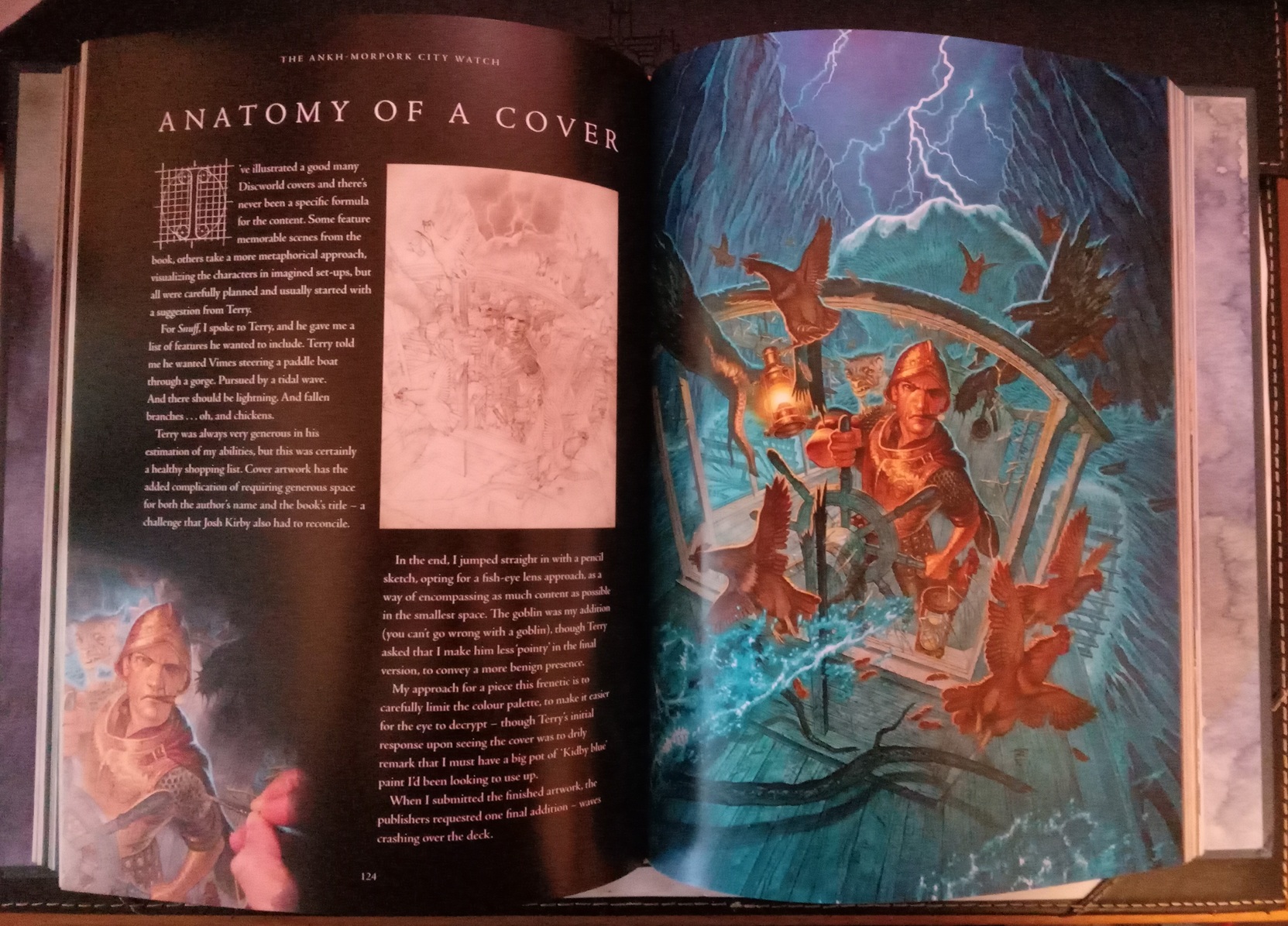
As well as showing us the evolution of Discworld, the book manages to show us how book covers have changed in the publishing world, with the tweaks required to make a book stand out in a crowded marketplace. To illustrate this further, throughout the book Paul breaks down the process of creating some of the book covers such as Raising Steam and Snuff, which I found fascinating. We even get glimpses of the whole world, as In Chapter 2, Creating A Universe, Paul shows how the Discworld was brought to visual life from his drawings of The Great Turtle for SFX Magazine in 1997, from the earliest sketches to the final magnificent version.

Part of the fun of Discworld is how Terry would take contemporary ideas and cultural references and add them in a skewed way to his world. What many fans will know is how Terry and Paul absorbed influences from art and pop culture, fusing them into the Discworld landscape. Readers will appreciate seeing some of their favourite Discworld characters in other iconic settings, such as the 1966 England Soccer World Cup Squad, the Apollo 11 astronauts, the painting American Gothic, and The Beatles’ Sergeant Pepper. Personally, I liked the Bat Out of Hell homage from Soul Music and the 2011 Discworld Calendar, but there are many more readers may recognise.

It really goes without saying that the book as a package looks great, and the commentary by Paul is as good as you would hope for. Honest, engaging and often irreverent – there’s a lightness of tone that belies the hard work that goes into any such artwork.

And, in a special final chapter, Designing Terry Pratchett’s Discworld also outlines the images that we never got to see – the early sketch ideas of the great unwritten novels, with intriguing little snippets of ideas. Lots to dissect here, but I found one that was most poignant, and clearly an idea that Terry had on his own mind – The Turtle Stops (an homage to E. M. Forster’s famous SF story The Machine Stops, perhaps?) was the idea of what would happen when The Great Turtle dies. A sign of the end, perhaps?
This book reminds us that whilst it is unlikely that we will see any more Discworld books in the future – his family have refused anyone else to write more, I understand – the legacy of what we have is worth remembering. I suspect that this book will make a fan want to pick up their copies of the book and read them again one more time – or read those of the 40 or so novels that they have not read yet.
Would it attract attention from readers new to Discworld? Possibly. After all, it looks great, and there’s enough fun details in the narrative as well as the details of the production process that may make the book interesting to read about, whether a Discworld fan or not.
But really, it is a nice collection for any Discworld fan – and yes, out just in time for Christmas! (But how are they going to top this next Christmas?)
DESIGNING TERRY PRATCHETT’S DISCWORLD by Paul Kidby
Published by Doubleday, November 2024
256 pages
ISBN: 978 085 7529 480
Review by Mark Yon