Stephen Graham Jones has become a Name in the Horror genre over the last half-decade or so, his writing is insightful, smart, and generates dread. After spending the last few novels writing about slashers (The Indian Lake Trilogy*, I Was a Teenage Slasher), he turns his authorial voice to an even more iconic horror character/monster: the Vampire. An epistolary novel told through a found journal, the story takes place in two timelines: 2012 when Etsy Beaucarne is reading the journal of her ancestor and in 1912 when her ancestor is writing the journal, recounting his confessional interviews with Good Stab, a member of the Blackfeet tribe who also happens to be a vampire.
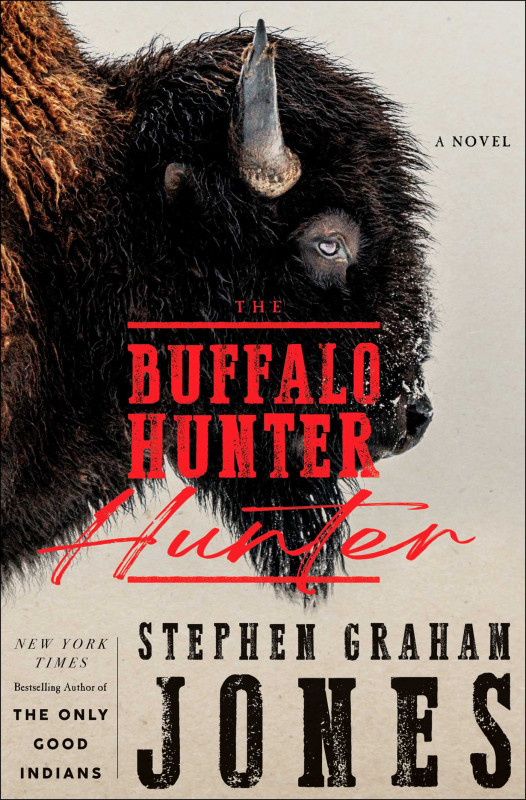
The bestselling author of The Only Good Indians and I Was a Teenage Slasher returns with a chilling tale of blood, buffalo and revenge. Based on gruesome true events, Jones blends history and horror in a haunting story of vengeance and survival.
A diary, written in 1912 by a Lutheran pastor is discovered within a wall. What it unveils is a slow massacre, a chain of events that go back to 217 Blackfeet dead in the snow. Told in transcribed interviews by a Blackfeet named Good Stab, who shares the narrative of his peculiar life over a series of confessional visits. This is an American Indian revenge story written by one of the new masters of horror, Stephen Graham Jones.
The novel is framed by Etsy, a struggling academic hoping for an extension when a journal her great-great-great-grandfather, a Lutheran pastor named Arthur Beaucarne, is discovered. The journal relays Pastor Beucarne’s interactions in Montana with Good Stab, who confesses his life … or rather unlife. Good Stab is an unkillable Indian who had a tussle with a Cat Man that should have killed him. But Good Stab did not die, he woke with a thirst and need for blood and, through his own words, takes many, many lives. The scene of Good Stab’s rebirth as a vampire is visceral, fascinating, and immediately iconic. There are other elements of vampirism Good Stab conveys that feel fresh and unique. The Vampire characteristics SGJ utilized in this world were constructed with careful consideration. These “traits” of SGJ’s vampire play out so well in the story and are just one facet of what makes The Buffalo Hunter Hunter such an incredible work.
As Good Stab repeatedly returns to Beucarne, whom Good Stab comes to calling “Three Persons” because of the Holy Trinity, their relationship becomes stronger and more unique than simple listener and confessor. Good Stab’s story is an addictive thing to the pastor (and to this reader!) that Beaucarne realizes is something that should abhor him, but his fascination grows as the story grows in the telling.
Jones uses a historical event as the starting point, the 1870 Marias Massacre in the Montana Territory, wherein 200 members of the Blackfeet tribe were killed by the United States Army. This sets the novel very much as a revenge story, especially for a Blackfeet Indian who now has incredible strength and consumes blood. Because Jones himself is a member of the Blackfeet tribe, there’s an authenticity to this novel unlike almost anything I’ve ever read. The language, the cadence of the story, the raw emotion conveyed by Good Stab is powerfully immersive and genuine.
The three characters who prop up the novel are of course Beucarne, Good Stab, and Etsy. Etsy may not play as large a role through the large middle portion of the novel, but her framing story adds a great deal of narrative weight and pulls together the throughline of history conveyed in the novel. Beucarne and Good Stab, make for a fascinating combination as I’ve already noted.
SGJ calls out Dracula as an influence, of course, and the structure of the novel as an epistolary novel (a novel whose narrative is largely told in letters) hammers that home. Well, that and the fact that Good Stab is a vampire (though the word is only said once in the entire novel). What the structure of the novel does is to really layer in the character’s voices and sort of throw a thin cloak over whether or not these narrators are trustworthy. There isn’t as blatant of a unreliable narrator element as the most famous in the genre, Severian from The Book of the New Sun (the first book of which was recently reviewed here by Mark), but there’s always that question of believability and trust when a story is told through first person narration. Even if Good Stab and Pastor Beucarne may not be 100% reliable as narrators, their authenticity is never in doubt.
Although Interview with the Vampire was not specifically called out by SGJ I can’t help but feel the resonance, largely because of the confessional nature / relationship between Good Stab and the Pastor.
There are some novels, they are rare I think, that as you turn the pages, you realize you are reading Something Special. That you’re reading maybe a game-changer of a novel, a Landmark Novel. I began feeling that way maybe one third or so through my reading experience of The Buffalo Hunter Hunter. By the time I read the last page (and the acknowledgements), I knew this novel was a revelation. I have no problem putting this book on my personal shelf of Vampire novels (and Horror novels) alongside the Big Ones like Dracula, I am Legend, ‘Salem’s Lot, and Interview with the Vampire. This is the real deal and all-timer for me, possibly the best and most important Vampire novel thus far published in the 21st Century and maybe in the last 50 years. An absolute masterpiece.
Highest possible recommendation.
* Our own Randy M. reviewed the three books of The Indian Lake Trilogy this past year (2024) for our annual Countdown to Halloween:
My Heart is a Chainsaw
Don’t Fear the Reaper
The Angel of Indian Lake
Hardcover | Saga Press
March 2025 | 448 Pages
https://www.demontheory.net/
Excerpt: https://people.com/new-stephen-graham-jones-horror-buffalo-hunter-hunter-cover-reveal-exclusive-8668930
Review copy courtesy of the publisher, Saga Press