

In his sci-fi debut Daros, Dave Dobson blends action, heart, and humor in a universe teeming with danger and discovery. We caught up with him to talk inspiration, character journeys, and what’s ahead in his expanding galaxy of stories.
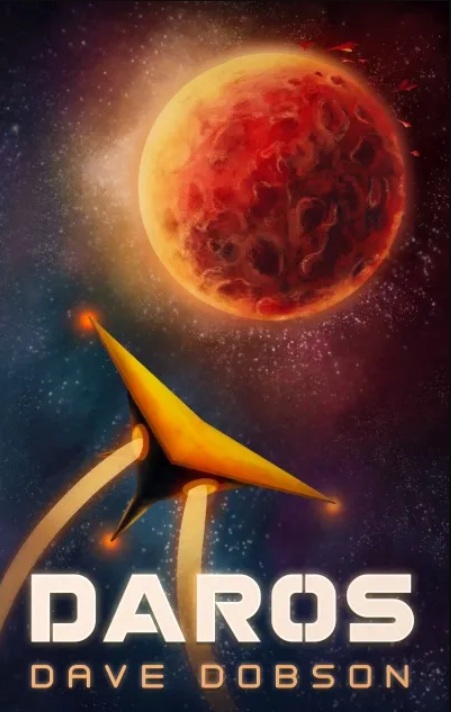 Q: I believe Daros marked your debut in science fiction. What drew you to the genre, and can you tell us a bit about the story and its inspiration?
I have loved science fiction since I was a little kid. I was eight when the original Star Wars came out, and that shaped a ton of my childhood, along with Star Trek, Dr. Who, Battlestar Galactica, and a ton of books – we went to the library every week or so when I was a kid and I would come back with an armful of new adventures. With Daros, I was trying for a far-future space-opera feel, with multiple human worlds, common space travel, and some aliens, plus a sense of an old universe with sentient beings having existed for a long time, with humans only playing a small part. I wrote the first few chapters of Daros (only the Brecca chapters) and set them aside to do further work on my Inquisitors’ Guild series, and then I actually used the Daros and its unexplained alien invasion for a two-year-long tabletop RPG I ran with some friends. What happened in the game had almost no overlap with the book other than the setting. When we were done playing, I was excited about the world and the premise, so I came back and wrote the book, adding Frim as a character to give me narrative access to what was going on with the Zeelin.
Q: Becca undergoes a remarkable transformation throughout the novel. Which aspects of her character were you most interested in exploring as she evolved?
I am a sucker for good-hearted people struggling to do good in tough situations. I love reading books like that, and I love writing books like that. So, that was where she started. I wanted her to have some sass and some skills, but I also wanted her to be vulnerable. After all, she’s a kid thrown into an impossible situation, alone in the middle of an alien invasion. At first, she merely survives and copes, but eventually she learns more and gathers enough resources and allies to start trying to take action towards her goals. If she started out supremely capable, I think the story would be a lot less interesting, and if she were merely a damsel in distress, she would hardly be a fun character to follow, so I tried to strike a balance there.
Q: Becca forms intricate relationships with several characters. Were there any dynamics you found particularly rewarding or challenging to write?
I absolutely loved writing Lyra. I am fully aware that a sassy sentient ship is a trope, but I tried to make their interactions interesting with the cultural background of the Vonar, as Brecca learns how she has to suggest action to Lyra, and Lyra nudges Brecca towards her goals. I realized about 60% of the way through the book that Lyra is as much of a protagonist as either Brecca or Frim, even though she doesn’t get to be a point-of-view character, and that shifted her a little from comedy sidekick to someone with more depth and impact. As for other relationships, there’s a point later in the book where two major characters meet for the first time, and I was terrified about writing both sides of that, since the stakes were so high. I actually got up and walked around my basement a few times trying to psych myself up for that chapter.
Q: Frim’s perspective gives us an inside look at the Zeelin culture. How did you approach developing their values and way of life through her unique voice?
I realized when I came back to the book that Brecca was fun, but she just didn’t know enough or have enough agency to carry the book on her own. That’s when I hit upon the idea of showing what was happening from within the invading Zeelin. Often books will split focus between the good guys and the villain, but I don’t particularly like that juxtaposition, nor do I like writing villains as point-of-view characters. Having Frim as a secret rebel within a vicious dictatorship was a great solution for me – it gave me a sympathetic character to show what the Zeelin were about and what they were up to, and it added another storyline and another heroine with her own set of goals to complement Brecca’s story. I had a lot of fun imagining what a society that took survival of the fittest to an extreme would feel like. Humanity has applied Darwin the wrong way at several points in history with dire consequences, and I thought it would be fun to expand on that with a whole species. That’s what informed their culture and behavior, and it’s what made Frim (I hope) sympathetic, realizing that the life she’d been given to lead was limited and founded on lies and violence.
Q: The chapter titles in Daros are fascinating. Can you shed some light on how you chose them?
Oh, those are very self-indulgent. In all ten of the books I’ve put out, I’ve used silly jokes (often groaner dad-joke puns) as chapter titles. I add them during my first editing pass. In the first draft, the titles are all locations and timing, e.g. “Brecca on the planet at the escape pod” or “Frim on the second day of the invasion.” When I do the first edit, I try to come up with funny titles related to what’s going on. Many of them are present-day references (e.g. There’s No Place Like Foam, From Here to Paternity, Hooked on a Zeelin), which of course makes no sense in a far-future setting, but I amuse myself with them, and people seem to enjoy them. The only time I go with a more sincere, serious chapter title is when I get to serious, emotional, high-stakes scenes. For those, I try to match the tone of the title to the chapter and leave the jokes aside.
Q: You’ve worked in a variety of genres. How did writing Daros differ from your experiences with fantasy or mystery? Were there new challenges you encountered with science fiction?
Daros was my first such departure, from fantasy to sci-fi. Those were surprisingly similar for me, in that you have to come up with a bunch of history and lore for your setting, and you have some ways humans can exceed our limitations in the real world. In fantasy, that’s magic, while in sci-fi, it’s technology. In both, I try to make sure the world and setting are detailed enough to feel real and hold together, and that there are enough limitations and rules for the magical or advanced-tech elements that the way they’re used feels real and expected rather than just something you pull out as a crutch for the plot you want. With Daros, I actually engaged the help of an astrophysicist friend to give my advanced technology at least a veneer of plausibility. He helped me a lot in making sure I was treating physics with some respect even as I screwed around with reality. We had a really interesting discussion of how cloaking of ships might actually work. In that sense, I think sci-fi might be a little harder than fantasy, because you don’t want to create a world that just ignores all the science we do know.
When I wrote my three modern-day mysteries, the challenges were a lot different. You don’t have to think up and explain all the rules and cultures for your world, because they exist already. You also can just have people use the phone or the Internet or a car and not have to explain how they work and how they were invented. However, that easier part comes with a big challenge that I didn’t fully anticipate, which is that you have to work hard to make everything seem real, because your readers live in the real world and may know more than you do about how things work. I had to do a lot of research on guns and how people who are more familiar than I am with them think about them and use them, on how police might serve a search warrant and what happens during one, on genealogy websites and how they work, on what a librarian might do at work on any given day. All of that takes research, and people will hold you to a higher standard than when you’re making up how a medieval detective guild might operate.
 Q: Can you share your writing process with us? Do you tend to outline your stories in detail, or do they unfold more organically as you write?
I’m a total seat-of-the-pants writer, which I think comes from my nature, augmented by my experience playing role-playing games and with improv comedy, which I’ve been doing since 2009 with a local comedy club. I love putting my characters in situations and seeing what happens, and I will often start a chapter without knowing how it will end, or throw in a character I don’t know anything about and hadn’t intended to add until they appeared. For example, in an early chapter when Brecca gets an alien artifact from her dad, I had absolutely no idea what it was, who made it, or what it did, and I didn’t figure that out until well into the story. I will often have a vague sense of the story arc I’m headed towards, but I usually don’t get serious about the plot until I’m about 60-70% through the first draft. At that point, I will often have a list of all the plot elements I’ve added but not resolved, and I will sometimes put together a brief list of plot points I want to hit as I wrap things up. That’s the way it was with Daros. I think about it a little like juggling – when I get started, I’m happy throwing more and more balls in the air, but eventually, I get to the point where I have to start catching them, and that’s when I have to start being more organized. During my editing and rewrites, I will often take out the parts that didn’t go anywhere, and then I’ll pull together the characters and themes and storyline threads that have come out as I’ve written and weave them in throughout the book.
Q: You also have another sci-fi novel, Kenai. What’s it about, and how does it compare to Daros in terms of themes and tone?
It’s set in the same far-future setting, where humanity has expanded to the stars and then lost most of itself to war. That means it has the same basic human society, government, and structure, and the same technology. Beyond that, the books don’t share any elements. Kenai is about a disgraced former space marine who takes on a job as security for a xenoarcheology dig on a distant, unpopulated world. She gradually learns that the world and her mission aren’t what she was told they were, and she ends up wrapped up in an adventure full of betrayal, discovery, weird science, and long-lost alien culture. It tries to be funny like Daros does, so there’s humor throughout, but Jess (the ex marine) is an older and more damaged person, carrying some baggage from what she’s been through. She’s also a trained soldier, so there’s a bit more military stuff in this one. But they’re both similar in tone, and they share the theme of people thrown into something and trying to figure out how to survive and help. Kenai won the 3rd annual SPSFC, an indie sci-fi competition organized by Hugh Howey, beating out 220 entries (Daros was a semifinalist in the same competition in its first year).
Q: Looking ahead, what projects are you most excited about, particularly in science fiction? Is there more to come in the Daros universe, or are you exploring new worlds?
A number of people have expressed interest in a sequel to Daros, but I haven’t figured out exactly how that would work. The whole premise of Daros is what’s going on with invasion and on the planet, seen from two separate viewpoints in different places. So, a Daros 2 would have to take the characters to a completely different place and focus and probably have them together from the start, which would be a very different book. I haven’t quite figured out how that would work or what would make it fun. However, I’m totally excited to keep adding books to my far-future setting. I’ve got 35,000 words written for my next sci-fi novel, and it’s set in the same future as Daros and Kenai, although again, it focuses on a different adventure with a new character. This one is about a mid-level engineer, Dewi Hartono, on a long-range exploration starship that the remaining human colonies have sent back towards Earth, trying to learn what happened to all the planets they lost contact with during the war that destroyed most of humanity. The ship faces some sabotage and bad actors, and Dewi gets caught up trying to repair what’s been damaged while also figuring out who is trying to keep them from what they’re doing and why. It’s been fun to write a shipboard story, reminiscent of Star Trek in some ways, rather than a planet-based one, although I think Dewi will end up on a planet eventually. That’s my next sci-fi project. I’m also working on a new Inquisitors’ Guild book (my fantasy detective series) and a romance novel that I’m co-writing with a good friend, which is a hoot – I’ve never written romance before, but she’s helping me through the tropes and expectations.
* * * * * * *
Interview by Dag Rambraut – SFFWorld.com © 2025




Thanks for the opportunity! Those were great questions.