 One of the trends I have noticed in recent years is the mainstreaming of science-fictional or fantasy tropes in mainstream fiction, crime novels, police procedurals, urban fantasy and the like. David Mitchell’s Cloud Atlas, Michael Chabon’s The Amazing Adventures of Kavalier & Clay, and yes, Margaret Atwood’s The Handmaid’s Tale, amongst others. At the same time authors such as Phillip Pullman have become seen as respectable writers, despite writing fantasy or science fiction.
Whilst it is annoying to me that often these mainstream ‘literary’ writers claim that what they are writing is not fantasy or science fiction but ‘something better’ (I’m looking at you, Margaret Atwood, although there are others equally to blame, admittedly!), there’s no denying that one of the positives of this mainstreaming has been genre-reading through the back door, so to speak. I have personally had a few occasions of late where readers have enjoyed a book I’ve suggested whilst also saying, “I liked this – I didn’t realise it was Fantasy/Science fiction/Horror!” (Take your pick.)
This then allows me to suggest other material that may be even more genre-based. (“If you liked ‘X’, try ‘Z’!”)
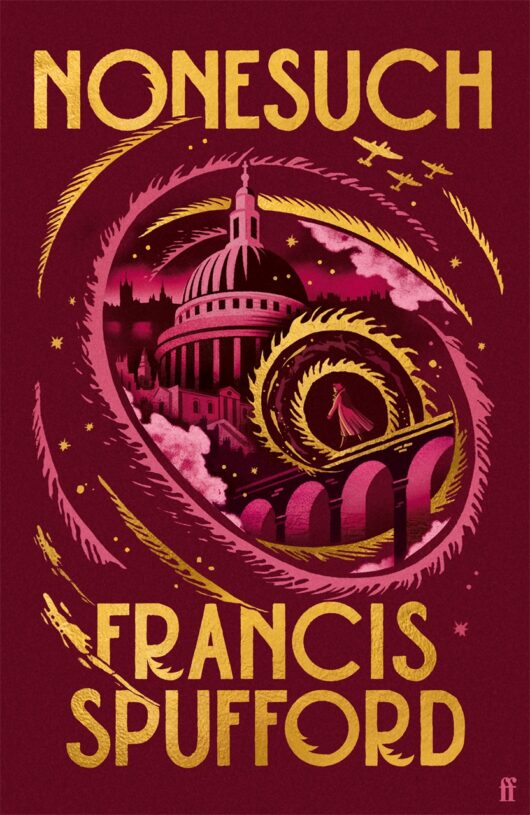
Which brings me to Francis Spufford’s latest novel, which I suspect is another one of those genre novels for people who don’t normally read fantasy.
Francis has been quietly adding science-fictional or fantasy elements to his books for a while now. For example, one of his previous novels, Light Perpetual (2021), gave us an alternate reality based around five characters who, instead of being killed by a WW2 bomb exploding in London, are shown what could have happened to them had they lived. His Cahokia Jazz (2023) reimagines how American history would be different if, instead of being decimated, indigenous populations had thrived.
His latest, Nonesuch, returns Spufford back to WW2 London.
Nonesuch itself initially feels like a wartime romance, backgrounded by London at the time of the Blitz in WW2. There is a nice sense of place here as the city’s lights darken and London adjusts to a long period of inactivity at the beginning of the war with then nightly bombing raids by the Germans.
The story focuses upon Iris Hawkins. In her twenties, it is clear that she is an ambitious girl with an intelligence that is often undermined by being female in a male-dominated world. Although she is ‘just’ a clerk in her day job for brokers Cornellis & Blome, she also shows a clear understanding of stock markets and bonds and the effect of the war on Britain’s economy, but her views and ideas are (at least at first) generally treated with a fair degree of distain, in that “Don’t worry your pretty little head about it, dear” kind of way.
Although Iris may give the appearance of one of those iconic “Battle of Britain girls’ coping with adversity, she is not a quietly demure shrinking violet, happy to just get on with her life and become a dutiful wife and mother. She enjoys a good time and is happy to sleep with men – the first chapter deals with a one-night-stand with Geoff, a young television technician she picks up at a party, having dumped her boring date, for example. Lall Cunningham, one of the people who Iris briefly meets at the party, shows herself to have fascist loyalties and keeps being seen by Iris around key places in London. We later find out that she is working for a secret society determined to find and access a secret portal in London. If Lall found access, this would allow her to change history and create an England where fascism prevails. Iris is the only person who can stop her.
The book initially feels like a more-adult version of those children’s classics like John Masefield’s The Box of Delights, Susan Cooper’s The Dark is Rising series or C S Lewis’s Narnia books** – an adventure story with tension and peril, but with added adult themes.
Since the book was first published in February of this year (three months ago at the time of typing), there have been many reviews of this fantasy novel in the press that don’t normally write about fantasy books.
It didn’t surprise me that that they have all been generally positive, some of them gushingly so, because Nonesuch shows Spufford as a writer who can write. Spufford’s world-building is excellent, managing to add details and colour without delving into huge splodges of information-dumping to set the scene. He also manages that difficult task of making the fantasy element of the plot seem real in the context of the novel, in a way reminiscent of Phillip Pullman.
It helps that the characters are nuanced and fairly complex, often with more going on than the usual stereotypes might imply, although I did feel that Nonesuch presented a WW2 from the perspective of a very middle-class type of existence, which limits the scope of the story a little – Iris works as a clerk in finance, for example, one character is a sculptor at Spade art school, another works for the BBC, another has dinner parties with political advisors, which still seem to continue despite rationing. It seems a world away from how the majority of London’s populace are coping.
Much of the book’s strength in its characters will come from how the reader regards Iris Walker. I found it interesting to read how Iris as a literate, intelligent and resourceful young woman coped with an unusual situation, although at times the writer’s determination to show Iris’s independence and to not become what we would now call a ‘trad wife’, felt a little too earnest, a little too forced.
At times this meant that Iris was not always likeable. Her early conquests are pretty much discarded, really there just to propel the plot and then ignored (but how often in such novels is it the males that do such things?) When with Geoff, the very reasonable yet boring and dependable boyfriend, Iris often berates her boyfriend, and treats his offer of matrimony with some degree of distain, even when she hates herself for it. Whilst I got the point that she was trying to be an independent woman whose values should be appreciated, at the same time it could also be read this as irritating, and even unpleasant.
There is also that ongoing debate of whether men can write about women in such intimate detail. I also wondered that because Iris thinks about sex more than is characteristic in similar stories, and the sex laced throughout the book leaves little to the imagination, was this was an author putting modern values on a historical situation, or was it a more accurate version of what really was happening in the 1940’s? Would women in the 1940’s refer to themselves as ‘randy’, as Iris does (page 354)? Possibly. Would they use the f-word quite as much as Iris does? Not sure, but it didn’t always work for me. Sometimes less is more.
In the wider context, there was also the point whether a man in his sixties writing about a young woman in her twenties write in a way that doesn’t seem creepy these days? We do judge such things much more critically these days than in the past. I did feel that it was generally OK, but whether it felt true without being voyeuristic I’m still thinking about.
Summing up, Nonesuch feels like a novel that deserves credit for trying to tell an old-school fantasy story for a contemporary readership, and so fits the pattern I mentioned at the beginning of this review. Unfortunately, it didn’t quite add up for me. What was a story that started really well for me in the end became less, because of its enthusiastic and often jarring attempts to be different.
There was much to like about the novel, but my overall feeling at the end was that it was trying too hard and had elements that didn’t work for me – including the lack of an ending! (I hope that the author can pull it all together in the next book.)
Nevertheless, Nonesuch may encourage those who don’t normally read ‘that sci-fi/fantasy stuff’ that the genre may have something of value after all, and might just persuade non-believers to dip their literary toe in the genre waters, perhaps, as long as they realise that there is more (and perhaps better) out there like this.
* There’s a definite feeling that Connie Willis has been here before (and if you haven’t read them already, I would recommend her Black Out/All Clear duology, as well as her short story Firewatch and her novella The Winds of Marble Arch as alternatives.) with a similar setting.
**It is therefore not a surprise to read after writing this review that one of Spufford’s favourite authors is C S Lewis.
© 2026 Mark Yon
Hardback | Faber & Faber
NONESUCH by Francis Spufford
February 2026 | 496 pages
ISBN: 978 057 1397 167