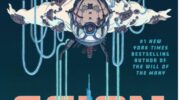
Though originally best known for Sabriel and his Old Kingdom young fantasy series, recently Garth has expanded his written repertoire. His most recent books have moved into the adult market, with his urban fantasy ‘Left-handed Booksellers’ series (reviewed HERE and HERE) and his dark fantasy collection, Sir Hereward and Mister Fitz, which I reviewed HERE (and loved.)
Now he’s taken on science fiction, with his latest, Massif.
From the publisher: It’s business as usual for Parnell Shi-Sawahla and the crew of the United Earth Government Navy ship Sassafras. For more than two hundred years humans have been hitching rides into space on vast sentient mountain ranges called Massifs in an endless interstellar war between the forces of Earth and Mars.
But the same unanswered questions burn behind every battle, every conquered world, every new colony.
Why do the Massifs carry humans to the stars?
Why do they help us export our wars?
What’s in it for them?
Ship crews aren’t supposed to ask these questions – and they definitely aren’t supposed to speak to the all-powerful avatars piloting the mountains. But when Parnell’s deputy, Kaz, is stranded on an enemy planet, he needs the Massif’s help to rescue her . . . and that means figuring out how to talk to it.
Nothing could ever have prepared him for what he learns of the secrets fuelling their voyages across the galaxy. The only certainty amidst the dread is that there is far more at stake than the lives of his crew.
In terms of style and tone, much of this felt like a combination of Stephen Baxter and Adrian Tchaikovsky. The aliens, who seem to have been hidden in plain sight, are quite alien, and are perhaps the most interesting and original thing about the book. We discover that the Massif are aliens seemingly made out of living rock, which the humans use to fly Massif space ships known as Basics.
I thought of these Basics as a sort of living LEGO; they are usually single but can merge with other Basics to make bigger spaceships. Humans then hollow out space inside the blocks to live in, whilst the blocks move from place to place, their pilots connected via some sort of telepathy to do so – or rather through an Avatar which seems to look after each vessel.
There are some issues with this. Humans don’t know how these Basics really work. The spaceships generate a ‘Massif M’ field around them which maintains an atmosphere but makes complex electronics useless. Long term, regular contact with the avatars can lead to Massif Psychosis, which renders the human psychotic, comatose and can lead to death.
There are also weird and often nasty species around on the Massifs themselves. Tackers – ten-limbed aquatic creatures that live within the Massif lakes – made me think of lamprey fish, with legs (look them up, but be warned!) and there are enough Lovecraftian tentacle-festooned things around to make me shudder.
The human characters themselves are that usual buddy group of mismatched people who work with each other under Parnell’s leadership. Think Firefly, Gareth Powell’s recent Jitterbug or perhaps even Christopher Paolini’s recent SF efforts as recent examples.
There’s also officious human administrators who struggle to cope with changing circumstances, whose administrational incompetence and corruption may be based on Nix’s own experiences as one of the Australian Army Reserve, where he served part-time for 5 years back in the 1980s. It all feels a bit Catch -22 at that point. As you might expect in a military unit, there are lots of abbreviations – you need to make sure that you know your UEGN from your MBPSF, for example. (That’s United Earth Government Navy and Mars and Beyond Prosperity Sphere, by the way.) There’s also a LOT of tea being drunk.
Focusing upon Parnell, I found that the character-focused story was fairly simplistic. You never get to know the characters in much detail, and this meant that when the writer put them in situations that should have concerned me, my lack of empathy with them meant that I felt less concerned about them than I was clearly meant to.
Generally, because I knew little about the characters, I felt less invested in what happens to them, even when lives are put at risk and death is possible. There’s a little bit of plot contrivance at times (no spoilers!) which seemed rather convenient.
Towards the end of the book, it became clearer that whilst there is resolution of sorts, and some big revelations are revealed, but with some solutions given glibly in a sentence or two, the ending isn’t conclusive. There are matters left unresolved that may frustrate some readers, and some readers may feel aggrieved that not all the questions raised are answered here, but I suspect that this will lead to another book.
Summing up, for me Massif was a solid read, but a bit of a mixed bag – it didn’t entirely work for me. It is eminently readable, and there’s some fairly good characterisation, if pretty standard. I liked that there were enough new ideas to make it stand out from the mass (ha!), even when there’s a fair bit of skating over the ‘science stuff’ by keeping it unknown, but readers may be frustrated by some of the book’s final scenes.
© 2026 Mark Yon
Hardback | Gollancz
MASSIF by Garth Nix
September 2026 | 352 pages
ISBN: 978-139 9627 177