 For many people (including me) in Britain, Hammer Horror movies have been an essential part of our genre lives, something that often began our interest in horror films.
I still remember with some degree of clarity watching Hammer Horror double bill movies in the late 1970s and early 1980s on BBC2 on a Friday or a Saturday night (usually a Saturday, but some were Friday into Saturday.) In my case it was watching on a black-and-white television, usually with the sound low in order to stop the rest of the sleeping household hearing the screams and dramatic music.
Later – with colour televisions – and then VHS – the movies were watched again – now in vivid, lurid colour – that red blood was REALLY red….
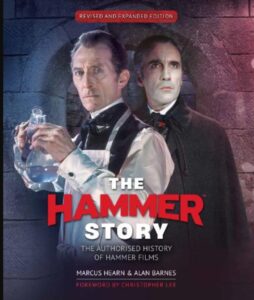
Which brings us to this book, a revised and updated version of a book first published in 1997, which tells the authorised story of the British studio from its early beginnings to the present day.
The book is in seven chapters:
- The Exclusive Years (1934-54)
- Reanimation (1955-64)
- Fresh Blood (1965-69)
- Setting Son (1970-75)
- Afterlife (1976-2006)
- Risen From The Grave (2007-24)
- The Story Continues.
There’s also a Foreword by Christopher Lee (from the last edition, 1997) and an updated filmography at the back.
Lee’s Foreword says that in his opinion “the key (to Hammer’s success) was collaboration – everyone who worked at Bray Studios had tremendous dedication and belief.” He also says that he would be “Always grateful to Hammer for launching my international career…”, although there’s no specific mention of his iconic personification of Dracula here. (I’m told he was often quite annoyed when people only wanted to talk to him about that role.)
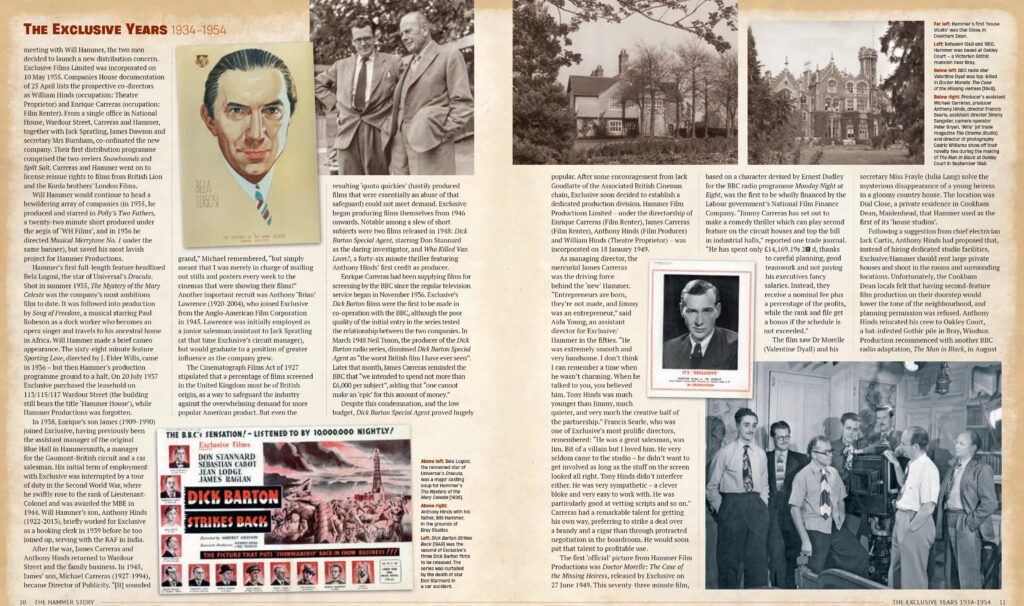
Personally, I’ve always thought of Hammer as “The little studio that could”, for, as the book shows, its initial productions were from a little British independent film and radio production company, small in scale and often with a limited budget and in a limited timeframe – the emphasis was to get them out quick and often.
The studio’s first big breakthrough was in 1954, with the film version of Nigel Kneale’s Quatermass, based on a television series for the BBC that kept people at home to watch. Hammer’s black-and-white film version, named The Quatermass Experiment (or The Quatermass X-periment as it was first titled – notice the X to designate the film’s over-16 categorisation) was a film that happened to be in the right place at the right time. It brought me science fiction but with a horror element, even though I thought that Brian Donlevy as Quatermass was rather miscast, an American actor brought in to satisfy a potential American market. It created enough profit to invest into other films, such as X-The Unknown (1956) and the unimaginatively titled Quatermass II (1957).
The Curse of Frankenstein (1957) was the studio’s first colour production, and the first of Hammer’s ‘gothic horrors’. It’s novelty value of being in lurid colour drew audiences in but it was the performances of Peter Cushing as Baron von Frankenstein and Christopher Lee as The Creature that stayed in the collective memory. As the authors here say, ‘”it redefined the entire horror genre.”
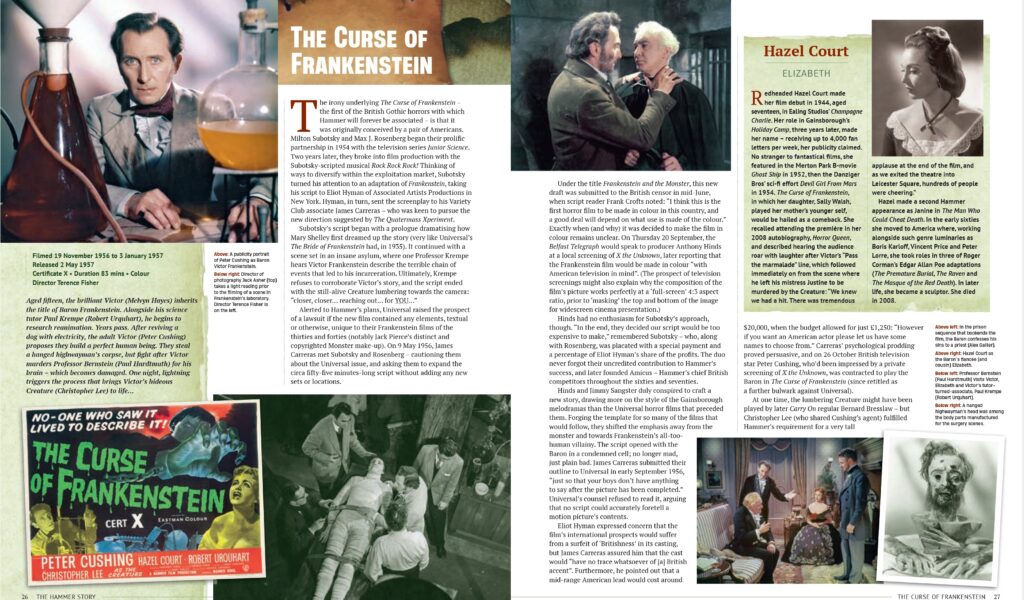
As you can see from this, each major film is given a detailed double page (in some cases, such as with The Curse of Frankenstein, a four-page spread) – the sort of thing most useful if you are about to watch or rewatch each film! As well as summaries of each film, there are posters, details of the main actors/actresses, interviews with many of the cast and production teams, as well as the author’s views on each film. It is enormously detailed and impeccably researched.
With these movies drawing audiences in, the studio built on this success, broadening its repertoire to historical movies, swashbuckling pirate films, comedies, crime dramas and war films. The book gives many of these themes a double page spread.
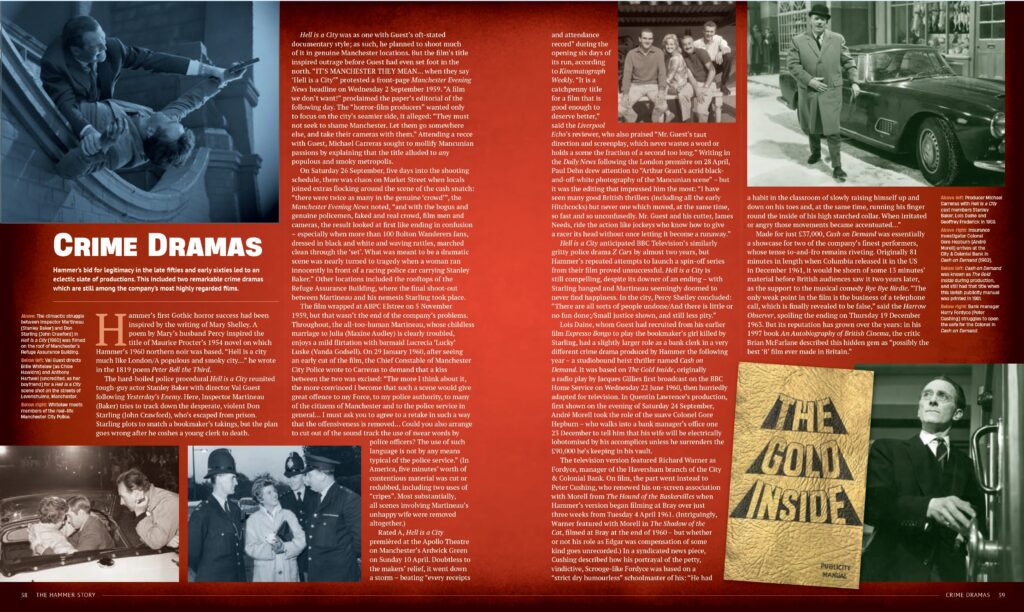
The success of these movies led to US and international deals, which in turn generated money to make perhaps Hammer’s most famous and memorable creation: Dracula (1958).
And it is here that Hammer Horror really made its mark for me (although you could argue that the Curse of Frankenstein (1957) got a lot of other people interested first.) Christopher Lee, in perhaps his most famous role pre-Lord of the Rings and Star Wars, gave Dracula his presence and menace. To me, and I’m sure others too, he was Dracula long before I saw Bela Lugosi. (I know!)
In counterpoint we also had Dracula’s nemesis, the calm intellectual van Helsing, as portrayed by the equally wonderful Peter Cushing (another actor known to me before Star Wars.)
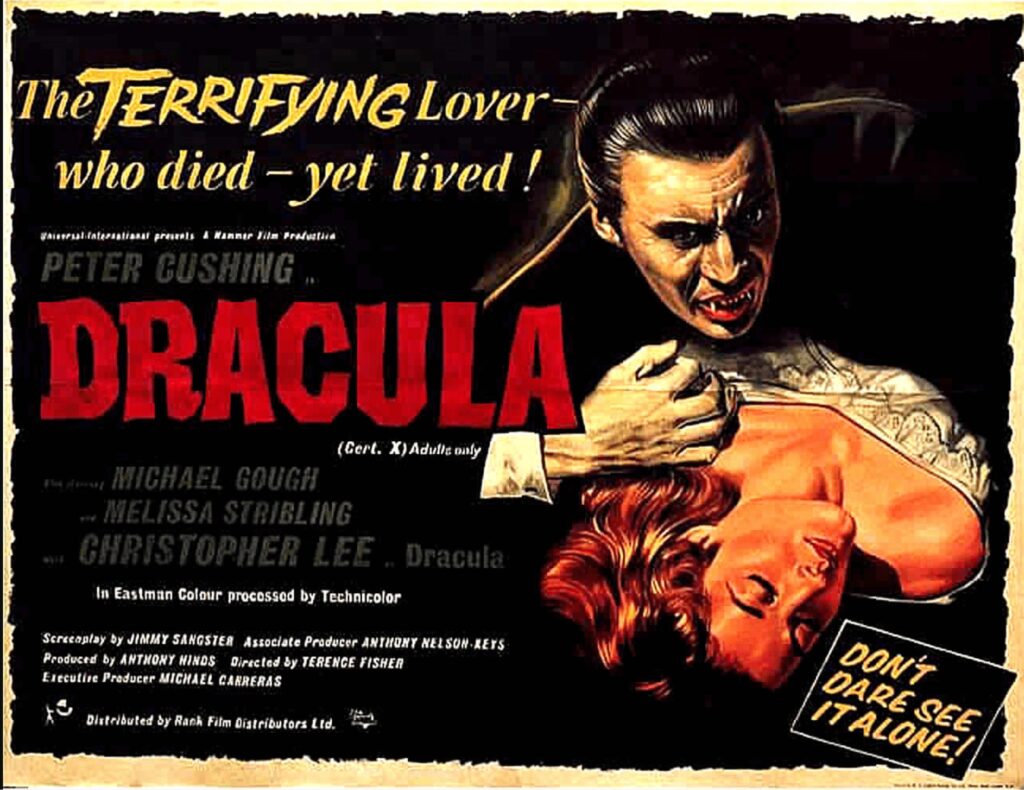
As you might expect, this movie is given some detail – a four-page spread on the movie itself, as well as detailed biopsies of Peter Cushing and Christopher Lee. Interestingly, there was some editing of the film required by the UK censors at the time – Dracula’s seduction of Melissa Stribling was felt to be too much.
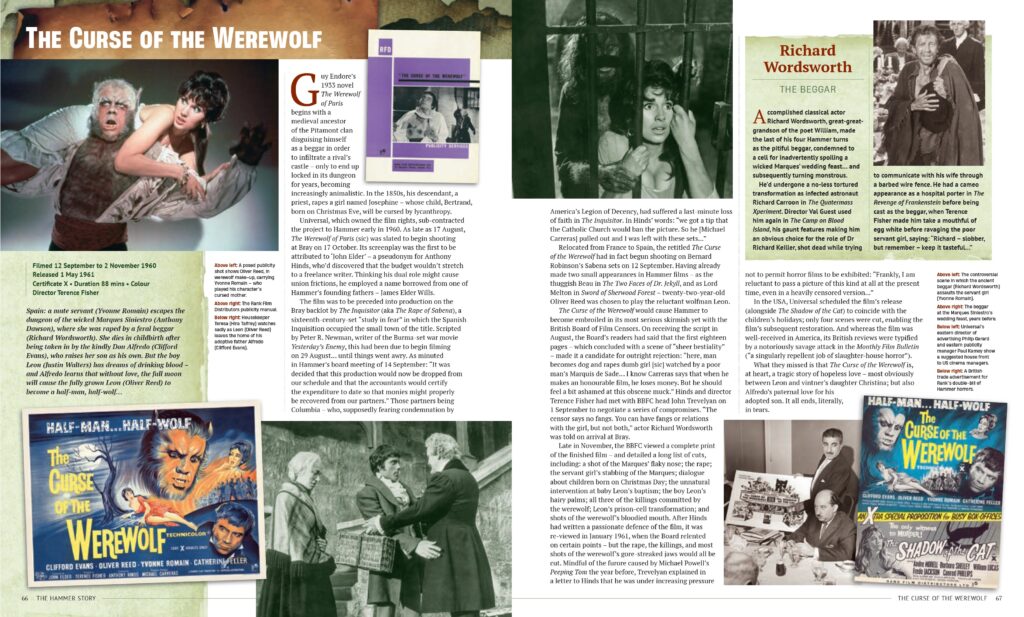
This was perhaps Hammer Horror’s classic hey-day, with film after film in colour reflecting their work – The Revenge of Frankenstein (1958). The Mummy (1959). The Hound of the Baskervilles (1959) (Cushing’s version of Sherlock Holmes often regarded as one of the best), The Curse of the Werewolf (1961), starring a young Oliver Reed and The Brides of Dracula (1960) which is summarised in the book as ” Hammer horror at its very best” (p 63) and Captain Clegg (1962), a creepy smugglers adventure movie with Peter Cushing (and that Oliver Reed again.)
By 1965 Hammer becomes a more stable studio with deals made with US distributors.
However, there was trouble on the horizon. This stability coincided with a shift away “from the production qualities that exemplified the films produced in the late fifties and early sixties” (p 93) which made Christopher Lee’s earlier comments in the book all the more appropriate.
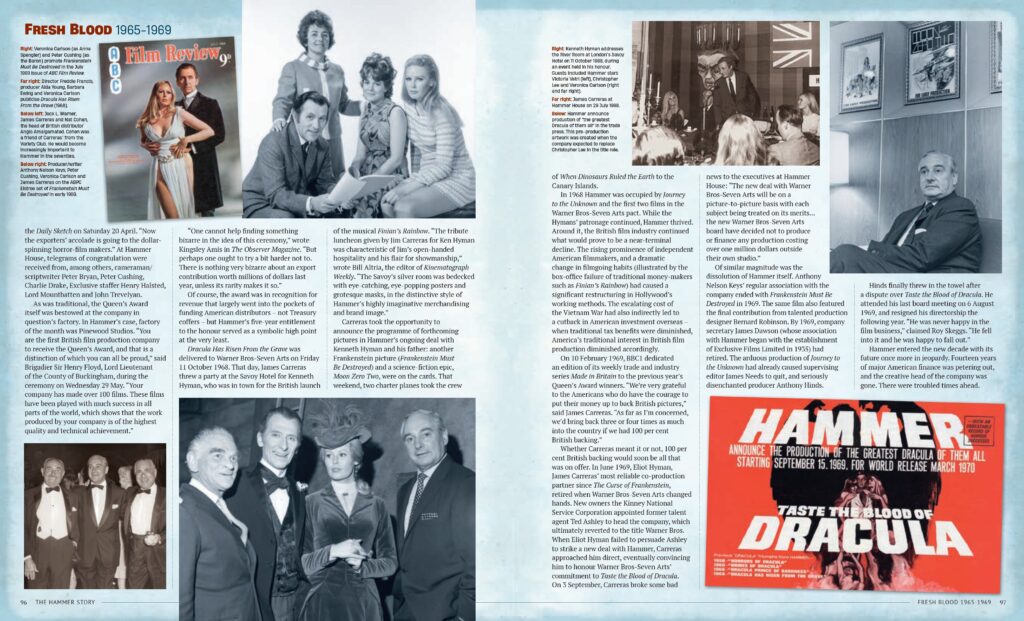
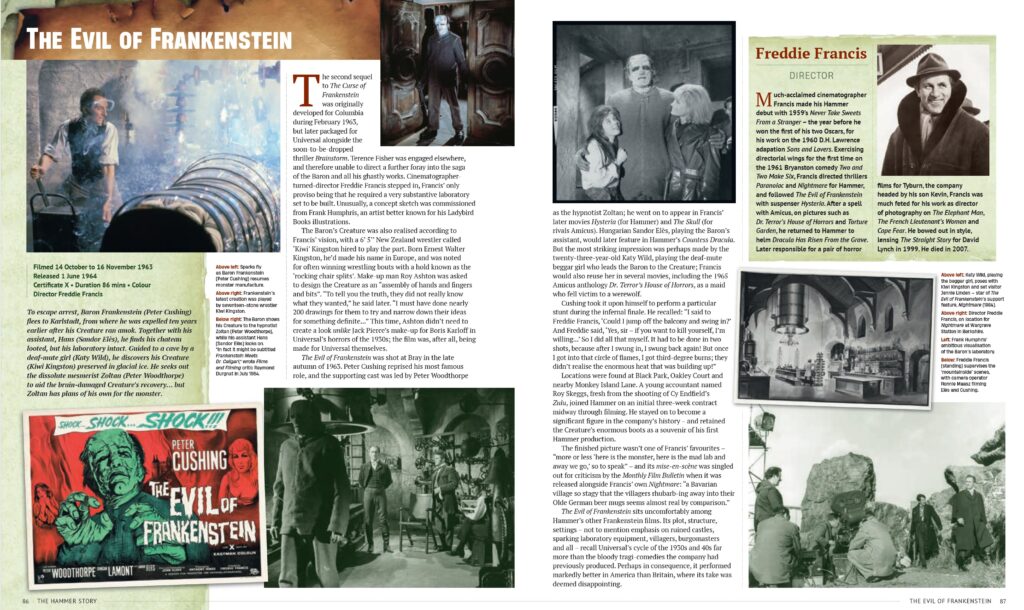
With this new economy drive, and the loss of key production staff, the studio began to struggle. Nevertheless, there were some films that are regarded as being of quality – The Evil of Frankenstein (1964), She (1965) and Dracula, Prince of Darkness (1966) “ are fine examples of such films” but tended to repeat themes already seen – Dracula and Frankenstein, for example.
Dracula, Prince of Darkness was seen as “perhaps quintessential Hammer Horror, but contains little that audiences hadn’t seen before.” (page 105) Frankenstein Created Woman (1967) was “perhaps the most poignant and affecting entry in Hammer’s Frankenstein series.” (p 119) whilst Taste The Blood of Dracula (1970) is described as “arguably the finest genuine Dracula sequel made by Hammer.” ( p 141)
PHOTO
A personal favourite of mine from this time was the return of Professor Quatermass in Quatermass & the Pit (1967) described as” a thought-provoking highlight of British exploitation cinema.” (p123.) Easily the best of the Quatermass movies, in my opinion – Andre Morell was much better as Quatermass – and in colour, but it was beginning to look like Hammer were trading on past glories.
The occult theme was still popular, with the studio’s adaptation of Dennis Wheatley’s occult story, The Devil Rides Out (1968) and with Christopher Lee as the Duc du Richleau. This is now widely regarded as a milestone in Lee’s Hammer career. Although he would go on to do more, Lee was now very tired of being Dracula, and it was clear that he was looking for new roles. Similarly, The Witches (1970) was an occult movie that seemed to be a proto-folk-horror film, based upon another Nigel Kneale (Quatermass) script.
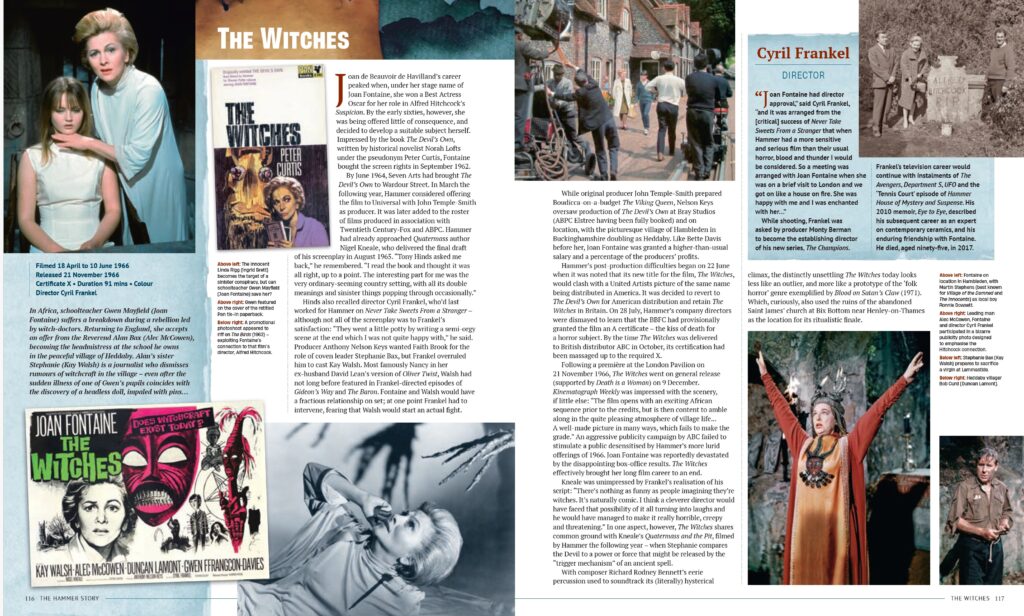
There were also clunkers – Moon Zero Two (1969) was an attempt to cash in on the interest in 2001: A Space Odyssey and the Apollo 11 mission by creating a space western, and did poorly.
Rewatching it recently, I did think it has a certain hokey charm today, and I think that it actually may please space opera readers more now than it did then, as the ideas seen as odd then are fairly common tropes these days. The book says that Moon Zero Two is ” An absolute must for lava lamp lovers everywhere. Moon Zero Two is so far-out it’s very nearly in.” (p139)
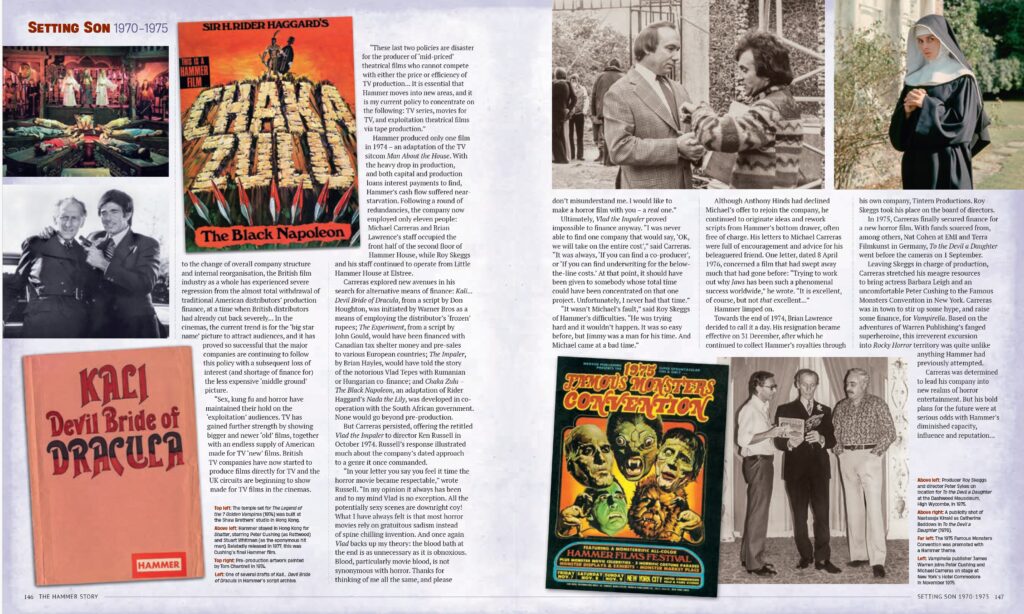
By 1970, things had changed in the cinema market further. Cinema audiences were in major decline at this point, and with a general tightening of the film budgets to accommodate, more key personnel left. In an attempt to bring back or at least hold on to cinemagoers, Hammer took advantage of the newly relaxed censorship by introducing full-frontal nudity and lesbianism in an attempt to attract audiences back to the cinema.
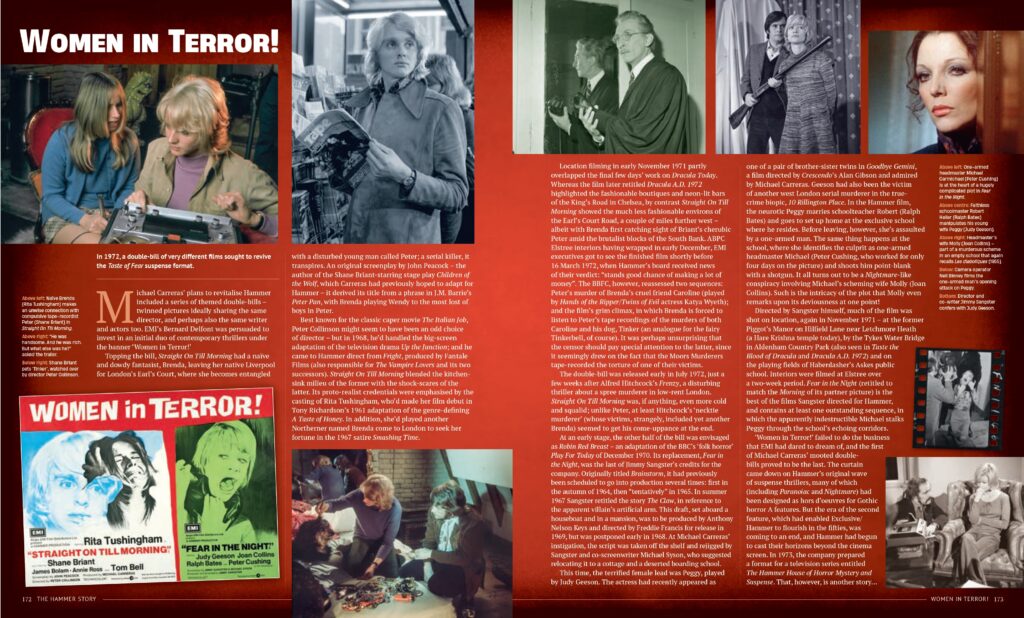
The result was movies such as The Vampire Lovers (1970) and Horror of Frankenstein (1970) which showed that “Hammer were no longer in the big league” (p151.)
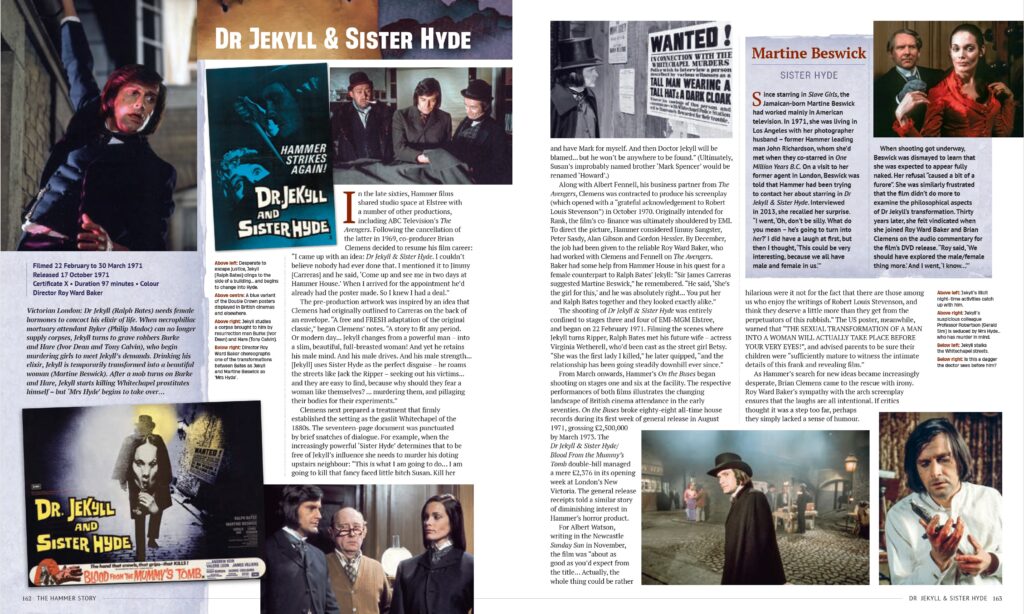
Dr. Jekyll and Sister Hyde (1971) was a misplaced attempt by an increasingly desperate studio to inject intentional humour into the usual horror plot. There were some successes, such as Countess Dracula (1971), Twins of Evil (1971) – but by now the studio was really beginning to struggle.
Interestingly, some of the box-office failures from this time seem to be better respected now. Dracula AD 1972 was initially seen as a gimmicky attempt to modernise the count, which on initial release did badly, but now is seen as “entertaining with the passage of time… an endearing, it naive picture of an era that was.” (p 175) The Legend of the 7 Golden Vampires (1974), taking advantage of the interest in Kung Fu at the time is seen as “enormous fun.”
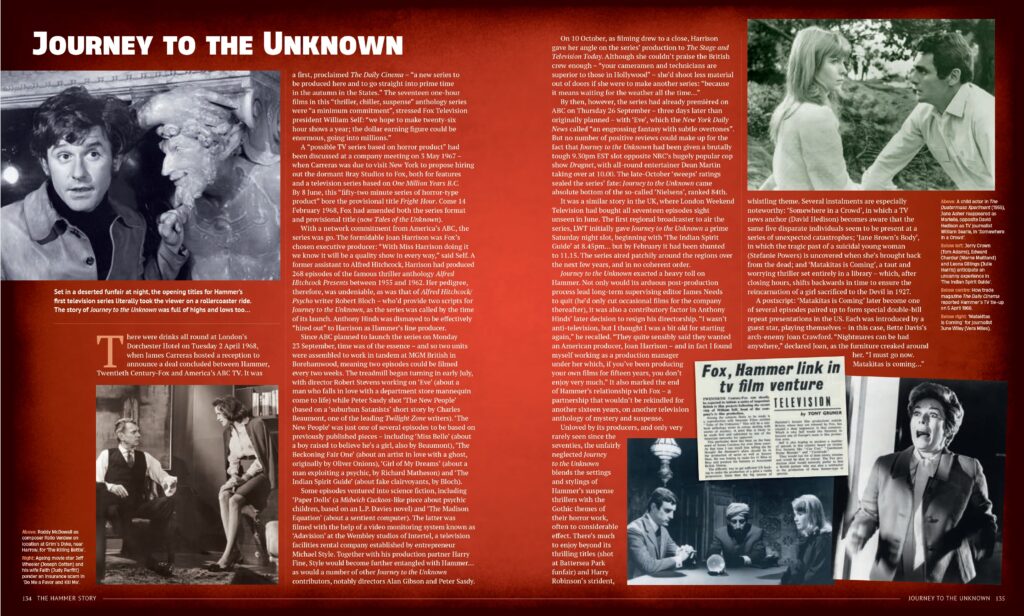
Hammer was now making inroads to television. Journey to the Unknown was a joint Fox-Hammer production attempting to access the American television audience in particular.
Captain Kronos, Vampire Hunter (1974), written and directed by the Avengers creator Brian Clemens, was felt to have the potential to become a TV series (p 177), but the film was a relative flop.
To The Devil A Daughter (1976) seemed to be a film that tried to emulate other successes, taking advantage of the interest in films such as The Exorcist (1975) starred a controversially very young Nastassja Kinski (allegedly 14 at the time of filming nude scenes) and despite Christopher Lee’s “chilling” portrayal, suggested here to be one of his finest, it has been suggested that the film was too experimental to do well.
By this point in the late 1970’s and early 1980’s film production generally was so much in decline that Hammer turned to television for revenue. It produced two well received series – Hammer House of Horror and Hammer House of Mystery & Suspense – aiming at the American viewer as well as the UK audience. Dependable Peter Cushing made a welcome return here too.
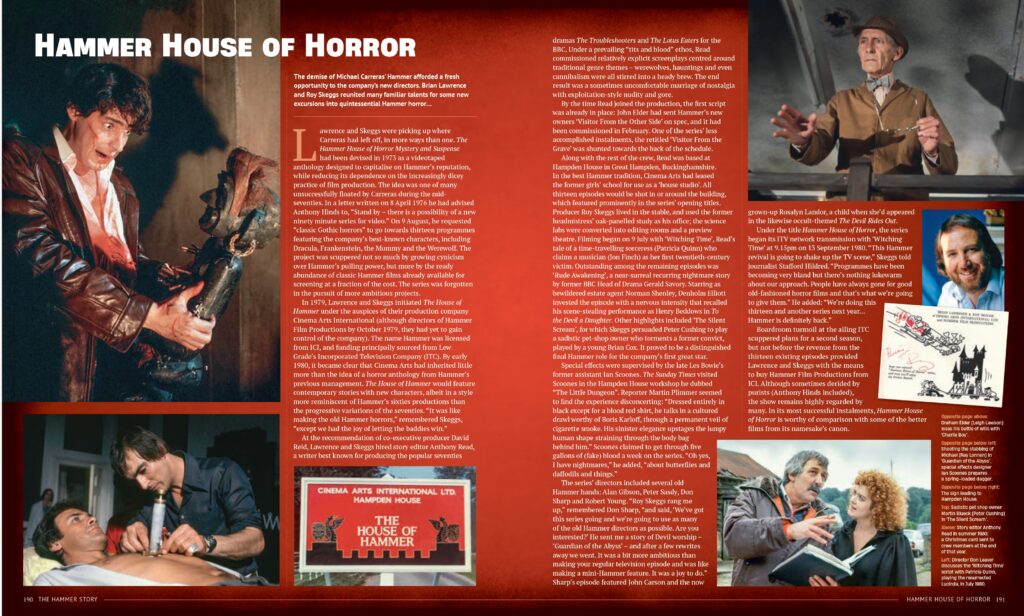
The final stages of the book are the part that’s been added to this revised edition: 32 pages that bring the story up to date by showing that Hammer films came back from the dead in 2007 and began producing new horror films for a modern audience, including The Woman in Black (2012), starring Daniel Radcliffe, regarded by the book as “A finely crafted reinvention.” (p 203). The film Let Me In (2010) was directed by Matt Reeves, now better known for his Robert Patterson The Batman (2022) movie. Christopher Lee returned to make an appearance in The Resident in 2011.
Since the rather bizarre remaking of Doctor Jekyll (2023) starring Eddie Izzard as Nina Jekyll, a reclusive billionaire, the studio has turned its attention to its legacy. The book lastly explores Hammer’s recent work on its acclaimed restoration programme, including the remastering of its classic films such as The Quatermass Experiment, Captain Kronos and X-The Unknown in 4K.
Over time (and another 40+ years) I have managed to watch more and more of these films, including the more obscure ones. I now have quite a few on DVD and Bluray and will happily watch again when just wanting ‘something to watch’. The special effects may have dated, the dialogue may be stilted – but there is an energy and a directness about them that I like. As director, producer and entrepreneur Jimmy Carreras once said, “There is an honesty about them. These were films made with love, by people who loved making them.”
And that seems to be true, in the main. Considering that some of these films are over 70 years old, I am amazed that they are still watched and revered today. There is a new 4K restoration of Dracula (1958) with rediscovered material coming out in October this year, and I am looking forward to watching it again.
The Hammer Story – Revised and Expanded is a book that also shows how a little film company made it big, and then declined but still endures. It is detailed, filled with pictures and interviews, many of which have not been seen before, as well as measured but fair commentary on each of the films themselves. It is one I will use for reference in the future as I put one of the films on or it appears on the telly.
It is also the book I will refer to when people ask, “Why is/was Hammer Horror important?”
It still is to me.
© 2026 Mark Yon
Hardback | Titan Books
THE HAMMER STORY REVISED AND EXPANDED by Marcus Hearn and Alan Barnes
September 2026 | 224 pages
ISBN: 978 1803 365 145
All images are courtesy of Titan Books.