 For the record: I quite like Robert Silverberg’s books. Lord Valentine’s Castle is one of my favourite books of all time, for example, and was one of the first novels I read that mixed fantasy tropes with science fiction. (I’ve since got to read writers such as Jack Vance, Gene Wolfe and Roger Zelazny, by whom Silverberg may have been inspired.)
The list of awards he was been nominated for and even won would be longer than this article – others clearly appreciate his work, and even after seven decades of being published he’s still around at the age of 91. (He did retire from writing in 2015, I believe.)
His writing is smart, literate and knowledgeable. He’s also been known to push the boundaries a little, writing in many different styles and genres – pulp material, weird New Age stuff and modern award-winning material – he won a Hugo in 1990, for example.
All of this makes him a writer I’m happy to pick up often. It helps that there’s a lot of it.
But…. And perhaps I should make that BUT… there are elements of his work and him that I struggle with. Yes, Silverberg is all those things, and deserves the recognition, but at the same time I can’t help feeling that he knows it. He’s not lacking in self-confidence is Robert, as I found reading some of his comments he wrote about his work in his collected stories.
Now, don’t get me wrong, I usually love it when an author tells us about the context a story was written in, the inspirations, the challenges and so on. When I first started reading SF I was a reader who would read all the pithy humorous comments given at the beginning of stories by authors such as Isaac Asimov and Harlan Ellison before I read the actual stories. And both of those authors were not lacking in immodesty, I understand.
But when it comes to Silverberg, his comments, informative and detailed as they are, feel a little… smug. I can never shake the feeling that the gist of his comments are to show off, saying ‘look at how good I am’. As much as I enjoy his writing, I can’t help feeling that the author thinks that we should be grateful and how lucky we are to have such material to read.
I am also aware that this feeling may be unfair. It may even be due to my ingrained British sensibilities, where we do not, ABSOLUTELY DO NOT, crow about our successes. But it does mean that I tend to read my Silverberg in small doses these days. See also Robert A Heinlein’s later work, too.
Which brings me to this one, a novella that has been in the pile for a while, for those reasons.
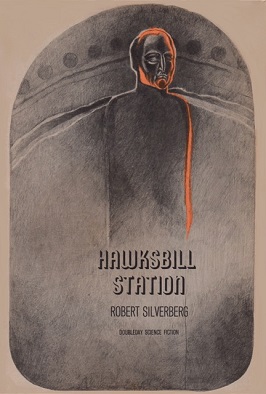
As Silverberg says in the introduction to my edition, Hawksbill Station was an expansion of a short story first published in Galaxy magazine in August 1967. This novel-sized version was published in October 1968 in the US, with the UK version being named The Anvil of Time and published in 1969.
The story itself is pretty straightforward. A harsh authoritarian regime in the US has found a way of using time travel to send all of its dissidents on a one-way trip to the Cambrian Era, where they are kept out of the way.
The result is an all-male prison camp named Hawksbill Station – the women are evidently sent somewhere else.
Their ‘leader’ is Jim Barrett, a middle-aged man, who was Supreme Commander of the Eastern Division of the Continental Liberation Front for over twenty years. Most of the colony are middle-aged with various skills and abilities. They generally work together, although some have never recovered from the shock of exile and have suffered mental breakdowns, schizophrenia and other bouts of ill health.
After a few years, things generally have settled into a routine. Using the materials randomly sent to them by the future (referred to as ‘Up Front’) they have built houses, can farm and have a stock of medical supplies. It’s not easy but it is possible to exist. Trilobite stew is regularly on the menu!
However, the arrival of Hahn, a young man who is rather vague about his background Up Front, causes things to become unsettled. Does Hahn have an ulterior motive for being there? Is he a government spy?
Published during the time of the New Age in science fiction, it would be easy to see this as a fairly straight-forward SF story by comparison – one of those where humans survive all the challenges of the story, despite the odds, where human ingenuity conquers all. The sort of story beloved by magazine readers of Analog at the time, for example. There’s no florid prose, no stylistic tricks, no fractured streams of consciousness here, all of which became part of the New Age revolution in SF.
But Silverberg is cleverer than that. Whilst the story is pretty straight-forward, the details of how Barrett and his fellow-conspirators got to Hawksbill, of how the government took over and made sure that they stayed in power, are astonishing. The revolutions of Malcolm X, the Black Panther Party and Martin Luther King happening in 1960’s, never happened here – generally they are gently but firmly crushed before they come to fruition. What was scary to me is that reading this in 2026 how parallels can be made between then and now – we never seem to learn. Secret police, surveillance of counterterrorists, manipulation of the press, bread and circuses – it is all here.
It also has something to say about the nature of government and the people governed. After more than 20 years of attempting to overthrow the government, it is understandable that Barratt becomes a little disillusioned:
They had been unable to move that vast placid mass of citizens, the ones who were satisfied with the government, whatever sort of government it might happen to be, the ones who feared rocking the boat more than they feared being devoured by the boat.
So, as well as commenting on the unrest of the 1960s in a science fiction novel, Silverberg also manages to made this story more grown-up than I thought it was going to be. There is romance and sex, not to mention homosexuality mentioned, although it is never graphic. This is not the puritanical SF of the 1950’s, and because of this has held up remarkably well, although there was the occasional moment that had me reaching for the dictionary – stochastic chess, anyone?
As a sidenote, women are generally not treated well here. If mentioned at all, they are generally subservient to the men. There are scenes that describe (albeit briefly) the possibility of rape by the hands of the police or prison guards in New York, and Silverberg can’t help himself in describing the attractiveness of various women in that male-gaze spotlight. For example: “The Revolution tended to attract the sort of girl who couldn’t wait to get her clothes off, so that she could prove that her breasts and thighs and buttocks made up for the deficiencies of her face.” Luckily, there are few of these sort of comments.
Despite this, with Hawksbill Station Silverberg has managed to write a story that not only examines the politics and society of the 1960’s, and mostly holds up today – one which is decidedly mature and logical in its telling. Though relatively short as a novella, it is not simple. In short, Silverberg’s done it again – Hawksbill Station is readable, thoughtful, and remarkably developed for its length.
If only he wasn’t so smug about it.
Hawksbill Station was nominated for the Hugo Award Best Novella in 1967.*
© 2026 Mark Yon
Hardback | 168 pages
HAWKSBILL STATION by Robert Silverberg
Based on a short story published by Galaxy Magazine, August 1968.
First published as a novel in the US by Doubleday in October 1968; in April 1969 as The Anvil of Time in the UK by Sidgwick & Jackson.
ISBN: 0 283 98055 9
*The winners and other nominees were quite something that year. There were actually two winners – Riders of the Purple Wage, which I hated, by Philip José Farmer in the Dangerous Visions story collection, and Weyr Search, by Anne McCaffrey (Analog, October 1967), a Pern story, which I loved, but I rather suspect has dated quite a bit.
The other nominees were: Damnation Alley, by Roger Zelazny (Galaxy, October 1967) and The Star Pit, by Samuel R. Delany (Worlds of Tomorrow, February 1967.) A pretty good list (excepting Riders of the Purple Wage, of course!)