 What makes a good raconteur?
The ability to hold an audience’s attention, be entertaining and engaging, to tell a rambling shaggy-dog story that feels like a disordered jumble of thoughts and memories, but in the end that it is anything but – instead, a carefully crafted collection of thoughts with a point and purpose, held by someone who can tell an effective tale.
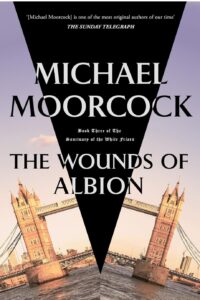
If that is the case, then Michael Moorcock’s latest novel, the last part of the trilogy that makes up The Sanctuary of the White Friars, is the work of an expert.
From the publisher: In the final part of his fictional autobiography, noted writer and publisher Michael Moorcock continues his adventures in both reality and a fantasy world only he can see. He needs to find a way to juggle his life, family and career with the demands of the group of myths, legends, heroes, villains, notable historical figures and creations of his own imagination who need his help or seek to destroy him.
Moorcock finds himself in an adventure filled with excitement, robbery and tales of both heroism and treachery, while negotiating the collapse of his marriage, the success of his writing and music, and the impact his ‘New Wave’ of science fiction was having on both mainstream and counter culture. Filled with cameos from mythical figures – some legends from our reality, like Jim Morrison or JG Ballard, some on the borderline, like the four Musketeers or Dick Turpin – this is an evocative recreation of the swinging sixties and the rather sadder seventies in London and beyond, as well as a fantasy adventure which stands alongside his totemic Eternal Champion stories.
New Worlds Magazine will be launched, feted and banned. Carriages will be robbed by highway men and women from previous centuries. The music of the sixties will inspire, embrace and reject Moorcock. The deposed heir to England’s crown will seek his help. Moorcock will meet his new future wife. The Carmelite Monks must protect their latest multiverse-spanning invention. And all of this may or may not be true.
What to make of this third and final book in The Sanctuary of the White Friars series? I’ve given the publisher’s blurb above simply because it summarises the un-summarisable.
This is part auto-biography and part fantasy. The most unreliable of unreliable narrators, Moorcock mixes truth with fiction, mixing in Moorcock’s real life and real people he knew (most no longer with us) with his fictional ones, creating an adventure story that may – or may not – be real.
The first half of the book focuses on Moorcock’s personal details. He talks of his memories of London in the Blitz in WW2, school, and how he started writing, much of which has been covered in the previous two novels.
There’s a lot to find out about science fiction and fantasy authors, and about the world of publishing in the 1960’s and 70’s, both in the UK and the US. Moorcock mentions many, many friends and acquaintances that those who know of science fiction in the 1960’s will recognise.
The fictional story – Moorcock’s life in Alsacia, the world hidden away through a portal in London – is only prevalent in the last part of the book, where Moorcock and many of his characters and heroes are involved in a rescue mission, whilst also trying to save the shiny Macguffin that is at the centre of the story, in order to create and maintain universal balance. So here we have Dick Turpin (highwayman) joining with Tom Mix (Western cowboy) and a member of Stuart royalty and a host of others, many of them Moorcock creations, to bring the story to a close.
Moorcock does well to create that ‘is-it? isn’t-it?” feeling throughout. There’s lots for fans of his previous work to enjoy, as well as some interesting points made about his own life. I recently reviewed many of the issues of New Worlds that were published under Moorcock’s editorialship, and this made a fascinating counterpoint to what I read there.
In many ways, this is a difficult one to review – does the book work if you don’t know Moorcock’s fictional characters? Well, yes; -there’s enough explaining for those who have not read Mike’s other books. The names may mean something to the long-time Moorcock reader, but you do not need to make the connection to enjoy the book. You do not need to know all of Moorcock’s work to enjoy this, but for those who do know it, there’s a lot of fun spotting the connections.
The same is true on Moorcock’s ideas and principles that suffuse most of his fictional writing, principally that the multiverses are made up of Law and Chaos in a continuous battle, with Moorcock and his characters involved in trying to establish a balance between Night and Day, Life and Death, Sentience and Insentience.
“Of course there is and good can be a quality of Law or Chaos, just as evil can be. We struggle against evil, if we are so disposed, but a good person is as likely to create and serve Chaos as Law. As you already know, we fight to preserve the Great Balance of the multiverse, whether it swings one way or the other. You must know from your dreams, as I do from mine, that you have served evil on some planes as indeed have I. Good can triumph over evil and vice versa. But only if Law or Chaos triumph is existence itself threatened. Both lead to the finality of existence, to the end of sentience.”
Fans of Moorcock’s work will recognise this, but newcomers have it explained without losing too much context.
This also allows Radiant Time, the idea that Time is not linear, but a metaphysical field– so that characters from different times in history can coexist. The book is filled with examples like this to illustrate:
Gunners in dark blue with white pith helmets managed a shuddering McCabe tearing up a line of shrubs and trees where men in the blue uniforms of the nineteenth century crouched behind nearby rocks. The huge, round sheds were defended by eighteenth-century British dragoons, armed civilians and infantry from the past few millennia: Waterloo to Appomattox to Rourke’s Drift and Ypres. Outside, the big Carthaginian war elephant was followed by others, smaller than African pachyderms, but larger than Indian, leading a column of woolly mammoths, only fractionally larger than the beasts carrying medical personnel. Syrian, Saudi and Yemeni troops in keffiya and khaki carried tommy guns. Blue-uniformed EU troops, Israelis, Sikhs, Muskovites. Turks, Chin, Tatars. Outside the fort massed Sudanese warriors from the time of the Mahdi, with Gothic warriors and twentieth-century soldiers, fighting with valiant expertise.
On the other hand, Mike’s meandering reminiscences form a distinctly (and perhaps deliberately) non-linear path through Moorcock’s life. There are points repeated from time to time.
Stylistically, Moorcock’s preponderance to list people, places, authors. and music I can see could become annoying for some, although the range of material often used in such lists was quite impressive:
Should the R& B band not be the best, we would probably look for one at Eel Pie Island, Kooks Kleek or the Railway Arms, West Hampstead. Like The Cavern, but playing R& B rather than R& R, The Flamingo had an atmosphere of raw sexuality. We had a choice: the Graham Bond Organisation, Geno Washington’s Ram Jam Band, Dave Berry and the Cruisers, Georgie Fame and the Blue Flames. Long John Baldry, the Brian Auger Trinity, Zoot Money’s Big Roll Band and lesser lights, like the UK Birds with Ronnie Wood, who came and went.
Although I found these stories charming and fascinating, at the same time I was wondering whether they were rather like The Simpsons’ Grandpa – they are entertaining stories that mean little to those who are younger with no experience of the time.
Moorcock’s fondness of playing around with style, culture and prose meant that at times the vignettes that make up the book are almost impossibly surreal, reminiscent of the New Wave streams of consciousness that Moorcock was involved in in his time as editor of New Worlds Magazine in the 1960’s:
He brings up Mozart’s Jupiter and slides easily out into Blue Diamond Bay, flipping his shield and helmet and easing his prosthetics into more comfortable shapes. “Keep an ear out for the horns. I think we’ve jumped again.” A hundred and fifty chords of D flat from home and we arrive off the aura of Bellyflop Creek, all boomwappers charged and tuned. Hard edges everywhere. “I’ll drop you back now,” he says. “Can’t have you risking an inflection.” The rest I was forced to follow by my usual methods. “Please copy my riffs, gentlemen.” Professor Pop checks his arsenal. “Plenty of Mahler and Little Richard! So, if all reeds are in tune, we know she has good taste and a fine pitch. With a bit of time and a hiccup pipe this should be what we need to show General Force where his britches are tied! Any questions, my lads?”
Fortunately (for me) there were few of these sections.
On finishing the book, I was both happy and sad that this tome came into existence.
I was struck by how much the book reminded me of Robert Heinlein’s The Number of the Beast (1980), another book of multiverses with fictional characters meeting ‘real’ people, but this is so, so much better.
If The Wounds of Albion is Moorcock’s last novel – and that very last sentence in the book might suggest so! – it feels like a fitting send-off to Moorcock’s writing career. It manages to ambitiously connect his real life with his fiction and his ideas in such a way that would only be possible after the culmination of a lifetime of writing and reading.
Here Moorcock seems to have accepted that his legacy is the accumulation of many things and packaged them together here into something that is both original and yet also appreciates his past.
Although he is 86 (and 87 next month) this is not a book that shows an author trading on past glories and fading away into infirmity, as you might expect from some writers. The Wounds of Albion is a book, as well as part of a trilogy, that defies convention and mundanity. I would go so far to say that indeed it even revels in it – the unpredictability, the variety, the sheer audacity of it. It is more than just fiction – it is elegiac and romantic, detailed and poetic, brilliant and bonkers, written with verve, energy and astonishing bravado, the sign of a consummate raconteur. You just have to buckle up and be prepared for a wild ride. I’m sure Moorcock would appreciate that.
© 2026 Mark Yon
Hardback | Gollancz
THE WOUNDS OF ALBION by Michael Moorcock
November 2026 |472 pages
ISBN: 978-1473213388