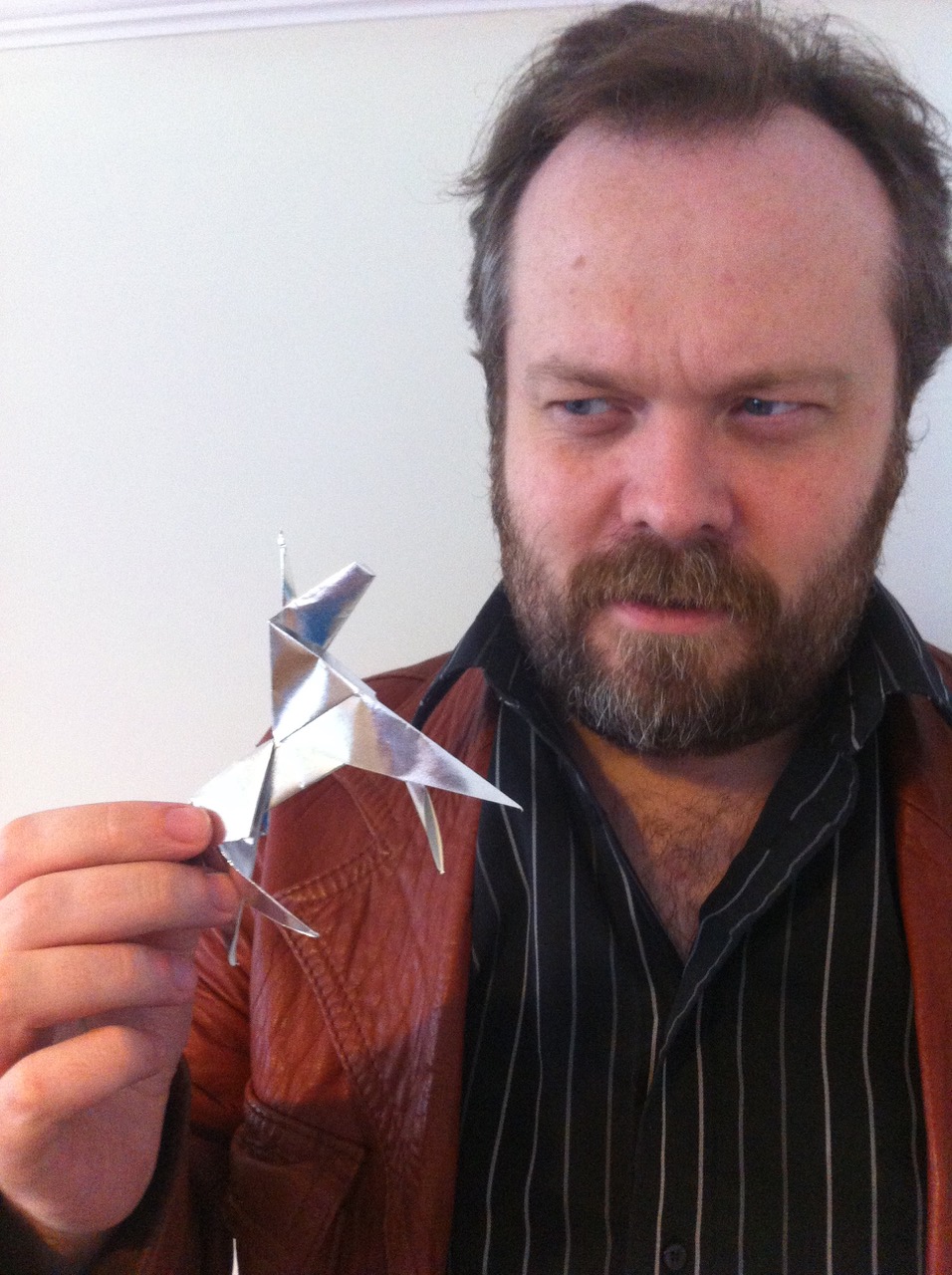
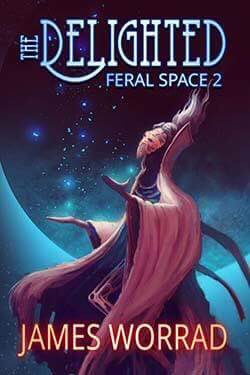
 James Worrad is the author of the Feral Space series, which takes us on a chase across the galaxy to unravel the enigma of the Scalpels in this fast-paced tale of galactic intrigue and clashing cultures. His first novel, The Scalpel, was published in 2018 by Castrum Press, followed later the same year by the sequel, The Delighted.
——————-
Hi James, and welcome to SFFWorld. One of my favorite things about your work is the rich worldbuilding. Each of your main characters comes from an entirely distinct culture, each beautifully constructed. Could you share a bit of your process in creating these different worlds?
Thanks! Honestly? It’s a case-by-case affair. With Zahrir, I worked outwards from the characters. I’d this idea of two personalities sharing the same head, so I asked what would a planet where humans raised from birth to have several personalities be like? I had to retro-engineer a history and culture from a couple of individuals.
The story’s antagonists, on the other hand, had been knocking around in seed form for decades. They Konsensus were part of a starship war game my friend devised and we all chipped in with. Just a skin for a load of stats and dice rolls. The funny thing is, they’re the culture readers tend to think are the most purposefully allegorical. A writer friend of mine was all like “Man, the Konsensus are an incredible satire on social media, what with their networked minds” and I was like “Dude, they started out on a piece of paper between some d20s and a bowl of Doritos. Don’t give them ideas.”.
But it’s all valid, however you start. Once the ball’s rolling I’ll break out the crayons and do some sketches of landscapes or ships or whatever. The results aren’t exactly Picasso but the process of drawing them gets my brain into a culture’s ‘groove’. I’d recommend getting an art pad to any budding sf author. It’s great fun.
Another interesting aspect of your worldbuilding is how you show each culture in relation to the other. You do an excellent job of creating misinterpretations that stem from the lack of understanding each culture’s nuances. Where did you draw inspiration for this?
 You only have to unlock your phone to find inspiration for that kind of thing. People are misinterpreting and misunderstanding more now than perhaps any other time in history. We Brits, for instance, have oft made arses of ourselves on Internet forums and the like these last couple of decades. We assumed it was universal to hide affection and warmth inside ironic mockery and sick jokes. Turns out that’s not always the case.
So misunderstanding seems a potent theme to explore nowadays. When it came to the cultures in Feral Space, it was just a matter of having a clear idea about each one’s outlook and then smashing them together as I wrote. Immense fun. I chose the title ‘Feral Space’ because it’s simultaneously the name of a zone in the galaxy but also a reference to the space between individual minds and, on a larger scale, cultures as a whole. The space where intentions end and words and actions begin.
Who was your favorite character to write, and why?
Tough question for any writer! Ray-gun at my head, I’d have to choose Hargie Stukes, pilot of the good ship Princess Floofy. The others could sometimes be a lot of hard work, being very ‘alien’, whereas Hargie (aside from an addiction to faster-than-light drugs) is someone you might meet in an after-hours bar, though it’d be you buying the drinks all night. The guy’s got a big heart sautéed in just the right amount of cynicism. I know a lot of Hargies. My home city’s full of them.
Of all the planets in your universe, which one would you choose to visit? And which one would you absolutely stay away from?
There’s a world the heroes briefly stop on that’s a mix of Parisian cafes and Arabic minarets. That seemed a nice enough place. I love coffee and there’s something very soothing about the call to prayer. I used to lie on my bed with a rolled-up cigarette and listen to the adhan coming from the mosque nearby my bedsit and just… think. Writing the chapter with that particular planet took me back to those days.
The worst places to visit would be anywhere owned by the Konsensus. They don’t believe anyone without a connection to their mind-nexus to be fully human and would thus slaughter me like the contemptible meat sack I am. Pleading with them that I’m their creator would, I think, only make them angrier.
You have a lot of great characters, but I especially enjoyed the dynamic between Sparkle/Swirl with their shared brain and body. If you had to divide headspace with anyone in the world, who would you choose, and why?
You could argue we all already share our headspace with other personalities. Try focusing on a task at hand when hunger rises. Hunger is a sort of sub-personality, a very persistent one, that we have to ‘talk’ with until the moment we cram nourishment down our cake-hole. And there’s self-doubt and suspicion and lust and a whole cast of other minor characters.
But to answer the question properly… for some reason I’m thinking Danny DeVito. Is that weird? He just seems pretty easy going.
The ‘mind habitats’ created by the citizens of the Harmonies were fascinating! Can you tell us a bit about this concept? Also, what would your personal mind palace look like?
 I figured people sharing a skull would need somewhere interior to get away from each other and get a bit of privacy, y’know, put their feet up and chill while their opposite number is handling matters outside in the real world. Plot-wise it made it so the two sisters don’t always see what the other is doing. I didn’t appreciate how vital obliviousness is to fiction until I put two characters in one body!
The beachside villa in the sisters’ head is exact in every detail to the one in mine! I invented the place while studying at university, a happy space in my mind I could visit when exams were getting stressful. I’d sit on my imaginary beach and listen to the waves.
One of the most rewarding things about The Scalpel getting published is that a reader approached me at a convention and said she had a mental place she’d go to, ever since childhood. She’d based it on the bit of Narnia just as you step out of the wardrobe (A prime piece of imaginary real estate!). It was such a lovely moment. We had to wonder if most people create ‘mind habitats’. If so, no one talks about it.
The thing is, I don’t visit the villa in my head anymore. That’s possibly because I’m less tense these days and, honestly, it doesn’t feel like my home now. I gave the keys to the Savard Sisters.
Besides your Feral Space novels, you’ve also written short stories and novelettes. How do you decide if an idea is going to become short fiction or a longer piece of work?
I know it’s a novel when a character materialises and says ‘hello’. Crassly speaking, the protagonist of a short story just has to walk through the plot and get the ‘big idea’ across; if they develop any eccentricities along the way then that’s a bonus but none of that can get in the way of the idea. But certain idea-seeds (two people sharing one body for instance) are the tinder to bring exciting personalities into being. Once that happens I’ll try ‘wearing’ them for a while, go shopping or to the pub and let them observe and comment on what I see. Pretentious, arguably, but whatever works…
Your science fiction almost has a fantasy feel to it, with the different divinities and beliefs scattered across your universe. What speculative fiction authors do you feel have had an impact on your writing?
A lot of ‘60s and ‘70s appears to have sunken into my bones. I spent a lot of my twenties either unemployed or factory temping and for the price of a shiny new sf book you could get six old sf paperbacks from the dusty second hand bookstore between the massage parlour and the bookies. So LeGuin, Dick, John Brunner and Cordwainer Smith soon lodged in my skull. The genre is a lot more polished nowadays and we’re all better off for it, but there’s a maverick, outsider artist quality we’ve lost along the way. There’s this unspoken quest science fiction and fantasy ran away from at some point. It’s hard to define but it’s sort of a quest to create new psychological states, to imagine mental frameworks that don’t exist. JG Ballard and Frank Herbert were very different writers but they were both trying to crack that nut. That was very much in my mind while writing Feral Space. There’s hardly a viewpoint character in it whose brain works like a brain today. Or at least that’s what I aimed for.
As for more contemporary works, I’d be a charlatan not to mention Iain Banks. Joe Abercrombie too. Eugie Foster’s short stories inspire the shit out of me. She died a few years back, tragically young. I shudder to think of the great fiction we were cheated out of. I’d love more people to read her.
What are you working on now? Can we look forward to more work in the Feral Space universe?
There’s always more stories in the Feralverse (Is that the name for it? It is now!). There’ll be a follow-up to The Delighted of course, because we all love trilogies, but in the meantime I’m working on a novel set in the same universe but slightly off to one corner.
The book’s called The Dragonfly Girls and its a military science fiction/ coming-of-age tale. It concerns the Xeanich, an all-female race of kinda-humans whose brains are spliced with dragonflys, the upshot being they can zip about in wing-suits. Two of them are lifelong rivals because each thinks she’s the best at zipping about. Trust me: if you’ve always wanted to read about power-armoured Tinkerbells then your feverish prayers are answered.
Power-armoured Tinkerbells sound terrific! Thanks for joining us here at SFFWorld and answering all our questions.
You can find more information on James and his work at jamesworrad.com
————–
Interview for SFFWorld by Juliana Spink Mills