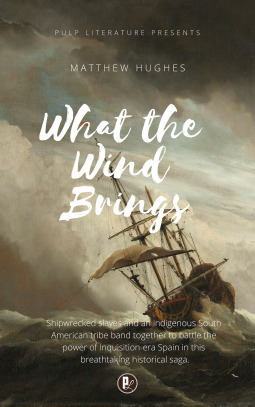
 What the Wind Brings by Matthew Hughes is a stand-alone, historical novel set in South America during the eighteen century. This story has ships, slaves, arquebuses, swords, jungles, and monks. It also has a good dose of indigenous magic that plays an integral part of the story. This is a story Matthew Hughes has said he wants to be remembered by, a story to define his career. While I’m not sure he succeeded, What the Wind Brings is a finely researched, detailed story that will touch your heart and make you realise, yet again, that while we may bodily beat each other down, we can’t stop our spirits from rising.
Our story begins with Expectation, our first main character, consulting with her spirit guide. Expectation is a healer for the Nigua tribe, but also acts in the role of advisor. It is a hefty and uneasy responsibility after the Spaniards have brought disease and destruction to their tribe, drastically reducing their tribe’s numbers, but Expectation handles it with cool competence. If I was ever lost in a jungle, I’d want Expectation to find me.
But Expectation is not looking for me when she consults her spirit guide, a force that fills her bodily and takes her flying over the sea. There the spirit guide shows a ship filled with Spanish men, both light and dark colored. The guide gives her warning, a warning to heed what the winds bring, but Expectation can’t really imagine what that might mean.
We are next introduced to our second main character: Alonso Illescas. A slave of a wealthy, Spanish merchant, an illness has besieged Alonso’s master, prompting Alonso’s elevation to overseer of an important shipment – a shipment of expensive, and troublesome, slaves. These slaves are what remain of a violent uprising in the islands of Caribbean. They are traveling from Panama to Lima, Peru, along the western coast of South America. But it is late in the season, the slaves are not the only trouble the ship will experience.
As a slave himself, Alonso is at odds with the ship’s captain, the crew, the fellow shipmates, as well as the slaves confined below decks. Alonso takes solace is caring for his pigs, a task he is well trained to do, but that soon becomes the least of his worries when the ship first experiences a lack of winds and then a storm. The uncooperative weather puts the ship further behind on schedule and diminishes the supply of food and fresh water. The ship is maneuvered to a small, sheltered bay where they can replenish their water, but as soon as they get settled into gathering water, a storm reaches them. The ship is lost on the shallow reef, but the slaves find an opportunity and do not waste it.
After bloodshed, the only ones left are the slaves and Alonso, who finds himself on the edge of a new order on a new world. But he’s not the only one who will have to not only change the way they do things, but change the way they think. Expectation’s Nigua tribe happens to live near the bay the escaped slaves find themselves on and together they must suffer the consequences.
From learning to live with each other, to defending their territory, to foraging a treaty with the Spaniards, the Nigua and the Africans find a remarkable path forward. A path that intersects with the book’s third main character: Alejandro de Espinosa, a monk fleeing his own troubles while trying to find his place in the world.
I really enjoyed the attention to detail in What the Wind Brings. Matthew Hughes brings the regional traditions and concepts to life in this book. What an incredible novelist does well is make a reader see the world from a different perspective. Mr. Hughes does an exceptional job of that in this book. I felt like I learned the Nigua concept of living and their strategies for survival, but I could also understand the African’s need to restore their notion of order. When the story gets to Alejandro’s point of view, the juxtaposition of the society the monk lives in with the indigenous society as well as what the Nigua and Africans are trying to forge hit this reader like a strong wind.
The world is so complicated! But the author managed to capture that complication in a way that show our humanity, both good and bad. And also offer a different narrative, a narrative that doesn’t end with the Spaniard’s boots firmly on the backs of colored peoples.
Another great aspect of What the Wind Brings are the descriptions of sailing, the jungle, the rivers, and the incredible highland landscape of Ecuador. This book should come with a walking tour. I’d pay for that trip.
One thing I would have liked to see was a map. Since I have a review copy, I suspect the final published book will have a local map, but if it doesn’t, I’ll have to take a star off my 5-star review over on Goodreads.com. While anyone can refer to a modern map to get an idea of where the action in the book takes place, I would have liked to see a map included. Maps play an integral role with some of the strategic movements of characters. It would have been nice to follow along with a map.
Regardless, with this book, you will be drenched in humid jungles and steeped in rarified, mountain air while immersed in cultures and histories we should all know more about.
What the Wind Brings will be published by Pulp Literature Press. Hardcover expected in August, 2019 with trade book and ebook to follow in December, 2019. I recommend this book if you like fantasy realism in a historic setting with diverse points of view.
Published by Pulp Literature Press 2019
(2019-December – expected publication)
Advanced copy for review
Review by N.E. White, July 2019.
Copyright © sffworld.com. If quoted, please credit “sffworld.com, N.E. White”.