As readers have seen in the previous two books of The Song of the Shattered Sand epic, (Twelve Kings of Sharakai and With Blood Upon the Sand) Çeda’s quest to bring down Kings of Sharakai shows no signs of stopping. Bradley Beaulieu picks up the saga with little break in the timeline in the third book in the series, A Veil of Spears. As a result of her growing abilities and knowledge, and how Çeda put those to characteristics together over those first two books, the number of Kings is fewer.
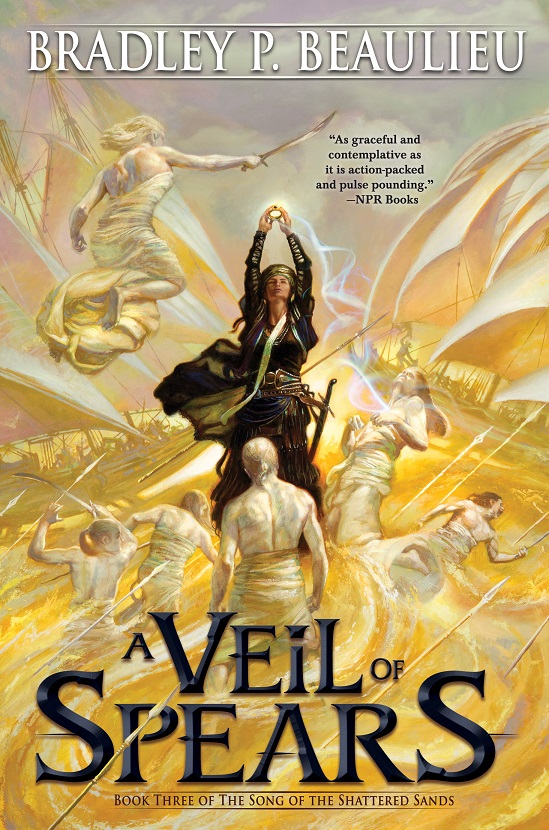
The Night of Endless Swords was a bloody battle that saw the death of one of Sharakhai’s immortal kings. When former pit fighter Çeda narrowly escapes the battle and flees into the desert, she takes with her the secrets she learned while posing as a Blade Maiden, one of the elite women warriors who protect the kings. Foremost among these is the revelation that the asirim, the kings’ frightening immortal slaves, are in fact Çeda’s own ancestors. They are survivors of the fabled thirteenth tribe, men and women whose lives were bargained away so that the kings could secure their wondrous powers from the desert gods.
To Çeda’s great joy, the scattered survivors of the thirteenth tribe are gathering in the desert, forming a new tribe from the descendants of the few who escaped the kings’ cruelties. Their very existence is threatened, however, both by Onur, the King of Spears, who is calling warriors to his banner to challenge the other kings’ rule, and by the other Sharakhani Kings, who will stop at nothing to see the thirteenth tribe destroyed once and for all.
In desperation, Çeda returns to Sharakhai, hoping to break the chains of the enslaved asirim and save her people. There she soon discovers that the once-unified front of the kings is crumbling. Feeling their power slipping away, the kings vie for control over the city and the desert beyond. Çeda plans to use that to her advantage, but who can she trust? Any of them might betray her as easily as they betray their fellow kings.
As Çeda works to free the asirim and rally them to the defense of the thirteenth tribe, the Kings of Sharakhai prepare for a grand clash that may decide the fate of all.
A grand event known as the Night of the Endless Knives revealed cracks and potential breaks in the rule of these Kings who were once thought to be gods. Of course, Çeda was at the center of this event, which has quickly grown into legendary status. Subsequently, she’s become a person many people are seeking for many reasons. One of those people is one of the remaining Kings of Sharakai, Onur, the King of Spears. Onur has his own reasons for capturing Çeda, which he does early in the novel. He is hoping to raise his stature among the Kings, and the world, by destroying them. Onur sees Çeda as a key to his goals.
As much as Çeda’s legend is growing, the story is growing, too. This makes it logical/necessary for Beaulieu to bring focus to additional characters. The Moonless Host is doing their part in trying to bring down the Kings, but no battle leaves its combatants without wounds, and the Host is not quite as strong as it was earlier in the story as they try to bolster their ranks. Çeda’s longtime friend Emre becomes more than an adjunct to Çeda, as he continues to grow in stature with the Moonless Host. The leader of the Moonless Host, Ishaq and his son Macide, turn out to have some closer ties to Çeda than she could have initially imagined.
While Onur gets a great deal of the spotlight and not just because he is a very large man, another King, Sukru, gets his share of story, too. I wouldn’t say Beaulieu is making these powerful villains sympathetic, but rather, by giving these characters who were set as the antagonist more depth, he’s adding weight to the story.
There’s potential conflict coming from outside “the shattered sea” in the form of Queen Maryam and Ramahd. Those two have a very … interesting relationship, you might say. Hamzakiir, who was not quite as active in the second installment of the series, grows in stature here in the third volume, too.
In other words, there are more points of view in A Veil of Spears and while Çeda’s is still the main point of view, I didn’t feel as if the narrative suffered too much when it wasn’t focused on her. Like I say above, this is largely because Beaulieu is doing a fantastic job of building a strong narrative around each of the characters in the novel.
I still find Beaulieu’s scenes and descriptions of the ships sailing and traversing the sea of sand enthralling. He pens an addictive action scene and is able to keep the action at a high enough level for the reader’s adrenaline to be pumping, I know I was sitting on the edge of my seat reading some of those passages.
Perhaps my favorite feature of the novel, and the series as Beaulieu reveals more of the world and expands the story is just how mythic everything feels. Sure Çeda is a well-developed character who has a great deal of humanity, but she is becoming a mythic, legendary character. Not just because of her success, painful successes, at bringing down the Kings, but also because of her drive to redeem or be something of a savior to the Thirteenth Tribe, the asirim. Add to that what is slowly being revealed about her family, then Çeda continues to ascend beyond simply “the protagonist” of an epic story, she is growing into a Hero of Legend, if you will.
Three novels into this grand Epic Fantasy, Bradley Beaulieu is managing to balance a story that exudes a feel of mythology with a great deal of humanity. A tough trick to pull off, but he’s doing it with skill and panache. When I’m immersed in this world and when I was glued to the pages of A Veil of Spears, I felt like I was witnessing a mythic story come alive.
Highly Recommended
© 2019 Rob H. Bedford
Hardcover | 582 Pages
March 2018 | DAW Books
Excerpt: http://quillings.com/fiction/twelve-kings-in-sharakhai/a-veil-of-spears/ | http://quillings.com/
Review copy courtesy of the publisher DAW Books