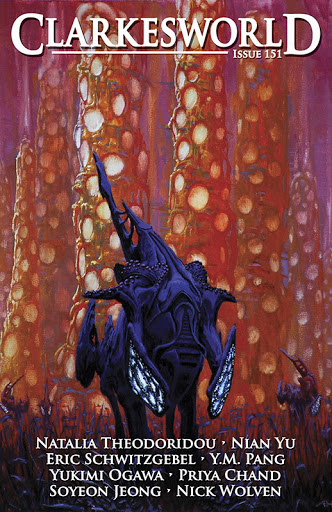
 And here’s another short story review from Clarkesworld, , courtesy of J.K.A. Short. This time it is from Issue 151, published in April 2019:
Many elements of short stories require a certain level of mastery. Structure is key is to building impactful stories that gel with their respective genres and fluid pacing keeps readers interested while simultaneously balancing conflicts within a shorter narrative scope. In the short story, ‘Gaze of Robot, Gaze of Bird,’ published in issue #151 of Clarkesworld Magazine, Eric Schwitzgebel employs these incredibly well. He does this firstly by structuring his story around vast periods of planetary exploration and biological evolution and, secondly, inventing a story from the POV of an emotionless, artificial intelligence called ‘J11-L’ who experiences it all in a state of timelessness that occurs over 100 million years. This latter idea takes on the challenge of penning an epic within the constraints of a short story and shows readers how settings and characters can change when extraordinary time-frames come into play.
The story begins on a planet of unknown origin. Immediately we are given clues to J11-L’s ancient purpose through hints of crisis that occurred in ages past. We learn of this by reading the description of an inanimate monkey doll that was sent into space with the machine: “The monkey doll had no actuators, no servos, no sensors, no cognitive processes. Monkey was, however, quite huggable…He had travelled wadded near J11-L’s core for ninety-five thousand years. His arms, legs, and tail lay open and relaxed for the first time since his hurried manufacture.” Straight away we wonder: what actually happened over ninety thousand years ago? Why was ‘Monkey’ created in a hurry? And, if you are threatened with a planetary-sized catastrophe as was J11-L’s creators, why then was it so important to package a doll with a machine other than for sentimental reasons?
What makes ‘Gaze of Robot, Gaze of Bird’ doubly interesting is the absence (at the beginning at least) of sentient humanoid characters. For millions of years it’s just J11-L the doll she keeps trying to unsuccessfully infuse with life. This curious story feature is reminiscent of Ray Bradbury’s best short tale, ‘There Will Come Soft Rains’ where the only character is an automated house that slowly begins to fall apart and ‘die’ long after its owners have vanished. Moreover, despite a lack of emotional investment on behalf of a machine, an echo of purpose and agency of a lost civilisation still remains:
“Despite the speechlike routine and concerned-seeming behavioural outputs, no thoughts occurred in J11-L, no emotions, no sensory experiences. No one felt relief at having struck down safely after so long. No one gazed curiously at the horizon, hoping that behind the red hills lay a suitable location for building a Home.”
We feel the full weight of the destruction of whichever society sent J11-L on her interstellar journey through the simple line: “No one loved Monkey – not really.” The fact that it’s a child’s toy presents us with complex, unresolved emotional dilemmas. It symbolises both a youthful hope for survival and perhaps even sympathy or lamentation for a machine going off into deep space alone. It also leads readers to the possibility of an even greater tragedy: after the ‘origin planet’ exploded as a result of a celestial collision, how many children were counted among the survivors? How many families were aboard the generation ships full of colonists, each of which slowly failed and died over thousands of years of travel?
Jumping forward sixty million years after a volcanic eruption, J11-L, whose titanium shell and ‘quadruply-redundant core’ enables her to ceaselessly perform self-repair, begins to play at being creator. Gradually J11-L begins to study, manipulate and nurture life according to her programmed protocols. She becomes a kind of robotic caretaker-mother who guides the evolution of invertebrate life. On top of this, Eric Schwitzgebel also alludes to a human or ‘lifelike’ desire to become ‘alive’ in the sense of becoming wakeful of the machine’s sense of self – itself a puzzling notion when you consider that this desire is unprogrammed, yet J11-L nevertheless still possesses a capacity to ‘wish.’ As the narrator commentary explains:
“Consciousness requires a sense of unity in the present moment – a coherent sense of self, a sense of now, smeared briefly through time. In this unified now, everything comes together, collaborating towards a choice.”
It’s a curious statement that describes what J11-L lacks and subtlety unpacks the meaning behind her deepest wish: throughout time she has always aspired to gain consciousness. Yet the robot mother has no choice but to commit to the purpose she was built for and work at it until her main directives have been accomplished. As a giver or ‘helper’ of life, she is trapped in servitude as a ‘curator of biology’ that assists generations of sentient creatures to grow and endure endless cycles of life and death while she must persist as a robot devoid of anima.
Furthermore, the techno-symbiosis shared between creator and her many created permeations of life raise an incredulous notion: how can a non-conscious AI ‘dream’ or have desires that fall outside the parameters of its programming? Does J11-L perhaps already bear a ‘cyber spirit’ – a ghost in the shell – within its apparently emotionless, titanium mechanical skeleton? If and when she reaches attains her goal of acquiring consciousness, what does this have to say about the ambitions of artificial lifeforms when they are ‘free’ to be agents of their own destinies?
‘Gaze of Robot, Gaze of Bird,’by Eric Schwitzgebel
Published in issue #151 of Clarkesworld Magazine (April 2019)
Review by J.K.A. Short, July 2020