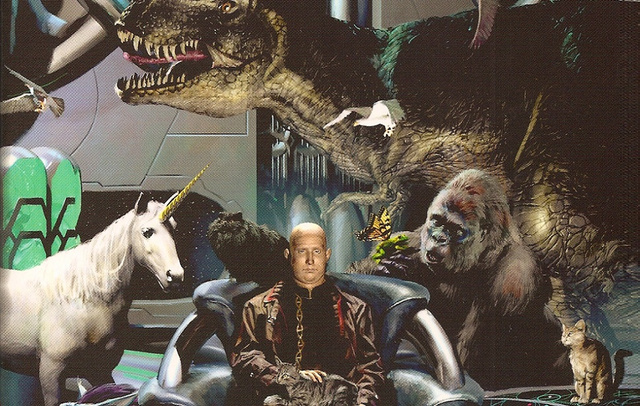
Haviland Tuf is a simple trader and ecological engineer, offering solutions to planets whose ecosystem is in some sort of trouble. Of course, many of these people mistrust Haviland and think he has ulterior motives. In this far future, Tuf is practically the only honest man, or at least the only person who can view a situation with pure logic and no emotional entanglements. In Tuf Voyaging, the short stories George R.R. Martin wrote about the large, bald man with a fascination for cats come together under one cover. In other words, Tuf Voyaging is a fix-up novel and a fine and entertaining batch of stories.
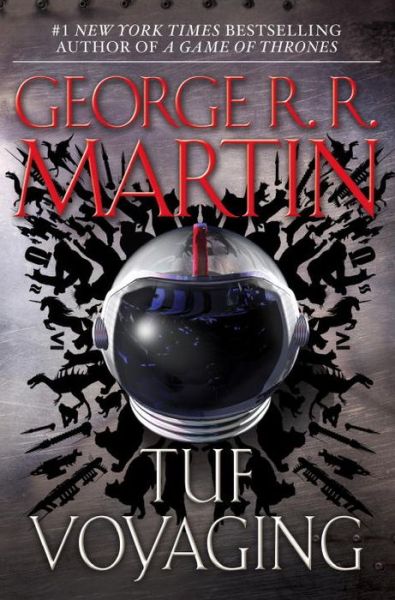
Seven stories are included in this fix-up novel/book and are presented in chronological order of the events of Haviland Tuf and his acquisition of the Ark rather than publication order. The Ark is an enormous space vessel, a relic of the Federal Ecological Engineering Corps. The first story The Plague Star recounts how Tuf acquires the ship when he signs on with a crew of scavengers and thieves. The man with a fascination for cats outwits all of them and finds himself a newly self-appointed Ecological Engineer.
The second story, Loaves and Fishes, tells of how Tuf meets the closest thing to his intellectual equal in Tolly Mune, a high ranking officer of S’uthlam, a planet on the brink of death, with dwindling resources and over-population. Tuf initially visits S’uthlam because the Ark is in dire need of repairs but learns of the ecological disaster looming over planet. Tuf presents these people with options to avert the planet’s disaster, few of which are to their liking. The plan he does arrive at; however, may only delay the inevitable. Tuf is able to broker a deal with Mune that allows him to leave with a promise of returning to pay for a portion of the repair bills.
In Guardians, Tuf descends to a world comprised mainly of water. This planet Namor (likely an homage to the comics character Sub Mariner of Marvel comics), becomes nearly overwhelmed with sea monsters which appear in greater numbers as the days progress, threatening to completely destroy its human inhabitants. Tuf discovers the root of the problem much to the surprise of the planet’s inhabitants. Again, Tuf’s logical solution is not believed at first.
 Second Helpings, the fourth story/episode in the fix-up novel sees Tuf returning to S’uthlam to repay part of the debt owed to the people. The people the world ignored much of Tuf’s advice even if they did enact some of his instructions. Tuf pays his bill and averts planet-wide breakdown once again.
The earliest published story/episode in the book is A Beast for Norn and perhaps that’s the reason it was the only story that didn’t work for me completely. In it, Tuf creates a monster for a gladiatorial fight (think of an amped up cock-fight). This episode in particular seems like it could work very well as an episode of The Twilight Zone.
Call Him Moses is the second published story of Haviland Tuf and the second to last story/episode in the book. This one involves a man calling himself Moses and unleashes Biblical plagues on the Tuf found himself. This one was a fun tale that illustrates what a clever individual Tuf is.
The final story/episode, Manna from Heaven, might be considered the final in the S’uthlam trilogy. In it, Tuf returns to S’uthlam to find his old friend Tully Mune much higher up the bureaucratic ladder. Tuf, while hoping to pay off the remains of his outstanding debt, learns the S’uthlamese are still facing impending doom. Though published almost a decade after Call Him Moses, this story could be seen as a spiritual successor as the religious overtones and theme of Tuf playing God come into greater focus. Ultimately, Tuf offers potential solutions in this episode as he’s done in previous episodes.
 Martin has long professed his admiration for Jack Vance’s writing and these stories can very much be seen as homage to Vance or his style. The balance of humor and fantastical situations were hallmarks of Vance’s work. In particular, one might imagine Tuf himself interacting with Cudgel the Clevor or Rhialto the Marvelous. Undoubtedly, Tuf’s deadpan style and pure logic work in direct contrast to every personality he encounters. Nobody trusts Tuf, he is distressed by this lack of trust when he always attempts to present himself as, if not altruistically as possible, as logically as possible. Humanity has evolved to a state on many of the planets he visits that logic is far from even the tenth lens to view their respective world.
Much of George R.R. Martin’s backlist was out of print prior to him publishing A Song of Ice and Fire and HBO’s airing of Game of Thrones. For reasons likely due to copyright, Tuf Voyaging seemed to be out of print the longest here in the United States. Even without Martin’s enormous popularity due to Game of Thrones, the stories in this volume should never have gone out of print. They are humorous, smart, engaging and just plain fun. One can see hints of characters in A Song of Ice and Fire, specifically the physical similarities between Tuf and Varys to the point that Martin has even commented that Conleth Hill (the actor who portrays Varys on Game of Thrones) would be an ideal choice for the character. In addition to Martin’s admiration of Jack Vance, he peppers in references or Easter Eggs to other things SFnal such as the aforementioned planet Namor as well as Chris Claremont (long-time writer of X-Men) and the X-Men themselves.
This is a terrific episodic / fix-up novel that will appeal to fans of Martin’s work and fans of smart, fun and engaging Science Fiction in general.
© 2013 Rob H. Bedford
http://www.georgerrmartin.com / Published (reprint) January 2013 /
Bantam (http://suvudu.com/) / Trade Paperback 448 pages 978-0-3455-37-99-7
http://www.georgerrmartin.com/grrm_book/tuf-voyaging/