 As I type this, we’re approaching the 59th anniversary of the first episode being shown on the BBC. The last episode starring the current (13th) Doctor has just been shown, with a new Doctor (and an old one!) due to appear in 2023.
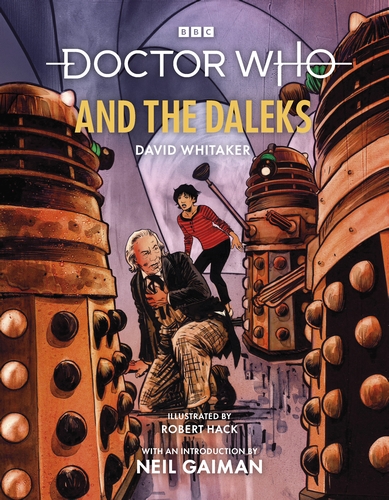
Although new books are released all year around, it has become a thing to release new Doctor Who material each year around the date of the 23rd November, the date of that first transmission. This year we have this, the illustrated novelisation of the first time the Daleks appeared in the series, when the First Doctor was portrayed by William Hartnell.
The original episodes, shown between December 1963 and January 1964, were the second serial in the first season and introduced the Doctor’s first real enemy, the Daleks, that first turned the television programme into a now-globally recognised brand. By November 1964 the UK was gripped by “Dalekmania” on a merchandising scale like no other at the time. The episodes’ popularity led to two films for children’s cinema, starring Peter Cushing as the Doctor. This book was originally released in hardback in November 1964 because of this fame.
The story in this novel is told from the point of Ian Chesterton, not a school Science teacher, as in the original television episodes, but now an unemployed rocket scientist looking for work. Unlike the original episodes, where both Ian and Barbara are teachers at Coal Edge School, this is the first time Ian and Barbara meet, following a lorry accident. They both then meet the Doctor and his granddaughter Susan, who Barbara was giving a lift home to before the accident. The story therefore takes elements of the first episodes of the television series (from the episodes An Unearthly Child) before launching into a version of the second story in the first series.
Most of the rest of the story remains faithful to the plot of this television series and the Peter Cushing film version. In essence, this is the story of how the Doctor, Susan and Ian and Barbara travel in the TARDIS to the planet Skaro.
The planet’s surface is petrified, as we find out later the result of a nuclear war which obliterated the planet. The war was between the peace-loving Thals and the Daleks, a mutated people who now live in metal war machines. Now the Thals live in subservience to the Daleks, in a city away from the radiation. The Doctor needs to find a mercury link to power the Tardis and get back home, but at the same time, the Doctor and his companions are determined to free the Thals from their life of enslavement and oppression by the Daleks.
The point of the book is I think for older fans to relive an iconic moment from the 1960’s and for newer fans to read what it was like before Christopher Ecclestone (the 9th Doctor in 2005) and his descendants.
The prose itself is typically straightforward, no-nonsense in its telling, which makes the story an exciting adventure story. If you wanted an idea of what Doctor Who was like in its earliest incarnations, this is not a bad place to begin. Telling the story from the perspective of one character was an unusual decision and allows us as readers to see the other characters and Ian’s opinions of them, which is an interesting idea, I thought, and allowed the writer to bring something else to the book that you would not have got from a straight script translation.
In the same way, a novelisation without the constraint of special effects budgets can expand on what has gone before. For example, Whitaker here introduces a glass Dalek, some kind of superior Dalek leader who clearly is a precursor to the Emperor Dalek in later stories. (There was a glass Dalek in The Revelation of the Daleks about 20 years later, too.) The overall picture is therefore a bigger one, although in this case not too different from the original.
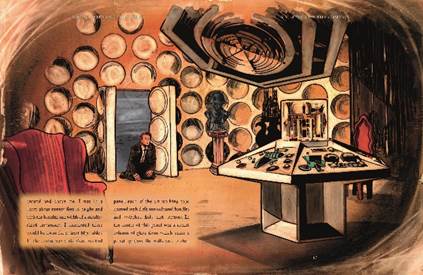
So: why buy this book? Although the text is the same as the Target paperback version (which has been republished for a while now), it is the illustrations by Robert Hack that will entice you most here. The illustrations are a nice touch, as although they’re not on every page, they are all in colour (unlike the original episodes!) and give you a context and a setting for the prose. For younger readers intimidated by blocks of text, this illustrated version might be a way into the Doctor Who stories. The characters are recognisable as their television counterparts – the Doctor is clearly William Hartnell rather than Peter Cushing, for example –
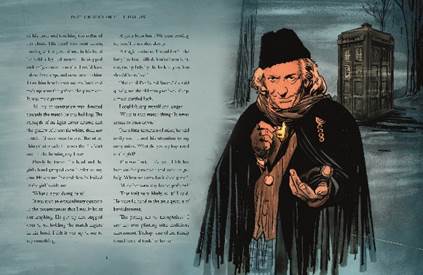
but generally, they are relatively unfussy and uncomplicated.
As you can see from the pictures, they’re not the computer graphic style so beloved of many a graphic novel these days, thank goodness, but they’re not really of the complex detailed nature of some similar illustrated books recently published. Most of them seem to have a colour wash or filter on them, with colours being pretty basic:
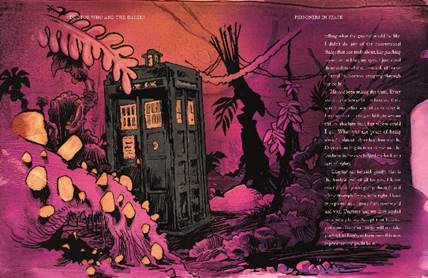
Compared with the recent George RR Martin artbook (Rise of the Dragon), or Jim Kay’s illustrations for the Illustrated Harry Potter books, I think that they suffer in comparison, although they are similar in style to the Jim Kay books and the two might sit nicely together on the same bookshelf. It is an artistic style that you will like, or not, and I suspect that this will help you decide if this book is for you.
As well as the story itself, as in the original Target paperback, we have an introduction from 2011 by the ubiquitous Neil Gaiman (who, don’t forget, wrote an episode of Doctor Who – The Doctor’s Wife – for Matt Smith as the 11th Doctor in 2015), which tells us of the context of the story in terms of the Doctor Who history. Basically, back in the day this novelisation was the only way to revisit the Doctor and his companions – there were few television reruns, no copies for you to buy and watch or stream – so if you wanted to enjoy Doctor Who before the next programme, this was it.
We also have from the Target edition pocket characterisations of the main characters – the enigmatic Doctor (little backstory at this stage), Barbara, Ian, and the granddaughter Susan. They are brief – a paragraph or so – but help fill in background detail for those who know little of the First Doctor.
At the end of the book, we have Between the Lines, which gives us the context of the story in relation to the original TV series, with details of the writers – Terry Nation, who invented the Daleks and wrote the original teleplay, and David Whitaker the script editor who wrote this novelisation – and details of the first showing of the serial in Britain.
In short, for those looking for an ideal present for a Doctor Who fan, especially one who wants to know what it was like when the series first started and how the Daleks first appeared, this is a pleasant way to start. Whether an old fan or a relatively new one, this illustrated version provides an accessible nostalgia trip for fans of the series.
Doctor Who and the Daleks (Illustrated version) by David Whitaker
Illustrations by Robert Hack
Published by Titan Books, October 2022
ISBN: 978 1 78594 801 5
288 pages
Review by Mark Yon