 The house was built beside a river. In the evening the sun would lie reflected in the dark water, a stain of red in between the thick shadows cast by the buildings. It was twilight now, and there was the ripple of dull crimson, shifting as the water rippled sullenly between the high houses.
Beneath this house was an old stake, hung at the bottom with stagnant green, white and dry at the top. A rotting boat that fluttered the tattered remains of faded crimson cushions was affixed to the stake by a fraying rope. Sometimes the boat was thrown against the post by the strong evil ripples, and there was a dismal creaking noise.
— from “The Sign Painter and the Crystal Fishes”
Entering many of Marjorie Bowen’s stories, one becomes intensely aware of color, frequently the color of clothing and furnishings, but also at times of the characters’ surroundings – see above. Bowen’s descriptions usually ground the reader in the work-a-day world and when their clothing doesn’t differentiate between characters, their furnishings and surroundings often suggest the characters as extensions, for better or for ill, of their circumstances.
Perhaps her attention to clothing and furnishings shouldn’t be a surprise. In Monster, She Wrote, Lisa Kroger and Melanie R. Anderson say that Bowen was raised in poverty, her family barely staying afloat prior to her earnings as a writer. Wikipedia states Bowen was a best-selling author around the turn of the 20th century. But even though praised by writers like Graham Greene and, in the speculative fiction world, Fritz Leiber, her work has fallen into obscurity. And that’s a pity if the stories in this collection are representative.
According to Kroger and Anderson, after Bowen and her family moved into a new home, they began to hear groaning and endured flickering lights, and when investigation found a murderer had once lived there, she began to write ghost stories. The most famous story in Kecksies, and probably Bowen’s most famous story, is “The Crown Derby Plate,” a favorite of ghost story anthologists. It concerns Martha, manager of an antique shop, who has, “a perfect set of Crown Derby save that one plate was missing.” The problem is, she bought the set from the Hartley family, whose one remaining family member has returned to the Hartley house which is rather far away and reputed to be haunted. Still, Martha has never seen a ghost, if there are such things, and completing her collection is something she’s dreamed of for twenty years. And so Martha goes to meet the owner of Hartley house …
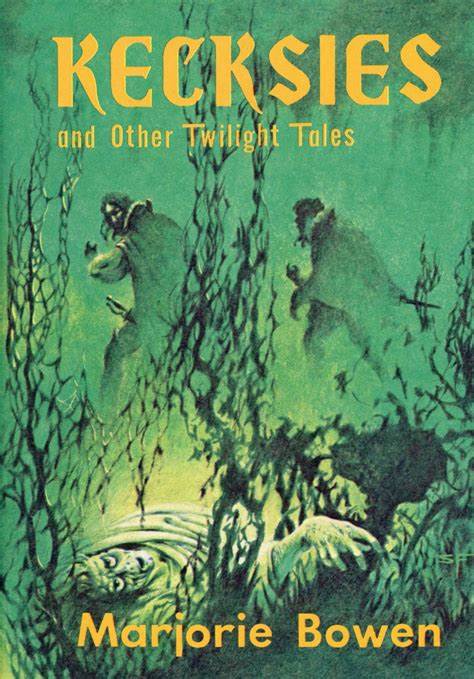
Bowen may have been drawn to historical fiction, for at least two of the strongest stories here are set in previous centuries. “Kecksies” involves two young men of high birth, landowners, needing shelter in a storm and demanding that shelter from Goody Boyle. Goody Boyle, though, is housing the wake of an enemy of one of the men.
Another historical tale, “One Remained Behind” tells of a young, poor student at university studying forbidden magic, magic that grants the user his fondest wishes. And we all know what you need to be when asking for what you wish. For much of its length this could almost be a tale by Clark Ashton Smith.
“Scoured Silk,” is a domestic drama. Twenty years after the death of his first wife, a widower looks to marry again. But his bride to be, at first willing to marry, comes to have reservations and the question becomes, are those reservations shared by his first wife? As Kroger and Anderson note, there is in this story something of the preoccupations of Daphne Du Maurier’s Rebecca.
My favorite story in the collection, one I first read years ago in an anthology and that drew me to want to read more by Bowen, is the apotheosis of Bowen’s tendency to characterize through clothing and furnishings, at least among this group of stories: “The Sign Painter and the Crystal Fishes” is a weird love story with ghosts. Here her descriptions, instead of grounding the story, create a sort of Technicolor reality, the setting along the river at once distinctive and hyper-real, yet also dream-like, Bowen creating an allusive atmosphere in which she sets the story of Lucius the sign painter and his competitor for his fate, Lord James. This story and “One Remained Behind” seem to move away from horror without quite leaving its trappings, and to verge on a more Gothic fantasy.
For the most part, these are the kind of ghost stories readers may refer to when thinking of reading beside a cozy fire during autumn and winter. Bowen knew how to draw her reader in, immerse her or him in the time and place even in a brief story, and present her finale with enough force to satisfy the reader. As with most collections, some stories I like more than others. “The Hairy Ape” and “Half-Past Two,” for instance, are not bad stories, but they read like filler compared to the rest. Unfortunately, Kecksies and Other Twilight Tales is no longer an easy volume to find. But the good news is that some of the stories in this collection – “Kecksies”; “The Crown Derby Plate”; “Scoured Silk”; “Florence Flannery”; “The Avenging of Ann Leete” – are also in The Bishop of Hell and Other Stories reissued last year from Valancourt Books.
KECKSIES AND OTHER TWILIGHT TALES by Marjorie Bowen
Arkham House, 1976
206 pages
ISBN: 0-87054-077-7
Review by Randy Money